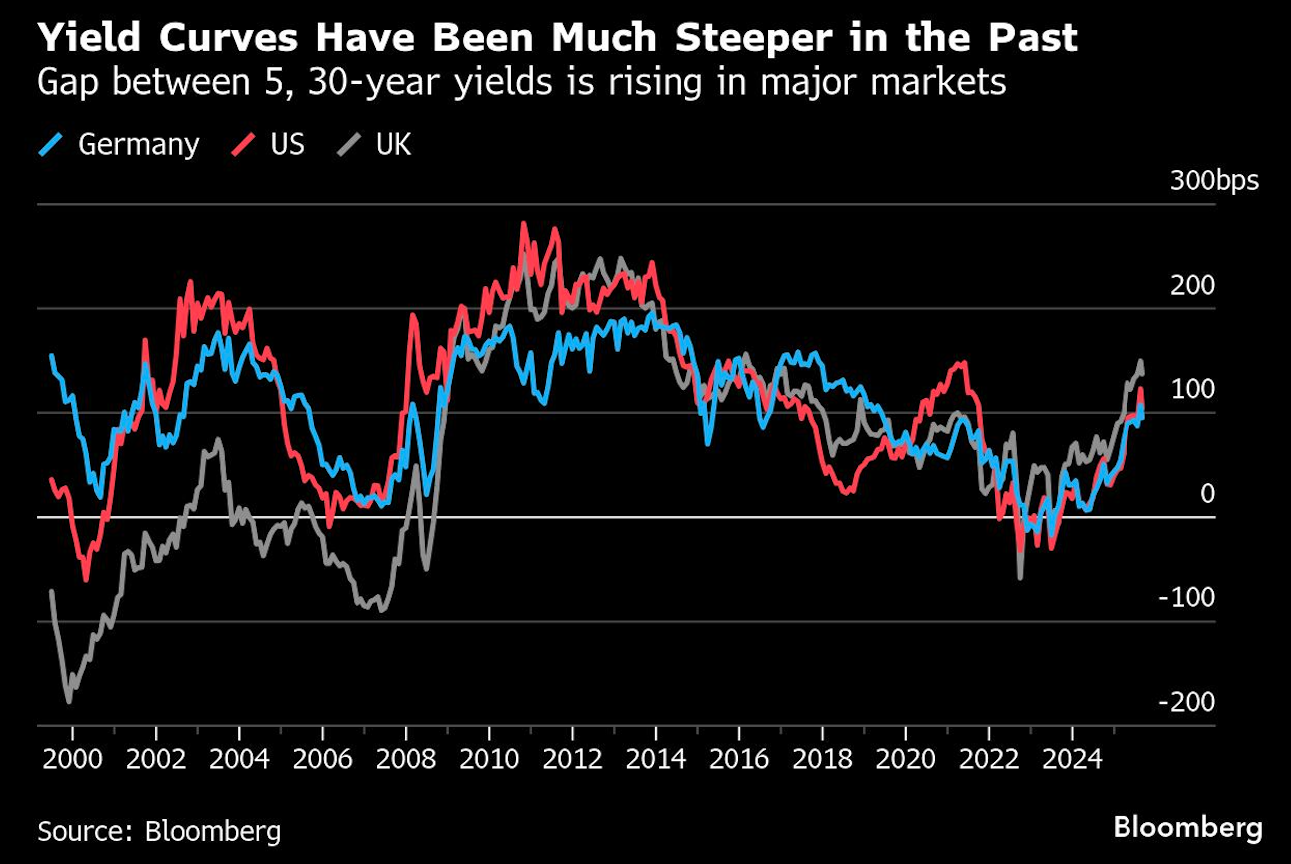
Rising yields in global government bond markets reflect expectations that interest rates will remain higher, rather than concern over brewing fiscal crises, according to BlackRock Inc.
From the US and UK to France and Japan, yields on longer-dated sovereign debt have soared this year, driving curves to some of their steepest levels in years. But while this repricing is often blamed on heavy government borrowing and budget deficits, Alex Brazier, BlackRock’s global head of investment and portfolio solutions, takes a different view.
“I don’t think these global moves reflect worries about fiscal positions,” he said in an interview at Bloomberg’s London offices. “I think they reflect what people think the neutral level of interest rates is, and some premium for persuading people to buy longer duration rather than short duration.”

The neutral rate refers to monetary policy that is neither stimulating nor restricting economic growth. BlackRock reckons that rate is now higher than in the past, partly due to looser fiscal policy, but also factors like high investment spending, particularly in the artificial intelligence sector.
“All of those things are pushing up the level of interest rates needed to keep the economy on an even keel,” Brazier said.
Bond markets are also still seeking a new equilibrium after years of ultra low yields in the easy money era. Germany’s 30-year bonds for example yielded less than zero just four years ago, compared to 3.25% now. The equivalent UK yield recently touched the highest since the late 1990s.
And aside from some bouts of volatility, such as the reaction to former UK Prime Minister Liz Truss’s so-called mini budget in 2022, that readjustment in yields has been largely orderly. Moreover, new issuance is drawing multi-billion order books, underlining investor demand.
Even France, where the prime minister stood down earlier this week after failing to win support for budgetary cuts, isn’t struggling to find buyers for its debt. Years of lax public spending has left the country with the widest deficit in the euro area and debt is rising by €5,000 ($5,840) a second.
A French auction last week found plenty of appetite despite an impending confidence vote in parliament, while its 10-year yield premium over Germany has pulled back from a recent peak of 83 basis points — the highest since January — to 78 basis points.
The moves imply that investors expect France “to ultimately sort out its budget position,” Brazier said.
While long bonds in France and the UK have captured much of the market’s attention in recent weeks, a similar repricing has been underway across major government bond markets. Morever, the pressure on long-dated debt may linger, based on a history of steeper yield curves globally.
“To be frank, there’s not many areas that we would be comfortable taking long duration, including the UK,” said Simon Blundell, the firm’s co-head of EMEA Fundamental Fixed Income.
A message from Advisor Perspectives and VettaFi: Prepare your bond portfolio for changing market conditions. Register today for the Fixed Income Symposium on Sept. 18, 2025, 11AM ET / 8AM PT.
Bloomberg News provided this article. For more articles like this please visit
bloomberg.com.
Read more articles by Alice Gledhill