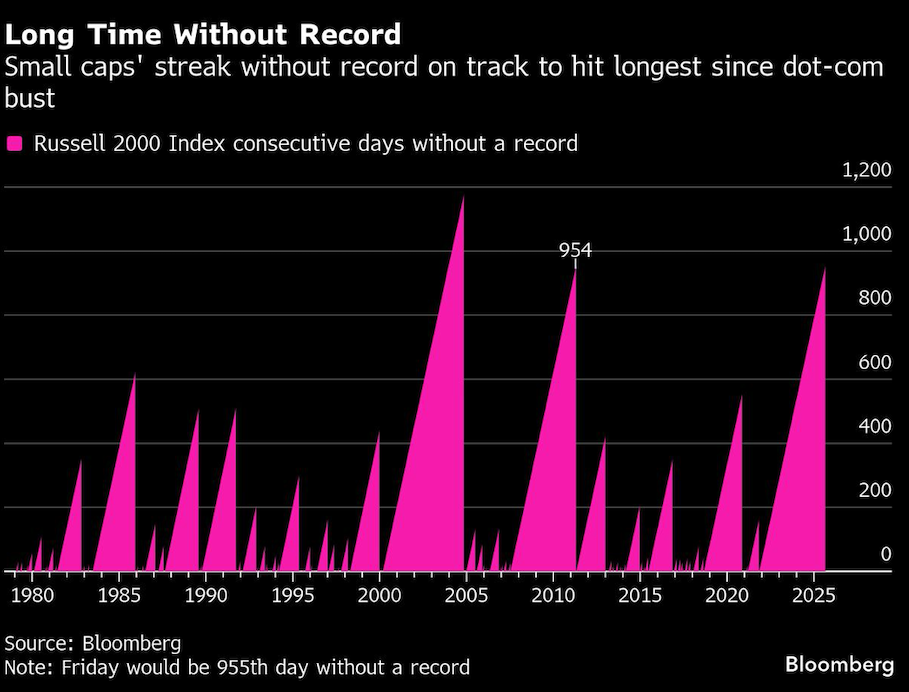
It’s been a tough few years for small-capitalization stocks.
The Russell 2000 Index last posted an all-time high on Nov. 8, 2021, and is still almost 3% from that level. Unless something drastic happens by Friday, it will mark the small-cap gauge’s longest streak without a record since the dot-com bubble. By contrast, the S&P 500 Index has clocked 19 records this year alone.
But things are starting to look brighter, as small caps have been on a tear for weeks. The Russell 2000 is up 7.3% so far in August, which ties for its best month relative to the S&P 500 since July 2024. With the Federal Reserve seemingly prepared to cut interest rates at its meeting next month, there is reason to expect more gains from the index, which includes regional banks and industrial companies that could benefit from looser monetary policy.
“The potential is certainly there” for the small-cap index to keep rising, said Matt Maley, chief market strategist at Miller Tabak + Co. “You have the momentum now, which has been badly missing for a long time.”

Another key bullish signal is coming from the iShares Russell 2000 ETF (ticker IWM), which is trading above $230, piercing a key technical level, Maley said. Still, he cautioned that investors need to be careful about getting overly enthusiastic. And he’s not alone.
“We still don’t think cuts alone can bring about a period of sustainable small cap outperformance without a stronger economic backdrop than the one currently in place or being forecast by the economic community at large,” Lori Calvasina, head of US equity strategy research at RBC Capital Markets, warned in a note to clients on Aug. 24.
Traders Are Skeptical
Meanwhile, signals in the options market indicate that traders are skeptical about the strength of the rally. “Positioning remains very short,” said Daniel Kirsch, head of options at the brokerage Piper Sandler Cos.
The fate of the Russell 2000 likely rests on the fortunes of the largest US technology stocks, Maley said. If Nvidia Corp., Amazon.com Inc., Apple Inc. and the rest of the Magnificent 7 keep climbing, or at least retain their current lofty valuations, that will encourage investors to rotate into the rest of the stock market. But if tech valuations start to slide, small caps may start to look suspicious.
“There’s a difference between a market broadening out and rotation,” Maley said. “As long as (big tech stocks) are moving up, then you can get a rotation.” If big tech stocks fall, however, the market will go with it and sellers will liquidate into cash rather than rotating out of large caps and into small stocks, he added.
To bet on the Russell 2000 Index finally surpassing its record high without tying up capital in shares, Wall Street pros from Susquehanna International Group, Piper Sandler and RBC all suggest buying call spreads on the IWM ETF. In this options trade, investors sell call options that bet on a massive rally in the ETF to partially finance the contracts wagering on a more limited upside.
“As investors get back from holidays you will see more interest in deploying tactical rate sensitivity plays ahead of the September Fed meeting,” Amy Wu Silverman, head of derivatives strategy at RBC, wrote in an email. “IWM call spreads are a good way to ‘rent’ this type of play.”
Or, put more simply, it enables investors who’ve been burned by small-cap bets to capture some upside while protecting their flanks.
“This is the alternative for if you’re not quite sure because you’ve been faked out too many times already,” said Christopher Jacobson, co-head of derivatives strategy at Susquehanna International Group.
A message from Advisor Perspectives and VettaFi: To learn more about this and other topics, check out some of our webcasts.
Bloomberg News provided this article. For more articles like this please visit
bloomberg.com.
Read more articles by Bernard Goyder