The Index Isn’t Always Accurate: Factors Influencing Treasury Yields
Membership required
Membership is now required to use this feature. To learn more:
View Membership Benefits Advisor Perspectives welcomes guest contributions. The views presented here do not necessarily represent those of Advisor Perspectives
How was the weather yesterday in the United States? You could answer by citing an average temperature or precipitation level. However, doing so would severely misrepresent the weather in many parts of the country. Similarly, the typical response to “What did the market do today?” is often to quote the change in the S&P 500 index.
While stock indexes generally give a broad idea of what is happening, they can greatly overlook the performance of many individual stocks. Likewise — and related to this article’s topic — most people quote the change in the 10-year U.S. Treasury yield as a sign of how bonds performed. Although this index of bond yields can be somewhat helpful, it can also be very misleading.
Treasury bond yields across the maturity spectrum — also known as the yield curve — tend to move together on most days. However, the size of changes across different maturities can vary significantly. These variations happen because different economic and monetary policy factors — along with investor sentiment and narratives — affect yields differently along the yield curve.
With the Fed appearing closer to cutting rates, and concerns about deficits and inflation continuing to alarm longer-term bond investors, it's important to understand what factors influence the yield curve. Having this knowledge helps investors optimize their bond allocations based on their economic and Fed policy outlooks.
Current environment
The Fed is worried that tariffs will increase inflation. On the other hand, it is seeing signs of weakness in the labor market. In its collective opinion, the struggle between its two congressionally mandated goals of price stability and maximum employment justifies keeping a restrictive policy.
That view is likely to change after the sharp downward revisions to the BLS employment report. The graph below shows that the three-month moving average of BLS jobs growth and ADP payrolls has slipped over the past few months. Additionally, future revisions might reveal that the number of jobs has been decreasing recently.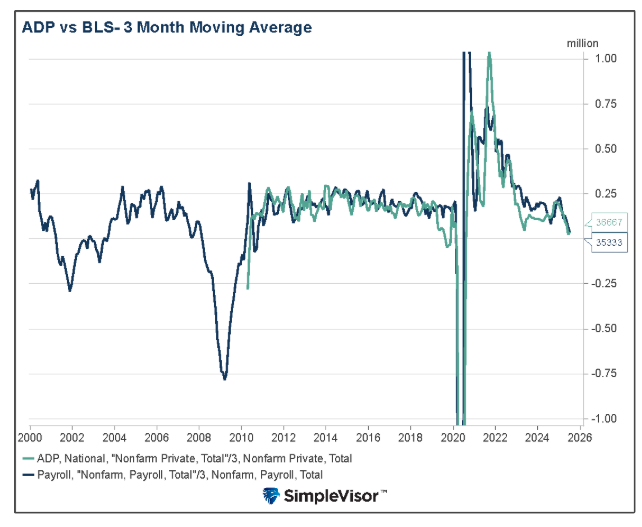
The following graph illustrates how the probability of a Fed rate cut at the upcoming September 17 meeting shifted meaningfully after the employment report and revisions. In the week before the report, Fed Funds futures traders saw a 50/50 chance of a rate cut to 4.00%-4.25% at the upcoming meeting. Now, traders are nearly certain the Fed will reduce rates.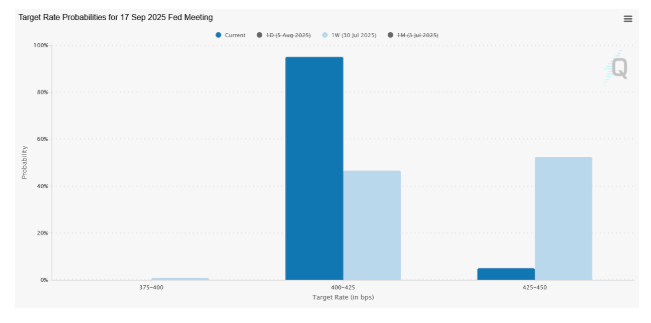
It's a mistake to assume that if the Fed cuts the Fed Funds rate, the effect will be the same across all Treasury maturities. Let's work through some math to better understand which factors influence the short and long ends of the Treasury curve.
The maturity spectrum
Looking out from Treasury bills maturing tomorrow to bonds that won't mature until the year 2055, we find the factors that most impact yields vary by maturity. We can think of this as a spectrum, whereas some factors gain strength as maturities lengthen and others diminish, and vice versa.
For example, the yield on a five-day Treasury bill depends entirely on liquidity in the money markets. In other words, the yield solely reflects expectations of where Fed Funds and overnight repo rates will trade in the coming days.
A three-month Treasury bill also depends heavily on the same daily liquidity factors. However, predicting where the series of overnight rates might be over the next three months requires considering whether the Fed will change rates at one or both of the meetings scheduled within those three months. Additionally, how might economic data influence the likelihood of a rate change?
So, while we have two short-term securities that investors generally consider money market securities — i.e., cash — their yields may not move in sync. That example is just for a three-month difference in maturity.
Let’s use statistics to better appreciate what drives yield differentials for securities with much longer maturity differences.
Factors impacting yields
The key factors affecting bond yields are as follows:
Federal Reserve (monetary policy) – The Federal Reserve’s actions in setting the Fed Funds index rate and the usage of QE or QT heavily influence bond yields. Moreover, it's not just their policy decisions but their opinions on the economy, inflation, and how those may shift policy in the future.
Inflation & inflation expectations – The true mark of a good investment is not necessarily its return, but its return after inflation. Investments should not be made if the investors think that doing so will erode their purchasing power. Therefore, in most cases, bond investors should prefer bonds that have yields greater than inflation and the expected future rate of inflation.
Economic activity – Economic activity has two important effects. The first is that the level of economic activity influences the demand for capital. During a strong economy, the demand for capital usually increases, causing other investments to offer higher yields to attract investors. Second, inflation and inflation expectations depend on the balance between the supply and demand for goods and services, which are most often directly linked to economic activity.
Supply & demand for Treasuries – The balance between the supply of Treasuries and investor demand, like any other financial asset, has a significant impact on yields.
Safe-haven flows – At times, demand for risk-free assets soars when geopolitical tensions escalate and or financial markets experience significant volatility. Conversely, when other financial markets are in speculative mode, money flees risk-averse assets, seeking higher returns.
Sentiment & narratives – All of the prior factors described have strong correlations with yields. However, the market’s sentiment and forecasts of those factors can have a meaningful impact. The term premium or discount is a measure of the effect of sentiment and narratives. It quantifies the yield of a bond less the fair value yield of the bond based on the factors listed above. Any difference is due to sentiment.
I provide more details of the term premium in Why Are Bond Yields Rising.
The graph below indicates that the current term premium on the 10-year UST note is 22 basis points. (The difference between the purple term premium calculation at the bottom and the gap between the two lines is due to the use of daily yields versus monthly economic and inflation data reporting. As of the end of last month, it was 36 bps, but today, with 10-year yields 14 bps lower since month-end, it stands at 22 bps.)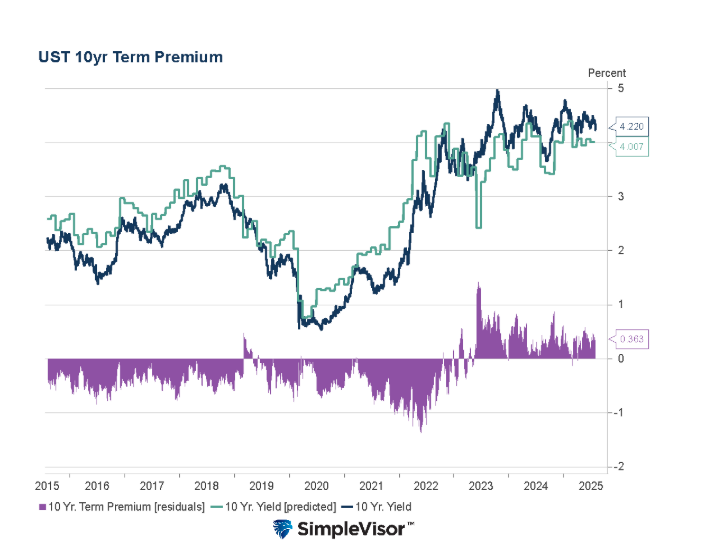
Visualizing the spectrum
As we note, different factors can have different impacts on yields based on the bond's term to maturity. To keep this simple, we examine the respective correlations over the last 10 years of the three-month UST bill and the oft-quoted 10-year UST note to various factors.
What's important to realize as you look at our data and commentary is that the factors shift in importance, up or down, as the maturity increases or decreases.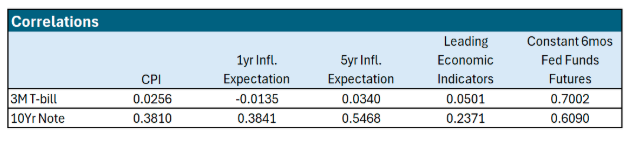
The three-month Treasury bill is highly correlated to the expected level of Fed Funds six months forward. However, it has no statistical relationship to the CPI index, inflation expectations, or economic activity. However, we would argue that Fed Funds expectations do change with the other factors. Thus, the relationship is likely more robust during periods when the Fed is actively changing its policy stance.
The 10-year Treasury note has a strong relationship to the Fed Funds futures markets and longer-term inflation expectations. It also has a less robust but still meaningful relationship with the CPI index, short-term inflation expectations, and economic activity.
As you move from the 10-year to the shorter end of the curve, the relationship with Fed Funds futures strengthens marginally. In contrast, the relationship with inflation and economic factors starts to decline. Conversely, as you move out toward longer maturities, economic activity and inflation and inflation expectations grow in importance.
Importantly, it's not just those factors that account for yield changes. As I noted with the term premium, it's also the sentiment regarding those factors and others. Thus, market expectations for inflation and economic activity, alongside political concerns and deficits, have a more pronounced impact the further out on the maturity curve you go.
Betting on the Fed and fading the narratives
A recent trade we made was based on our view of the factors I shared above. A few weeks ago, we sold the iShares 7-10 Year Treasury Bond ETF (IEF) and replaced it with the iShares 3-70 Year Treasury Bond ETF (IEI). The trade reduced our average duration. But by adding more of IEI than we sold of IEF, we made up for some of the return slippage if yields uniformly decline.
We did this because we wanted more exposure to the possibility that the Fed will start cutting rates. At the same time, we wanted to reduce our exposure to the poor sentiment and narratives that were keeping yields higher than fair value. One concern is that rate cuts might further spur inflation narratives. Such a narrative has less impact on the shorter maturity ETF.
Summary
The Treasury yield curve is influenced by myriad factors, including economic conditions, inflation expectations, Fed policies, and investor sentiment. Recognizing these factors enables investors to make informed decisions about their bond allocations based on potential shifts in economic and monetary policy as well as sentiment.
As the Federal Reserve nears a rate cut, these factors and their respective impacts across the yield curve grow in importance for those managing bond portfolios.
Michael Lebowitz is a portfolio manager with RIA Advisors and author for Real Investment Advice. For more information, contact him at [email protected] or 301.466.1204.
Join RIA Advisors and elevate your career within a deeply experienced team focused on innovation. Our collaborative environment is built on a foundation of advanced technology and effective investment models, designed to enhance your ability to serve clients and grow your practice. Benefit from a supportive culture that encourages professional development and fosters a forward-thinking approach. By joining our team, you’ll be part of a group dedicated to excellence and continuous improvement, empowering you to focus on building meaningful client relationships and pursuing your business ambitions. Discover the advantages of working with our accomplished advisory team by starting your conversation today.
A message from Advisor Perspectives and VettaFi: To learn more about this and other topics, check out some of our webcasts.
Membership required
Membership is now required to use this feature. To learn more:
View Membership BenefitsSponsored Content
Upcoming Virtual Events View All












