A long-feared change to Wall Street’s plumbing is paying off — and it’s freeing up billions.
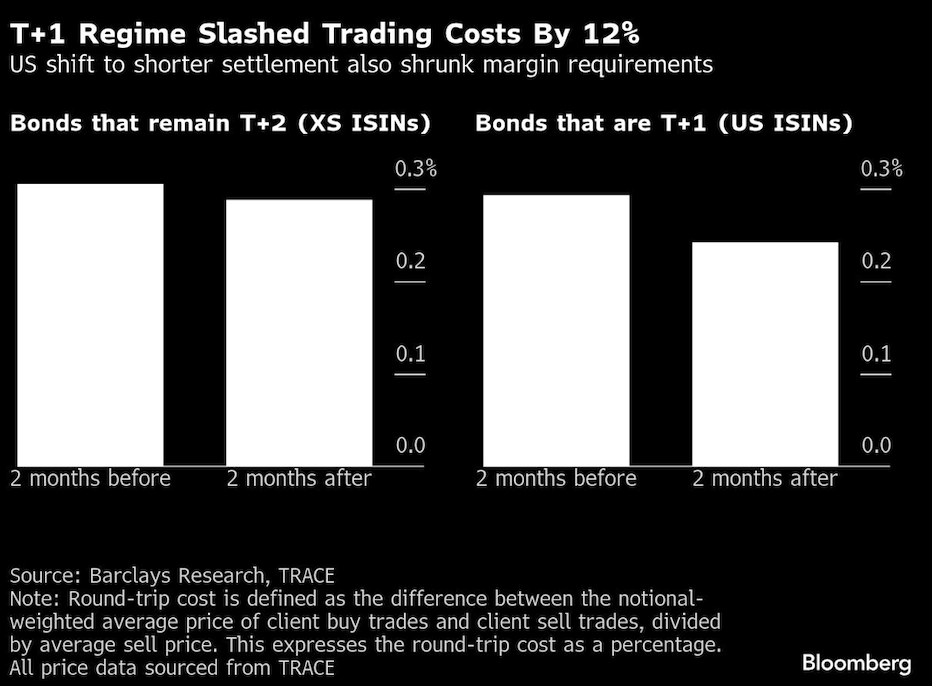
More than a year after the US adopted one-day settlement, a key measure of corporate bond trading costs is down 12%. Margin requirements — the cash or collateral firms must post to cover the risk of failed trades — have dropped 29%, according to Barclays Research. That’s capital that can now be put back to work. Plus, there are signs that those savings have boosted credit market liquidity.
Score one for the US regulator, at least for now. The shift to T+1 was born of meme-stock chaos, when a wave of settlement failures exposed the dangers of delay. Europe, including Britain and Switzerland, is slated to follow in 2027.
Barclays’ findings align with data from the Depository Trust & Clearing Corporation, which last year showed that capital held to cover potential trade failures fell 29% to a quarterly average of $9.1 billion, down from $12.8 billion.
“Think of it as an efficiency boost to the system — or, put differently, as if your insurance premium just went down,” Zornitsa Todorova, head of thematic fixed income research at Barclays, said in an interview. “That capital can either be used to trade more actively or deployed elsewhere.”

Todorova acknowledged that isolating the impact of T+1 is challenging because liquidity is influenced by a number of factors such as market volatility and macroeconomic shifts, making it difficult to measure.
In their analysis, Barclays tried to remove that noise by comparing about 200 pairs of corporate bonds that were identical except for their settlement cycles. One was tailored for US investors, with trade initiation and payment delivery coming on the same day. The other security was meant for international buyers, where settlement took two days.
“This creates a clean, apples-to-apples comparison that isolates the true effect of faster settlement,” Todorova wrote in a July note.
To be sure, Barclays’ sample size is a tiny fraction of the corporate bond universe, and while the transition to T+1 in the US credit market was generally smooth, some asset managers have found elevated funding costs.
In the credit space, where large trades are common and liquidity is often fragmented, these operational shifts reinforce the importance of funding agility and real-time processing capacity. Banks and other intermediaries have generally seen their expenses decline in the T+1 era.
Barclays also found that lower trading costs are fueling more market activity and reducing the share of bonds that rarely change hands. The monthly share of nontraded US high-grade bonds has dropped to 0.1% from 2% a decade ago, Todorova and her team wrote in a separate note dated July 29.
Better liquidity has also eroded the additional compensation investors are paid to own bonds that may be hard to sell quickly — the so-called liquidity premium — to nearly zero now, from 35 basis points between 2011 to 2017, Barclays said.
“If you’re compressing that settlement window, you’re removing at least 24-hours worth of potential exposure,” Marty Mannion, co-head of TD Securities Automated Trading, said in an interview. “In theory, that could improve liquidity because you could say, ‘well I’ve minimized some amount of counterparty risks. I’m more comfortable trading in size with particular firms because I’ve got less uncertainty.”
As a whole, market efficiency for the asset class has improved significantly in the past year. Investors have increasingly embraced portfolio trading, enabling large baskets of bonds to be traded in a single transaction. Also, the continued maturation of fixed income ETFs has made credit exposure more accessible and liquid. Add in the rise of electronic and high-speed trading — long dominant in stock trading — which is reshaping credit markets in what many call the “equitification of credit,” making execution faster and more transparent.
“Settlements are clearly part of the story, but the bigger story is how the evolution of credit products has created the most robust credit ecosystem that has ever existed,” said Alex Finston, partner and co-head of US credit trading at Goldman Sachs Group. “The differing ways in which a client can access liquidity in credit markets has never been better.”
A message from Advisor Perspectives and VettaFi: To learn more about this and other topics, check out some of our webcasts.
Bloomberg News provided this article. For more articles like this please visit
bloomberg.com.
Read more articles by Isabelle Lee, Caleb Mutua