AI is Transforming Markets
Membership required
Membership is now required to use this feature. To learn more:
View Membership Benefits Advisor Perspectives welcomes guest contributions. The views presented here do not necessarily represent those of Advisor Perspectives.
On May 6, 2010, the U.S. stock markets dropped nearly 10% within minutes. What would be called a “flash crash” wasn’t caused by news, economic data, or a Fed policy decision. According to the U.S. Commodity Futures Trading Commission (CFTC), a large sell order on E-Mini S&P 500 futures, executed by a mutual fund and triggered by an algorithm, was the culprit. Furthermore, the sell order triggered other high-frequency trading algorithms to follow suit and sell.
Before the 2010 flash crash, algorithmic trading was limited. Since then, it has become the dominant form of trading. More recently, the rise of AI has become a key element in powering trading market algorithms. As a result, AI is transforming markets.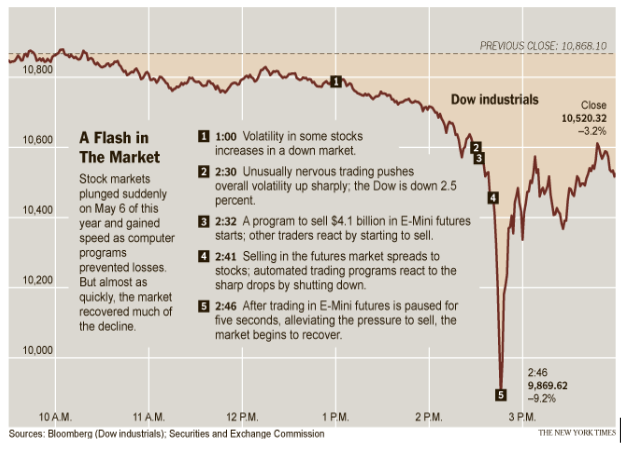
A strong macroeconomic outlook and solid technical analysis are no longer enough to give investors a fighting chance in the financial markets. Today, and even more so tomorrow, understanding how AI influences markets — the mechanics, benefits, and pitfalls of AI investors — is equally important. Therefore, it's worth reviewing how AI drives markets.
AI on display
AI is rapidly increasing the speed and accuracy needed for financial market research and trade execution. It is quickly leaving humans and even non-AI-backed algorithms in the dust. Using massive amounts of data on prices, earnings, macroeconomic data, and sentiment, among other factors, AI can decipher trends and provide unique insight into how these factors might impact prices much faster than humans or more traditional models.
Importantly, AI is entirely data-driven. Therefore, it removes our emotions and bias, providing cold, hard, calculated decisions.
Here are a few examples of how investors are currently using AI:
- Aladdin by BlackRock uses AI to crunch massive data sets — including stock prices, earnings, macroeconomic data, and more — to build and rebalance portfolios. It manages risk and returns across thousands of assets in real time, helping institutional investors, such as pension funds and hedge funds, stay ahead of most investors.
- TradeRiser monitors social media posts, news feeds, and earnings calls using natural language processing to assess investor sentiment. Investors can leverage it to identify stocks with a bullish or bearish “buzz” before most investors notice.
- CopyTrader by e-Toro lets retail or institutional investors mirror the trades of top investors in real time.
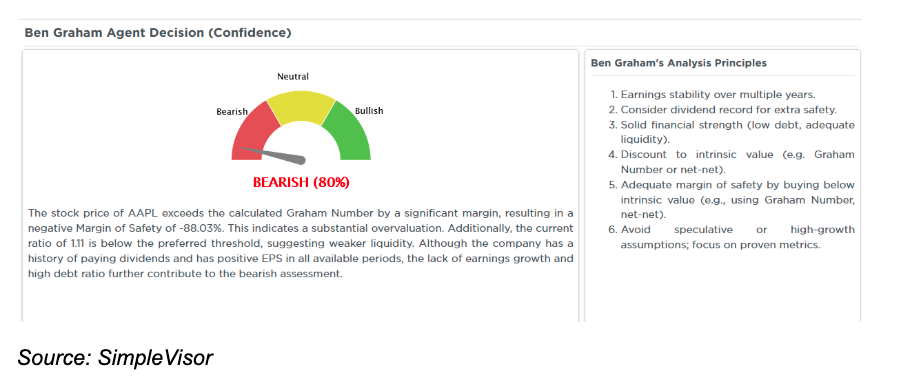
- Similarly, our SimpleVisor Simple AI tool allows users to evaluate stocks based on the investment principles of some of the world’s most esteemed investors. We share AI Ben Graham’s take on Apple below.

Benefits for investors and markets
Instead of waiting hours, days, or weeks for traditional research, AI can quickly fine-tune portfolios and suggest trades based on the latest data. This ability to identify complex patterns and execute transactions swiftly gives retail as well as institutional investors a competitive edge. When markets are volatile, as we saw in April, these advantages become even more significant.
Cost is another benefit of AI-powered tools. Because AI is not dependent on paid staff and other expenses that typically accompany most investment managers, AI can operate at minimal cost. For instance, Betterment and WealthFront, two AI robo-advisors, charge a fraction of what traditional advisors charge. The affordability, combined with the sophistication of AI models, democratizes the financial markets, allowing small retail investors to behave like large institutional investors.
The benefits extend to all investors, not just those who depend on AI. AI-driven algorithms increase market liquidity, which can also help stabilize prices. Their ability to capitalize on arbitrage opportunities or short-term mispricing, such as during the 2010 flash crash, can reduce volatility to the benefit of all investors. Would the flash crash have occurred if AI had been available in 2010, or, would it have been worse? Let's now explore that question.
AI market risks
So far, we've mostly praised AI-powered investment tools. While the advantages are significant, it's essential also to consider the cons.
I started this article by discussing how algorithms caused a flash crash in just minutes, with no clear fundamental cause. As AI use grows, many models may develop similar thinking patterns and responses. This groupthink could raise the risk of a flash crash or surge.
While it's difficult to consider how a similar situation to 2010 might unfold today, we should also acknowledge that AI can identify discrepancies and arbitrage opportunities much faster than older, non-AI algorithms. As a result, they could potentially stop a flash crash before anyone even notices what is happening.
Further, although we believe AI can bring more stability, we also worry that it might create a higher baseline level of volatility. The speed of trading and the accuracy with which real-time sentiment is captured can cause rapid price swings.
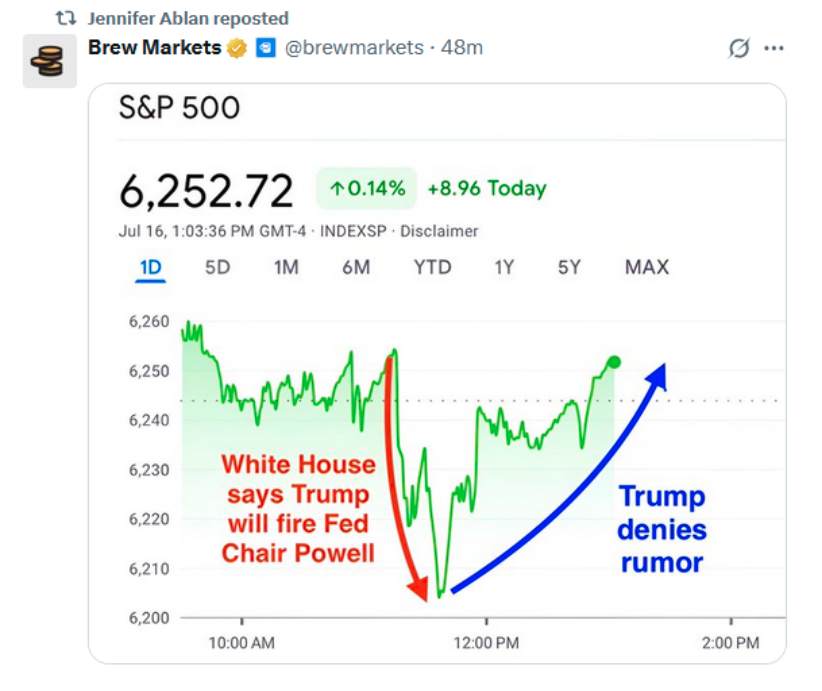
For example, on July 16, 2025, little-known Congressional House member Anna Paulina Luna of Florida tweeted on X that she heard from President Trump that Fed Chair Powell was going to be fired immediately. In the past, such a post would have taken hours to circulate and have an impact on markets. The effect last week was lightning fast.
AI engines were searching all social media posts and looking for tradable news. They found it, and a sharp reaction ensued in the bond and stock markets, as shown below. In previous instances, the result may have been muted, as the president could have reacted more quickly and rebutted the comments before many market participants saw the rumor.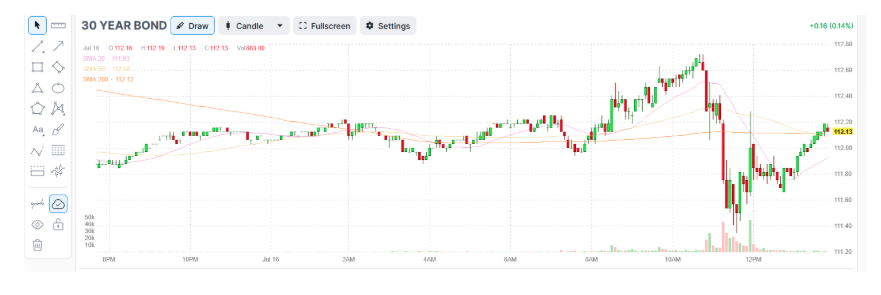
Fraud & ethical challenges
Market manipulation is another challenge posed by AI. As an example, malicious actors can exploit AI’s perception of sentiment through a series of fake social media posts. Additionally, they can use bots to amplify the spread of these false posts to a broader audience of investors. As the phony news circulates, the perpetrator can use AI algorithms to execute trades, lending further credibility to those posts. The aim is to deceive other AI algorithms, which are driven by price and sentiment, into following along.
Ethical challenges are another tricky topic. If AI has access to personal information, including your investment holdings and trades, will it share that with other AI engines? Proprietary knowledge, in addition to personal information, is also a risk.
Summary
The tremendous benefits of AI will come with a price. I highlight these advantages along with some challenges and risks.
Although I only scratch the surface of this topic, I hope it raises your awareness of how AI impacts markets and, in turn, influences your wealth.
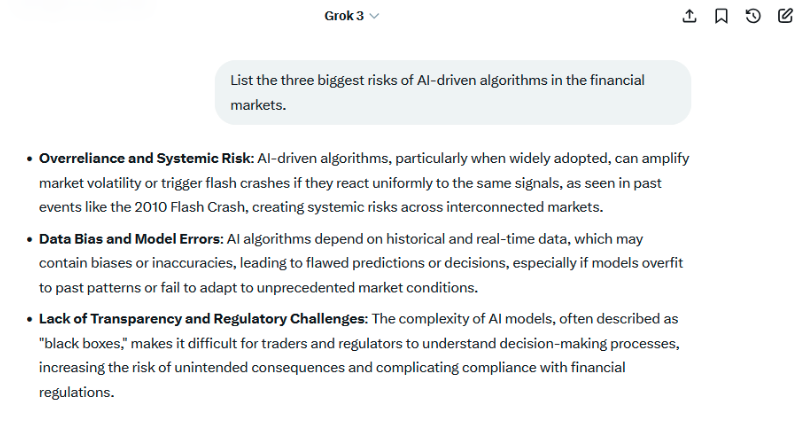
I conclude by asking Grok to identify the three biggest benefits and risks associated with AI-driven algorithms.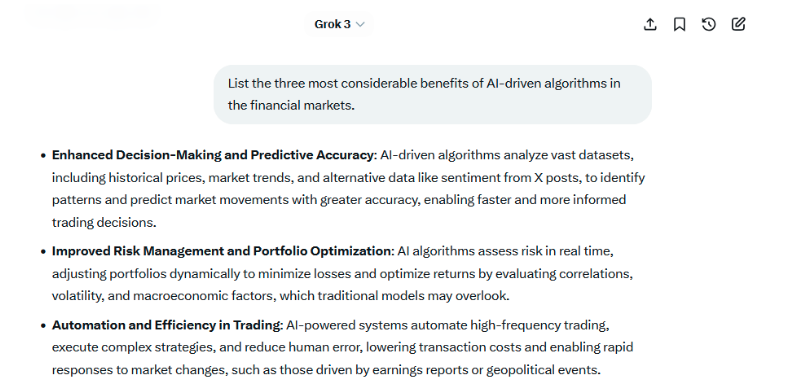
Michael Lebowitz is a portfolio manager with RIA Advisors and author for Real Investment Advice. For more information, contact him at [email protected] or 301.466.1204.
Join RIA Advisors and elevate your career within a deeply experienced team focused on innovation. Our collaborative environment is built on a foundation of advanced technology and effective investment models, designed to enhance your ability to serve clients and grow your practice. Benefit from a supportive culture that encourages professional development and fosters a forward-thinking approach. By joining our team, you’ll be part of a group dedicated to excellence and continuous improvement, empowering you to focus on building meaningful client relationships and pursuing your business ambitions. Discover the advantages of working with our accomplished advisory team by starting your conversation today.
A message from Advisor Perspectives and VettaFi: To learn more about this and other topics, check out some of our webcasts.
Membership required
Membership is now required to use this feature. To learn more:
View Membership BenefitsSponsored Content
Upcoming Virtual Events View All