The secret to getting a trillion-dollar valuation on a struggling car company is to convince everyone that you are not in fact a car company. Tesla Inc. led with that in its latest results announcement, declaring the last quarter — a dreadful affair in financial terms — a “seminal point” in its history. The second quarter apparently kicked off Tesla’s transition from leading in electric vehicles and renewable energy to the new vistas of artificial intelligence and robotics.
We’ve got the first bit of the transition alright, where the old stuff fades. But we are yet to see the other, more exciting bit show up in force. Tesla’s remarkably patient investors, treated to another earnings call that mostly elided discussion of the stuff the company actually sells in favor of stuff it either barely sells or doesn’t at all, now exist almost entirely on a diet of wild promises.
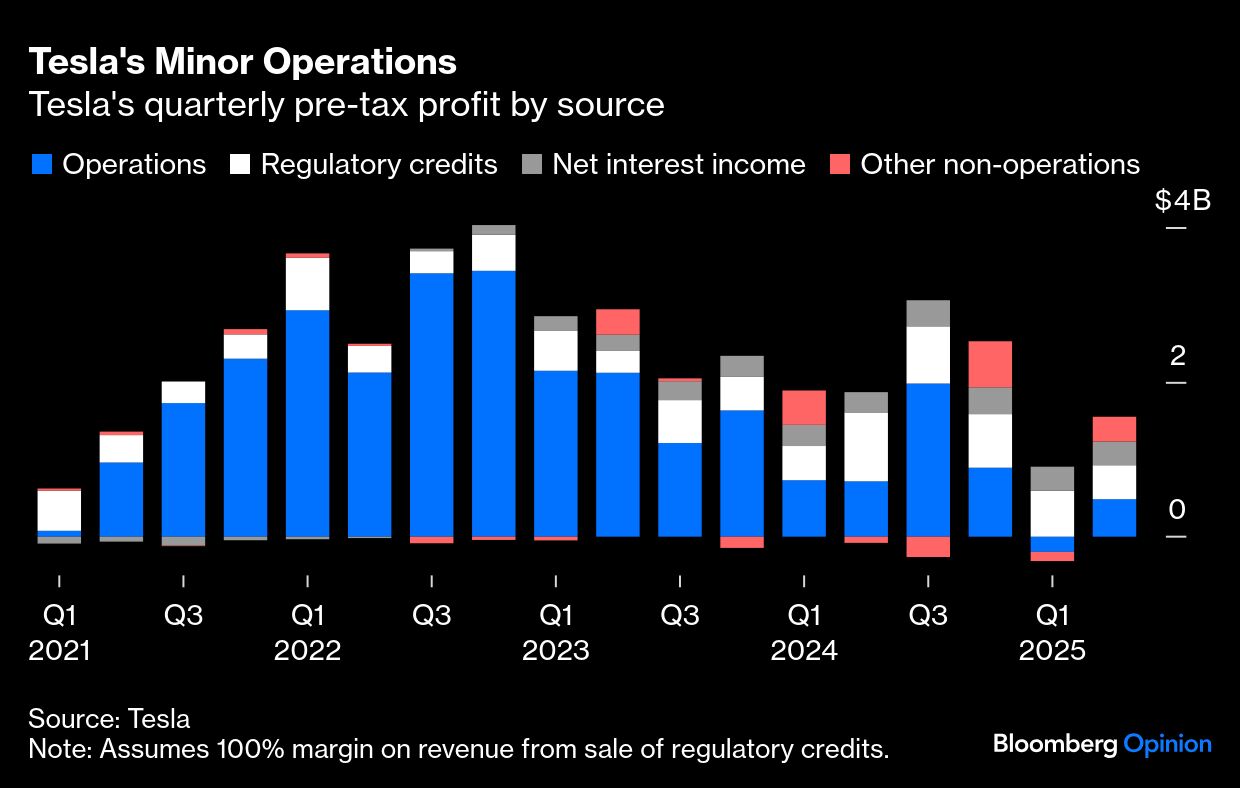
Tesla missed consensus earnings, but only by a little, which, in this inverted dimension, can often count as a win (even though the forecast had collapsed since the start of the year). More telling was what lay beneath the pre-tax profit of $1.5 billion. While underlying operations flipped back to a profit after the prior quarter’s loss, that still constituted less than a third of the overall amount. Little wonder given the decline in EV sales, including the woeful performance of the Cybertruck. Almost 69% came from selling regulatory credits, interest on Tesla’s bank balance and $320 million of “other” (likely crypto-related) income. So far this year, from a profits perspective, Tesla has looked more like a financial fund that happens to also make cars and batteries.

Tesla’s free cash flow collapsed further in the quarter, to just $146 million, down almost 90% from a year ago. Even getting to this figure owed everything to that “other” income, as well as Tesla continuing to underspend on capital expenditure. The company, which is apparently on the cusp of leadership in not-cheap robotics and AI, cut its capex target for the year.
Tesla’s ‘guidance’ on EVs was equally inspiring. Having suspended what passes for annual guidance in the first quarter and pledging to revisit that in the second quarter, the company appears to have decided to not bother reinstating it or even talking about it.
Tesla also said it began producing a “more affordable” model in June, thereby apparently fulfilling a prior pledge. I say “apparently” because these EVs are yet to be seen. It is deeply odd that an automaker would go through the trouble of recently indulging in a big public launch of a branded diner in Los Angeles while keeping a long-awaited new product under wraps. Tesla offered a rationale of sorts, saying it is focused on getting existing product sold before EV tax credits go away, meaning a slower ramp-up in production of the new model. But that still doesn’t explain the mystery. What might explain it better was Musk’s admission late in the call that it would look like a Model Y, which is not exactly the breakthrough for which the more ardent bulls may have hoped.
Taken altogether — the numbers, the guidance, the “seminal moment” — an air of resignation about EVs hung heavily over these results. Chief Executive Elon Musk, asked about the impact of US consumer EV credits being taken away by the Republican administration he helped get elected, averred that the company could be in for “a few rough quarters.” (Weird that didn’t make it into the formal guidance). This is all nothing short of remarkable when that business still accounts for 74% of revenue.
But that is the point, of course; Tesla’s valuation rests overwhelmingly on Musk’s visions of robots and autonomous vehicles. Hence, these featured prominently, with Musk talking about Tesla possibly producing 100,000 Optimus robots per month within five years and maybe rolling out robotaxis to areas covering half the US population by the end of this year. Bear in mind that they currently run for invite-only patrons in a limited area of Austin and that Musk has a long history of wildly overpromising.
Asked about actual, detailed metrics on the all-important Austin service to date, as well as customers’ uptake of the parallel Full Self Driving driver assistance systems, Tesla offered little. Because, while the secret to getting a trillion-dollar valuation on a struggling car company is convincing everyone that you are not in fact a car company, it helps to be a bit secretive, too.
A message from Advisor Perspectives and VettaFi: To learn more about this and other topics, check out some of our webcasts.
Bloomberg News provided this article. For more articles like this please visit
bloomberg.com.
Read more articles by Liam Denning