Chief executive officers in the US and beyond are becoming accustomed to the policy swings of President Donald Trump and are deciding they can pursue growth ambitions regardless.
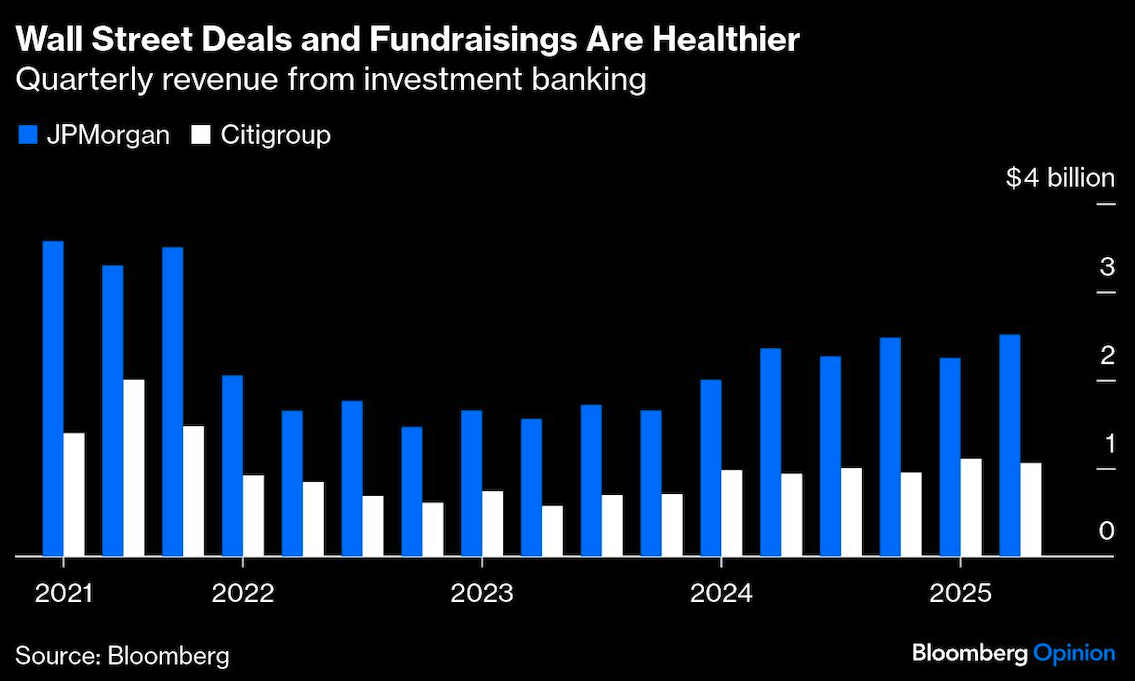
That was the main message in the strong investment banking fees reported by JPMorgan Chase & Co. and Citigroup Inc. in second-quarter earnings Tuesday. It will raise hopes among bankers for more deals and stock market debuts during the rest of the year despite the fast-approaching deadline of Aug. 1 for a fresh set of hefty trade taxes to be imposed in the latest round of tariff fights.
JPMorgan’s $2.5 billion in revenue from this segment smashed analysts’ expectations by nearly 25%, with the bank reporting growth in fees compared with both the first quarter and the same period last year. Its business had been expected to shrink compared with those prior quarters. Citigroup, too, did better than forecast, with investment banking fees up 13% compared with those in the period a year earlier, though down slightly from a strong first quarter.

“Generally speaking, I think CEOs learn how to navigate volatility and uncertainty in markets,” said Mark Mason, chief financial officer of Citigroup. To some extent, the uptick in deals and fundraising reflects an increasing comfort among executives with these conditions, he added.
Jamie Dimon, CEO of JPMorgan, said the passage of the sweeping tax and spending bill in Washington had also helped by creating clarity around taxes for corporate profits and research and development costs. “That’s a small positive,” he said. Trade-related paralysis has eased, however. “Executives are accepting a degree of uncertainty and pushing ahead anyway,” Jeremy Barnum, the bank’s chief financial officer, added.
The results bode well for quarterly earnings reports coming Wednesday from Bank of America Corp., Goldman Sachs Group Inc. and Morgan Stanley Inc., as well as for big European investment banks later this month.
Mergers and acquisitions and debt-raising activity had a late surge in the quarter after recovering from the shock of April when Trump unleashed his worldwide tariffs. Even the queue of companies preparing initial public offerings is starting to look healthier, the banks said. New listings remain scarce, but other share issuance has been strong in the US. At both Citi and JPMorgan, fees from equity capital markets exceeded forecasts most strongly.
While sudden spikes in market volatility or confusion about policy often scuttle executives’ plans, they can adapt to more ups and downs becoming part of everyday life in markets. Deals can still get done, it just becomes a matter of ensuring the pricing and financial targets involved are able to withstand a wider range of possible outcomes. Adjusting to this is part of what’s helping the mood. However, Dimon warned that sentiment could still change again completely overnight.
Elsewhere, trading was a hotspot, as expected. The trade war has kept markets lively and investors constantly on the lookout for ways to reposition their portfolios, profit from the turmoil or simply erect defenses against further swings. Bond, currency and commodity trading was up nearly 20% year on year at both Citi and JPMorgan. Equities trading didn’t grow as strongly, but JPMorgan still turned in its best second-quarter revenue ever, while Citi reported its highest quarterly revenue in at least a decade, driven in part by lending more to hedge funds.
Signs of trouble in the underlying economy remain scarce, meanwhile. Lower-income consumers are showing some strain but not much greater than in previous quarters, Barnum said. With US unemployment still low at 4.1%, there’s no reason yet to expect bigger problems. JPMorgan undershot expectations for provisions against bad debts, which was attributed in part to the bank cutting its probabilities of bad outcomes in the economy compared with its expectations at the start of April — a sign of the bank itself assimilating the uncertainty.
Plenty of strategists think that financial markets look dangerously complacent in the face of Trump’s hyperactive policymaking. Dimon pointed to returns on credit looking unnaturally low, which suggested markets still believe in a soft landing from the inflation and high interest rates of recent years. “We’ve been in that for a while,” he said.
There’s plenty that could knock this sideways, but dealmaking executives and investment bankers look ready to keep hitting “go” for now.
A message from Advisor Perspectives and VettaFi: To learn more about this and other topics, check out some of our webcasts.
Bloomberg News provided this article. For more articles like this please visit
bloomberg.com.
Read more articles by Paul J. Davies