If the Trump administration’s tariff policies result in higher overall inflation, a scenario that will play out in the coming weeks, the question is who will pay for it. A surge in prices will presumably raise the cost of doing business. Less clear is whether and to what extent companies will pass on those higher costs to consumers.
Any inflationary impact from tariffs should first show up in the Producer Price Index, which reflects changes in the cost of producing goods and services sold to consumers. Over time, producer inflation is passed on to consumers and shows up in the better-known Consumer Price Index.
The PPI and CPI’s long history shows that the two are closely related. They’ve grown at roughly similar rates — the PPI by 2.8% a year since 1913 through May and the CPI at a slightly higher rate of 3.2% a year. Annual changes in the two indexes have also been highly correlated over that time (0.8, counting monthly). The relationship was as strong during the past 30 years (0.81), marked by the increasing globalization of trade, as it was during the first three decades of the data series (0.79). That long and consistent history supports the intuition that in the long run, businesses do — indeed, must — pass on their higher costs to consumers.
Looking at shorter periods, however, the numbers tell a more nuanced story. The first thing that jumps out is that annual changes in the PPI have been twice as volatile as those of the CPI, as measured by annualized standard deviation. This suggests that businesses have routinely shielded consumers from much of the turbulence in producer inflation.
Notably, most of that shielding occurred when producer inflation spiked. The median annual change in PPI was 2.3% since 1913. During 12-month periods when producer inflation was lower than the median, roughly half the time, CPI outpaced PPI more than 90% of the time and by a median of 2.2 percentage points. But when annual producer inflation was higher than 2.3%, it was just the opposite. On those occasions, PPI outstripped CPI more than 70% of the time and by a median of 1.6 percentage points. The results are nearly identical when annual changes in PPI and CPI are compared on a six- or 12-month lag.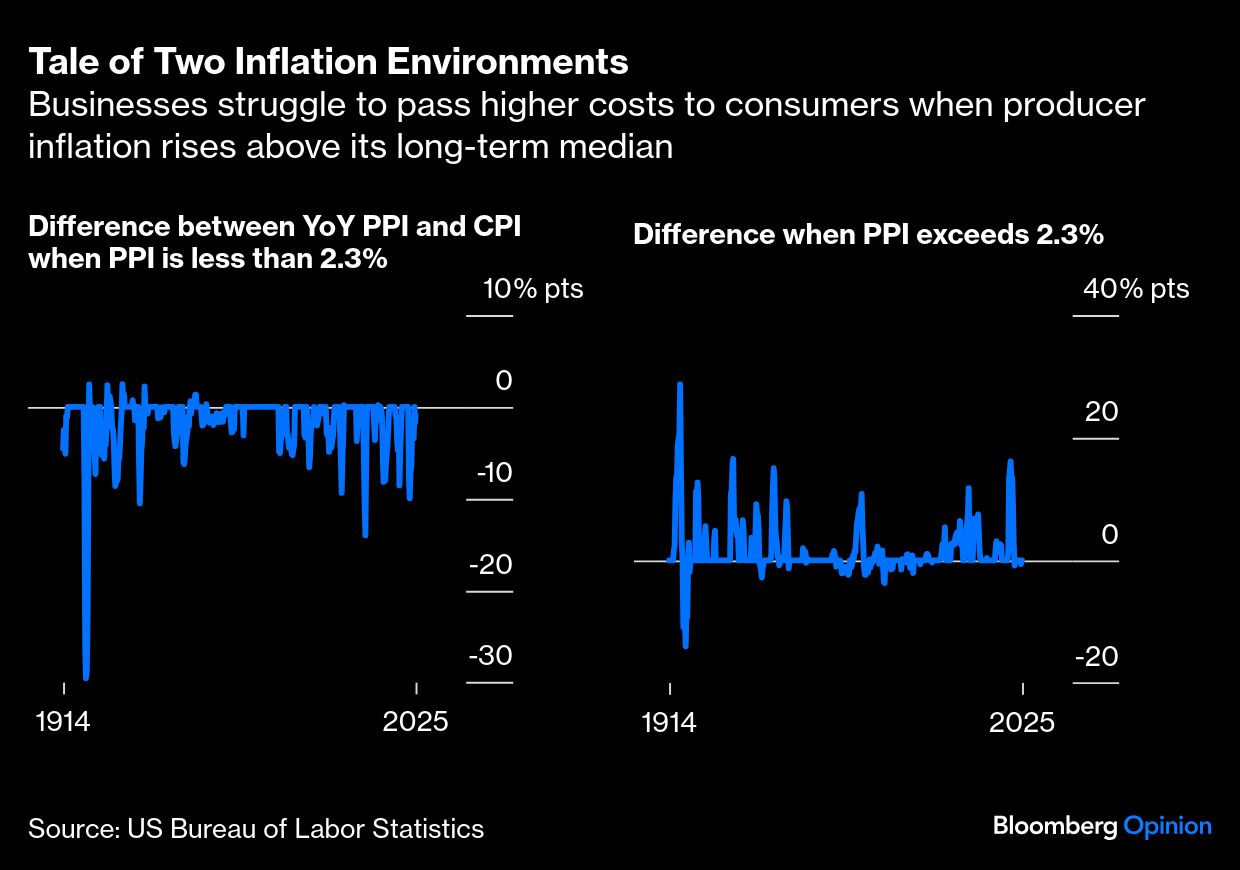
In other words, the higher the inflation, the more likely businesses were to absorb most of the higher cost, at least in the near term, and vice versa. One way to understand that divergence is that there may be a limit to how much price inflation consumers can digest at one time. It would explain why businesses seem to have little trouble passing on their own higher costs to consumers in normal inflation environments but struggle to do so when inflation spikes.












