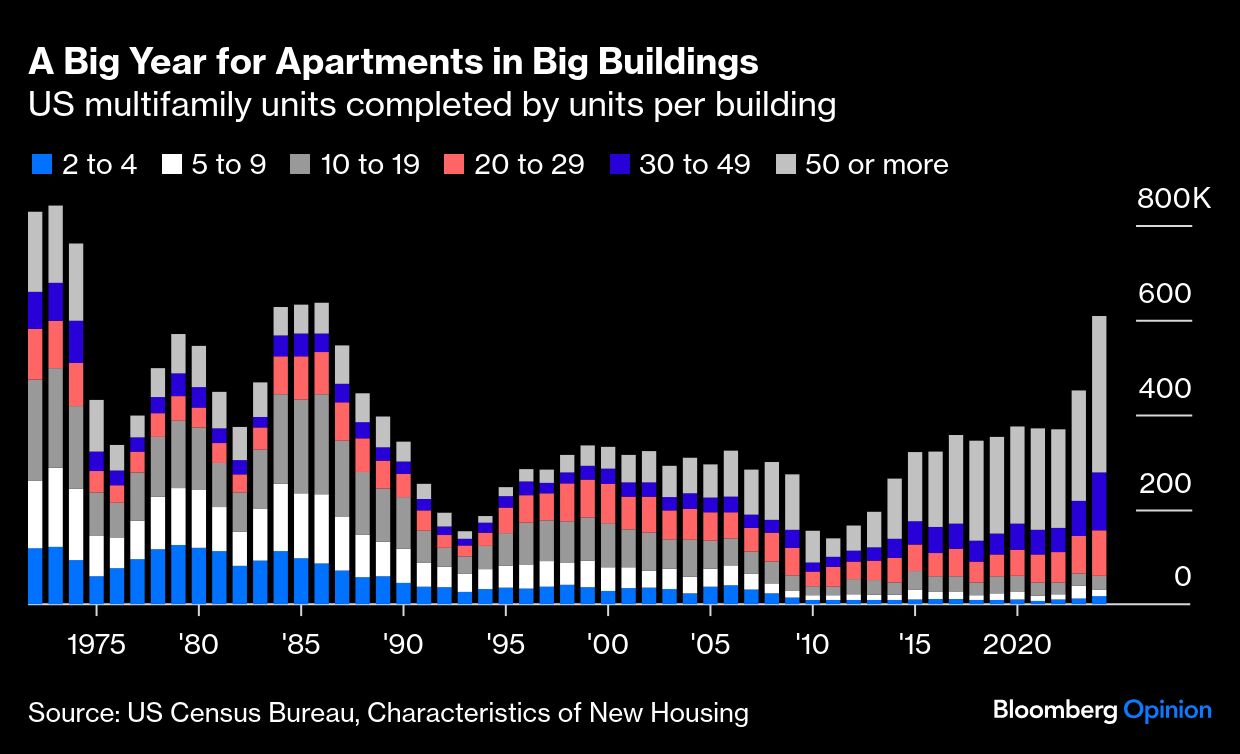
The US apartment-building boom that began about a decade ago appears to have ended last year, but it did so with a bang. It was the biggest year for apartment completions since 1986 and the biggest year ever for apartments in large buildings — that is, those with 30 to 49 and 50 or more units.
The leap in apartment completions in 2024 was the product of:
A boom in multifamily housing authorizations and starts — concentrated in Sun Belt metropolises that attracted lots of migration during the pandemic — that peaked in 2023, and
Longer-than-usual construction times as builders struggled with shortages of materials and labor.
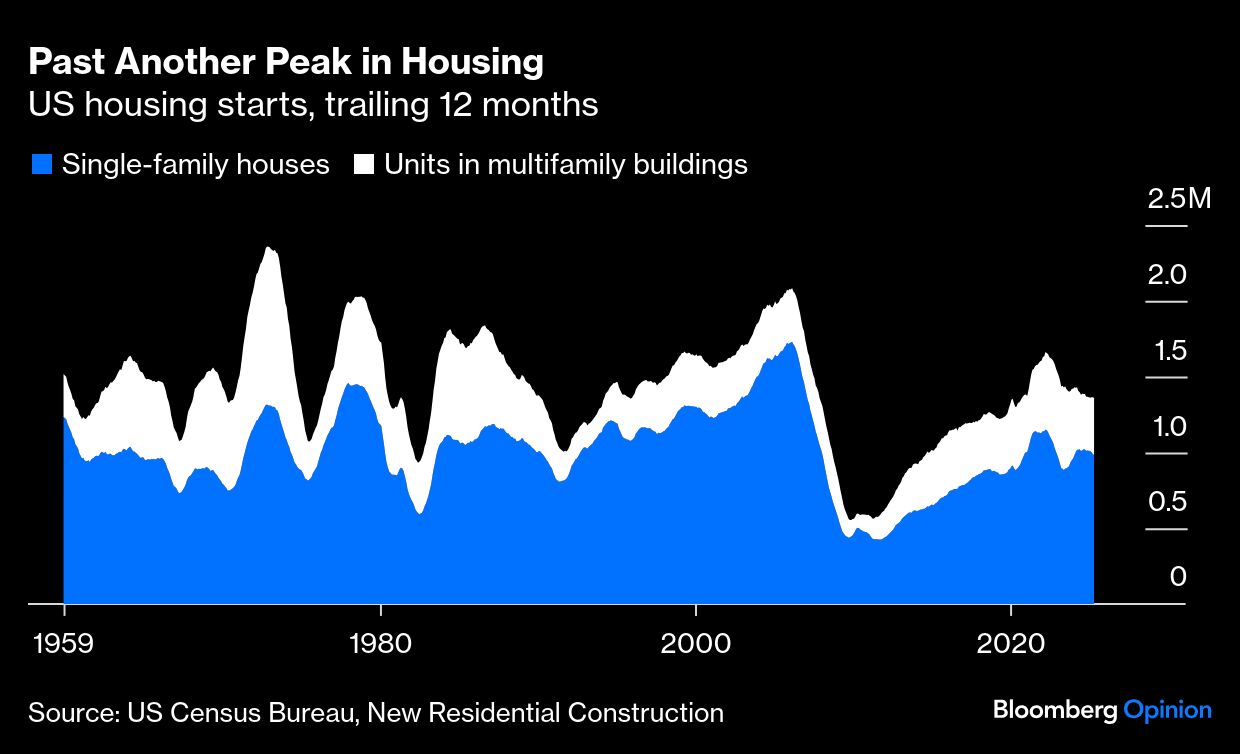
Overall housing starts began falling in 2022. The subsequent drop hasn’t been precipitous, but the historical record and the current combination of high mortgage rates, higher tariffs and increased deportations of construction workers point to continuing declines for a while.
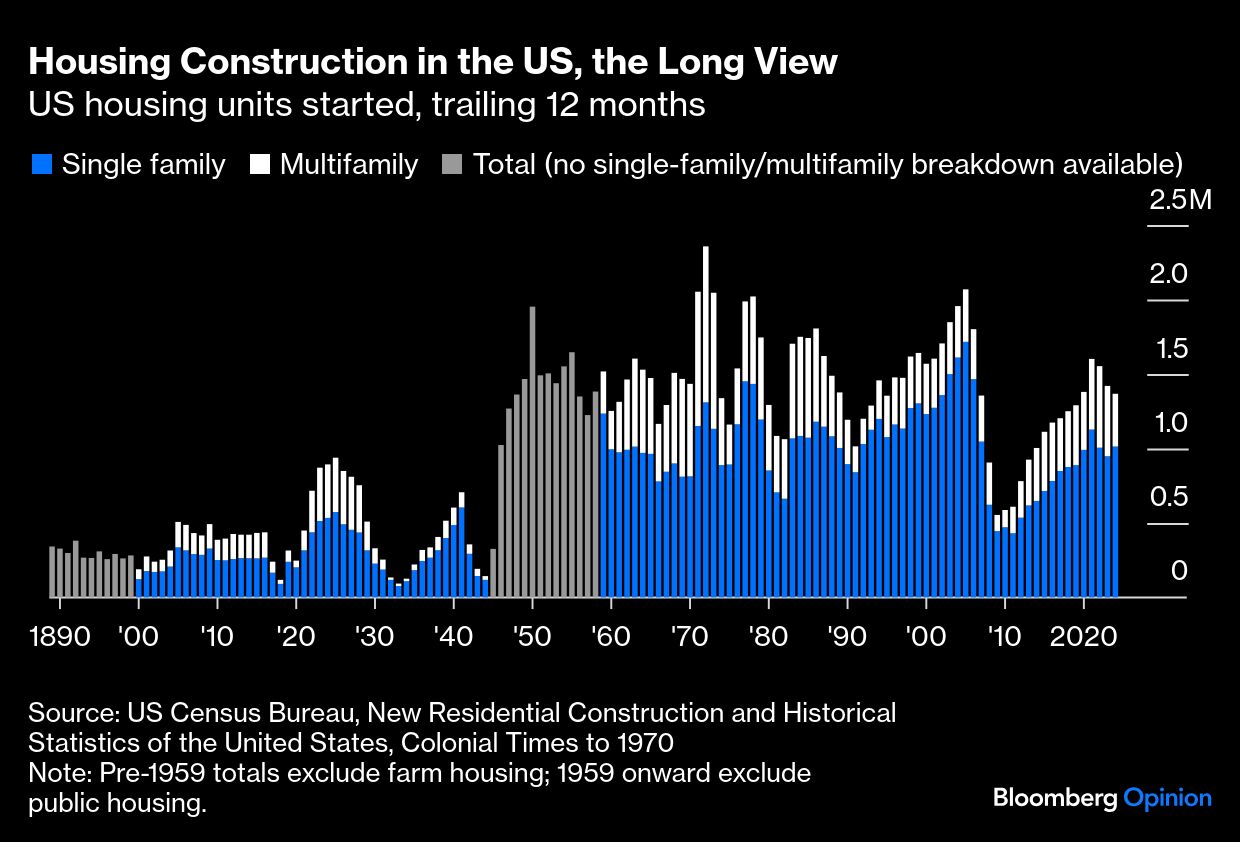
What happened over the past few years doesn’t truly qualify as a housing boom. You may remember hearing in 2022 and 2023 that the number of housing units under construction in the US was at all-time highs, but that was mainly linked to long construction times, due both to the previously mentioned shortage-related delays and the fact that big apartment buildings take much longer to complete than single-family houses. Single-family starts came nowhere near their record 2006 peak and didn’t even make it back to their 1959-2006 average.
But there was something of an apartment-building boom. The multifamily share of housing starts peaked at 38.1% in May and June 2023, slightly below the peak percentages of the 1980s, 1970s and 1920s but still quite high by historical standards.
How has the Great American Apartment Building Boom of 2015-2024 (or thereabouts; there are still lots of apartments being completed this year) changed the country’s housing stock? The Census Bureau’s Characteristics of New Housing, an annual statistical release out this month, offers some intriguing glimpses — among them the breakdown by building size shown in the first chart. It also raises some questions: To what extent has the apartment building boom been a response to existing demand, and to what extent is it a product of the sometimes-perverse incentives and disincentives facing multifamily developers in the US?
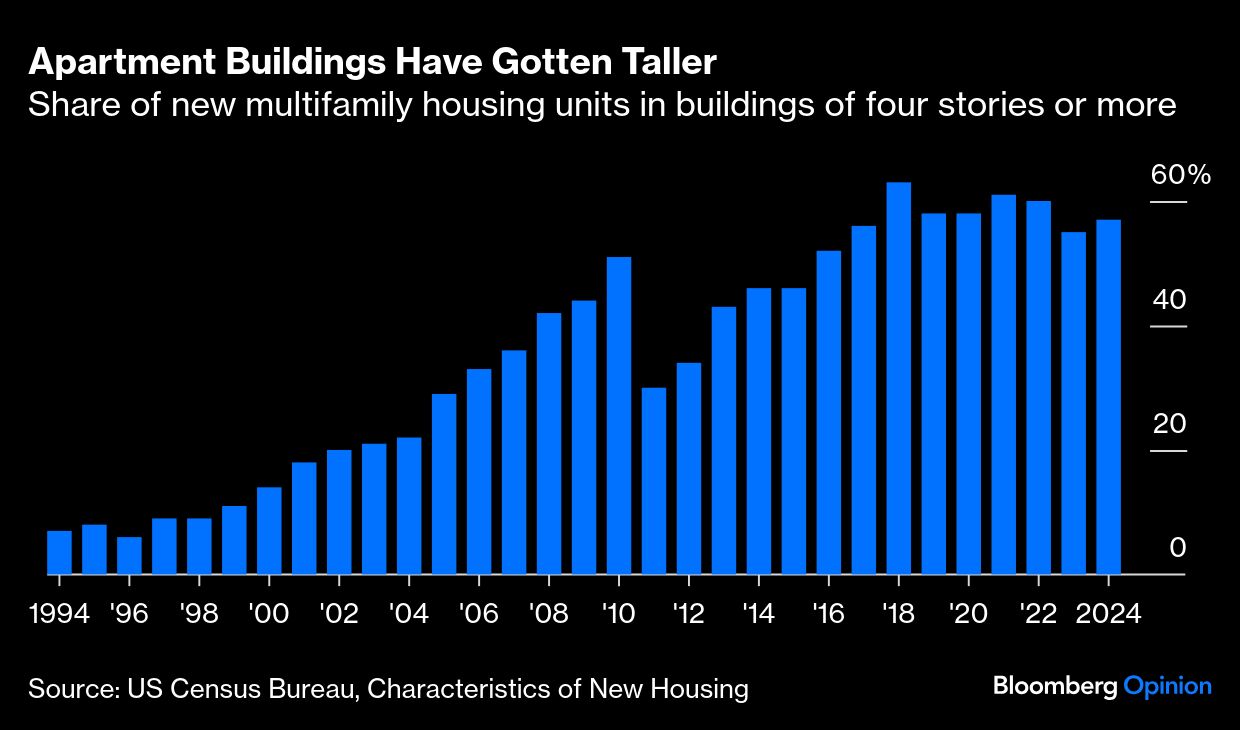
As already noted, large buildings have predominated, although the share of 50-plus-unit buildings has fallen slightly since the pandemic as development has shifted to suburbs and smaller cities. Not surprisingly, apartment buildings have also become taller, with those of four or more stories now the norm — although again their share has plateaued since the pandemic — and those of one or two stories now rarities, accounting for just 5% of new units in 2024, down from 20% in 2013.
Very tall apartment building are still confined to a few big cities. The boom has centered instead on buildings of four, five and six stories — boxy, stumpy wood-framed buildings, many with concrete bases, built mostly along commercial corridors. They’re built along commercial corridors because rezoning single-family residential neighborhoods to allow for apartment buildings has proved a so-far insurmountable challenge in most of the country, and they’ve taken the form they have because North American building codes and the lower cost of wood-framed construction have pointed them in that direction.
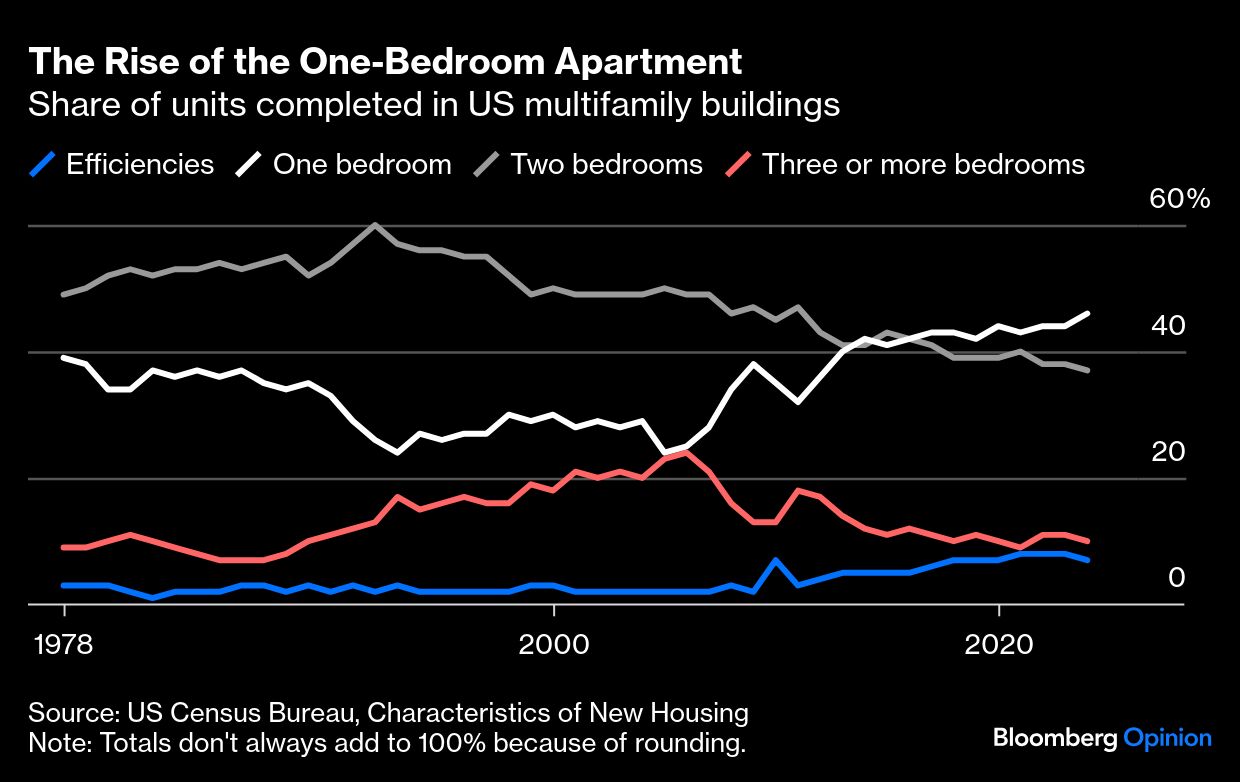
In 2019, I wrote at length about this rise of the “five-over-one,” which appears to have been named originally for the combination of five wood-framed stories over one concrete story that was pioneered in Los Angeles in the 1990s but is now usually understood to mean Type V (wood-frame) construction atop Type I (fire-resistive). One key element that I underplayed — in part because the people I talked to didn’t see it as new or unusual — was the requirement that new buildings of more than three stories provide residents with access to two staircases in case of fire. The two-staircase requirement generally leads to hallways that stretch the length of the building, with apartments on both sides, which in turn favors boxy buildings full of one-bedroom units and studios, with larger apartments mostly relegated to the corners. A quarter century ago, one-bedroom units and studios made up only 32% of new multifamily units constructed. Since 2020, it’s been more than 50%, with three-bedroom apartments down to about one-tenth of new units.
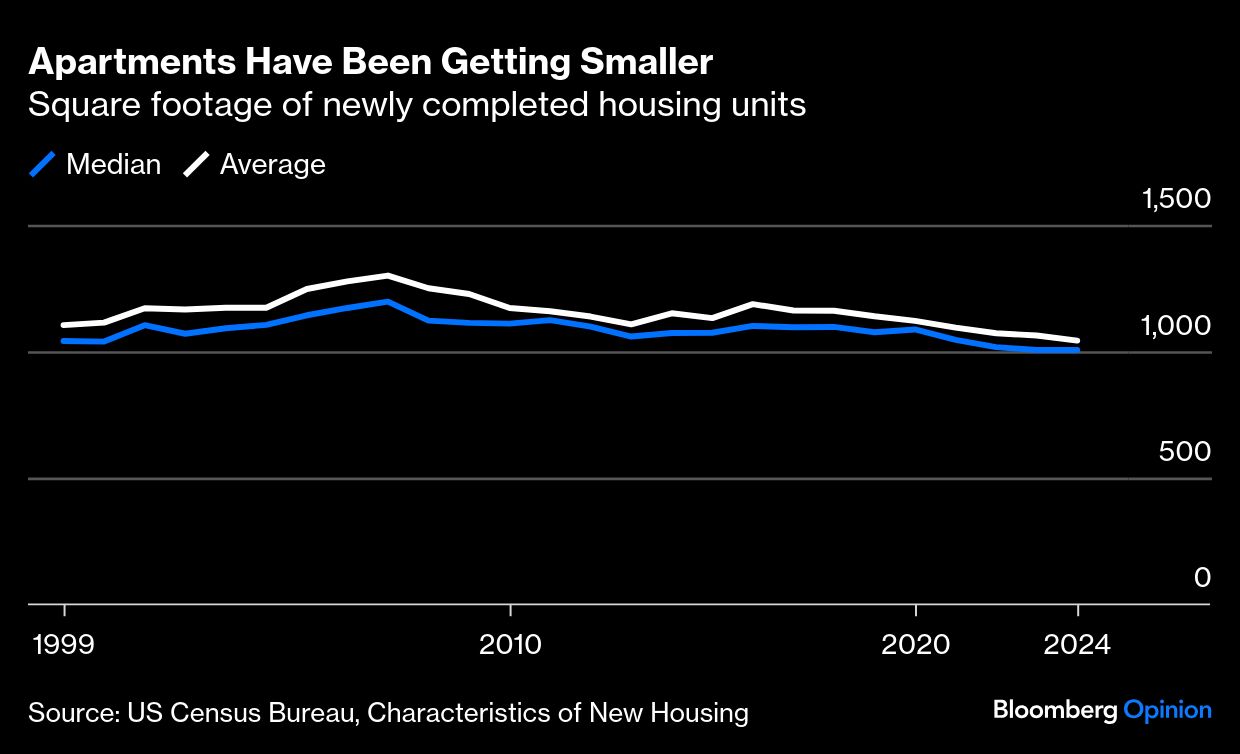
Square footage, for which the data go back to only 1999, is also down, although the decline hasn’t exactly been steep.
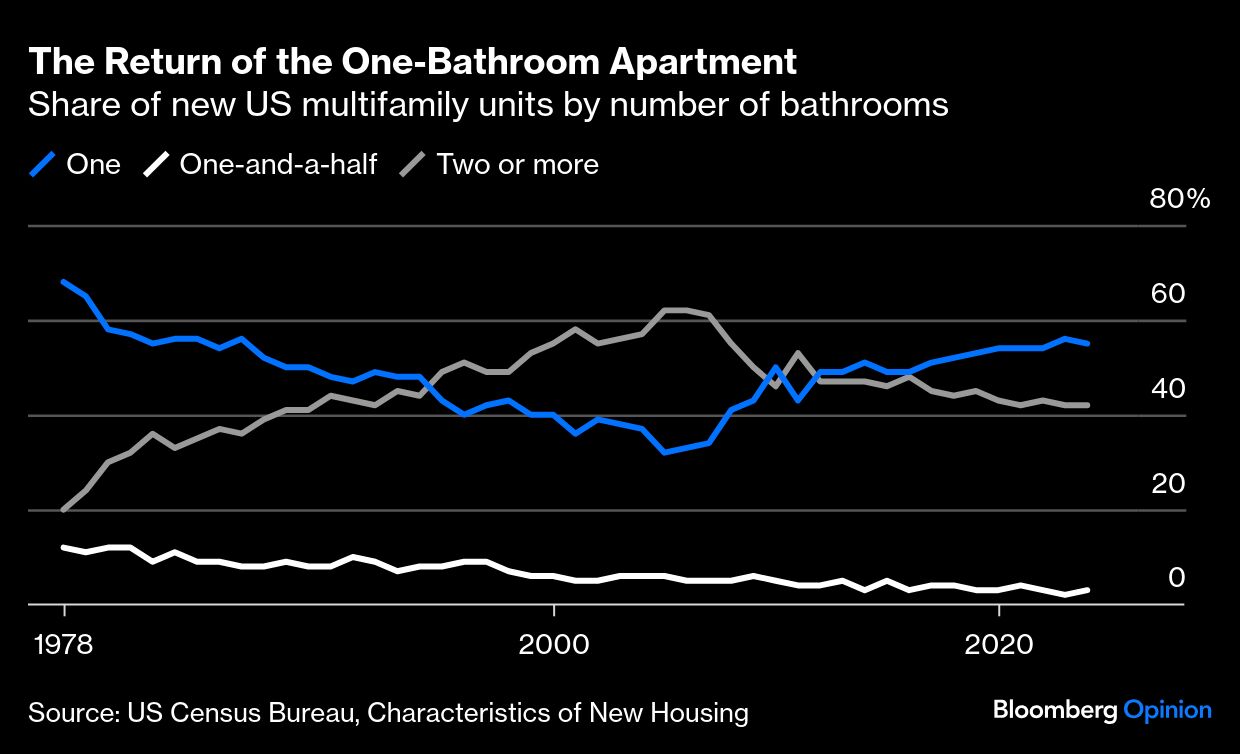
Bathrooms tell a mixed story. The share of one-bathroom apartments has been on the rise in recent decades, but there are still more apartments with two or more bathrooms than in the 1970s.
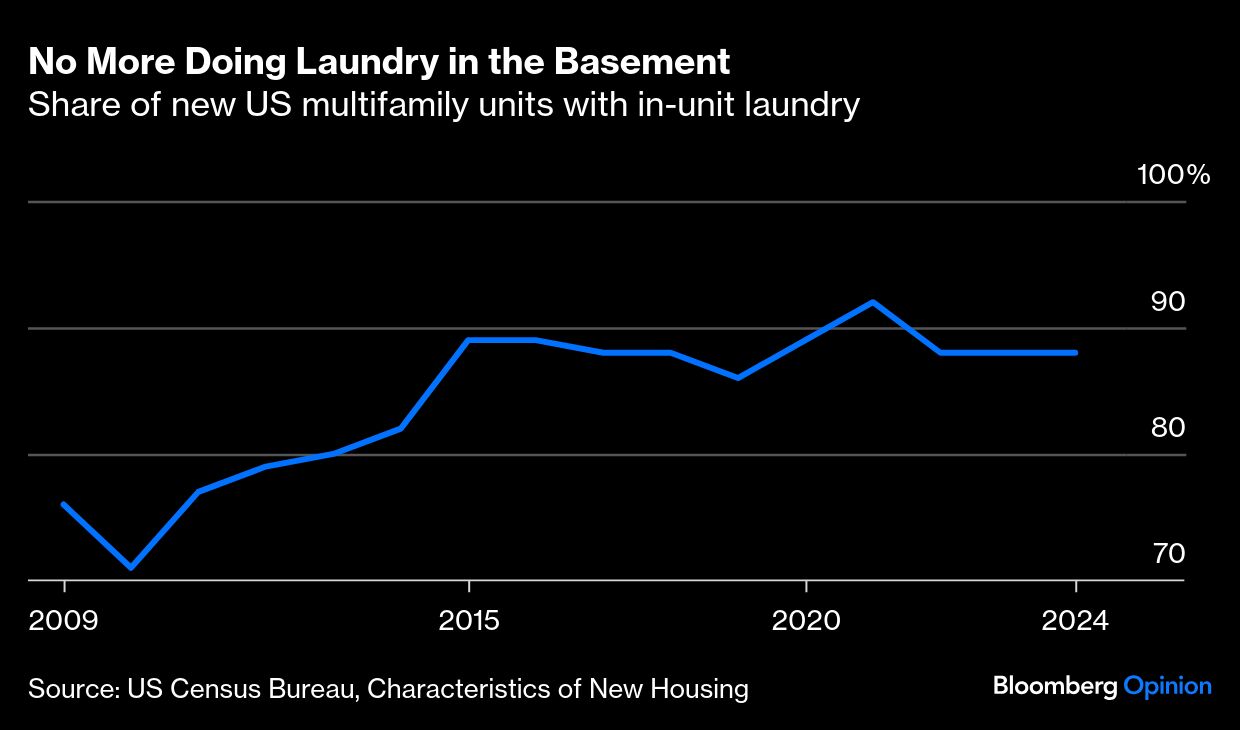
My interpretation is that while the apartments being constructed today have fewer bedrooms than those of past apartment-building booms, they’re not necessarily lower-rent (in both the metaphorical and literal senses). In-unit washers and dryers, for example, are more prevalent than they used to be.
The share of US households that consist of just one person hit a record of 29.1% in 2024, according to the Census Bureau, and the share of households of two people or fewer was, at 63.7%, just below the record of 64% set the year before. Apartment developers may just be giving Americans what they want and need. But housing availability may also be shaping household formation.
In a study published last year by the conservative Institute for Family Studies, demographer Lyman Stone found that women living in one- or two-bedroom housing units were much less likely to have children than those with three bedrooms or more. Again, one can question the direction of causality, but the paucity of new three-bedroom apartments certainly isn’t encouraging people to form families and have kids. Stone also found a strong negative link between neighborhood density and fertility: Residents of multifamily housing weren’t much less likely to have kids than inhabitants of single-family houses, but those living in dense neighborhoods surrounded by other apartment buildings were.
For years there have been calls for more small-scale multifamily development — the “missing middle” — to provide an alternative more affordable than single-family houses but more family friendly than big, boxy buildings on commercial streets packed with one-bedroom apartments. Most of the focus has been on zoning regulations, in particular relaxing the single-family-only zoning that has become the norm in the US but is rare elsewhere. In just the past couple of years, a few activists with knowledge of building codes outside North America have also taken aim at the two-staircase rule, arguing that single-staircase apartment buildings can be made fire-safe while also allowing for a much wider variety of building sizes and shapes and apartment configurations than is currently the case in the US. Let’s hope these efforts meet with enough success that the next US apartment boom doesn’t look just like this last one.
A message from Advisor Perspectives and VettaFi: To learn more about this and other topics, check out some of our webcasts.
Bloomberg News provided this article. For more articles like this please visit
bloomberg.com.