US stocks climbed Thursday, ending the day on the cusp of a record as optimism around potential rate cuts stoked risk-on sentiment across financial markets.
The S&P 500 Index jumped 0.8% in New York to close at 6141.02, just short of its Feb. 19 all-time high at 6,144.15. The technology-heavy Nasdaq 100 Index bounced 0.9%, building on its own milestone. The Cboe Volatility Index, or VIX, remained below 17 even as President Donald Trump’s self-imposed tariff deadline looms alongside uncertainty around whether peace can hold in the Middle East and souring economic data.
While initial weekly jobless claims fell in the week ended June 14, recurring applications for US unemployment benefits rose to the highest since November 2021, signaling more people are staying out of work for longer. Separately, a third estimate of quarterly gross domestic product was revised lower than expected as consumers slashed services spending.

Federal Reserve Bank of Boston President Susan Collins expects at least one interest-rate cut this year, but thinks July would be too early for such a move. Richmond Fed President Tom Barkin is among central bank officials that advocated a wait-and-see approach on interest rate cuts.
The White House dismissed a Wall Street Journal report from earlier in the day that Trump may announce Fed Chair Jerome Powell’s replacement soon.
The US president is pivoting his attention to passing the cornerstone of his legislative agenda, pressuring Congress to quickly approve a massive tax bill that Republicans believe will seal their political fortunes in the midterm elections.
On Wednesday in a mid-year outlook report, JPMorgan strategists predicted that the spending bill is poised to support investment and high-end consumption, helping drive stocks higher into the second half of the year.
Investors are piling into speculative and volatile edges of the stock market, throwing caution to the wind as the S&P 500 closes in on a new all-time high. A Goldman Sachs gauge of stocks with weak balance sheets is on track for the best month relative to the S&P 500 since September.
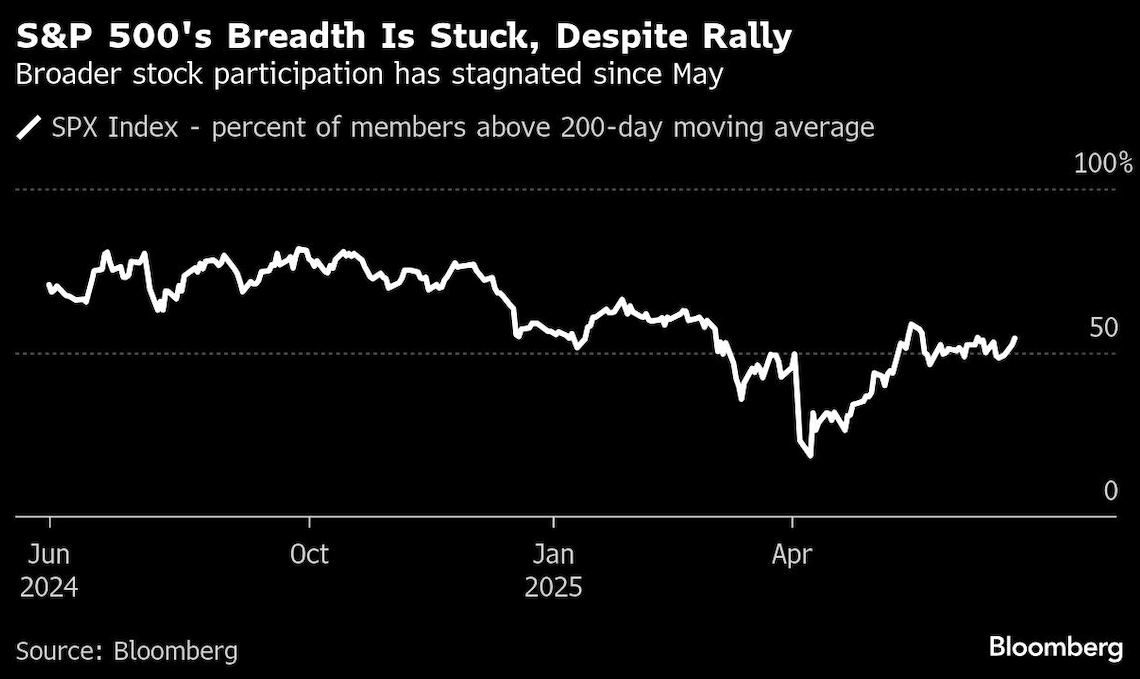
With technology stocks powering major US indexes toward record highs, technical analysts see the makings of a selloff in the coming months unless more sectors join the rally.
A key measure of market breadth — the percentage of the S&P 500 members trading above their 200-day moving average — hasn’t budged since May. The equal-weighted version of the S&P 500, which is often seen as a better reflection of market participation, is more than 4% below its own record touched in November.
Meanwhile, retail investors are piling into equities after a muted stretch. The group purchased a net $3.2 billion of stocks in the five-day period through Wednesday’s close, according to data compiled by JPMorgan quantitative and derivative strategist Emma Wu. That marks a sharp reversal from the lull over the prior week, she said in a report.
Stock market volatility is likely to remain higher in the second half of the year given lingering macro and policy uncertainty, according to Goldman Sachs strategists. The team led by Andrea Ferrario says stagflationary shocks remain a key risk for balanced portfolios amid tariff-induced inflation risks.
Among financials, JPMorgan Chase & Co. and Goldman Sachs Group Inc. climbed to record highs after the Fed unveiled a plan Wednesday to decrease a key leverage ratio that requires banks to hold a certain amount of capital relative to their assets.
Within tech, Microsoft Corp. climbed after Morgan Stanley raised its price target citing upside from the company’s Azure cloud service. And Apple Inc. shares slipped after a price target cut at JPMorgan on the iPhone 17’s incremental lineup launch.
A message from Advisor Perspectives and VettaFi: To learn more about this and other topics, check out some of our webcasts.
Bloomberg News provided this article. For more articles like this please visit
bloomberg.com.
Read more articles by Alexandra Semenova