Roaring returns for US IPOs are driving fresh optimism that activity will pick up steam later this year and into 2026, even as worries over geopolitics and President Donald Trump’s tariffs hang over the market.
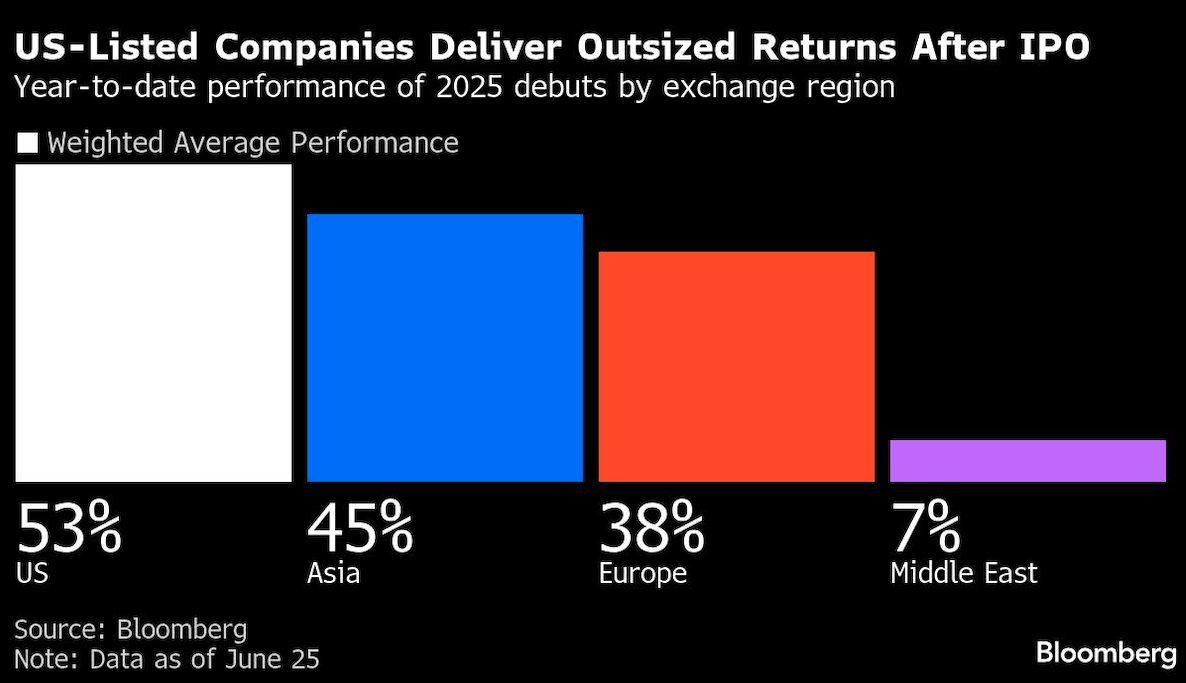
Led by triple-digit-percent increases for Circle Internet Group Inc. and CoreWeave Inc. — two of the year’s five largest initial public offerings on US exchanges — this year’s class of debutantes are trading up by a weighted average of about 53%, data compiled by Bloomberg show. That’s left investors hungry for more, particularly in a year where the S&P 500 Index has struggled to remain in the black.
“We’ve been positively surprised by the way the market has handled the tariff headlines, and how investors have thought about that potential risk factor,” according to Keith Canton, JPMorgan Chase & Co.’s co-head of Americas equity capital markets.

That resilience could draw out some of the companies that had been planning to go before Trump’s tariffs briefly derailed activity. The US IPO calendar into summer is sparse, but the second half of 2025 has more promise.
A handful of $1 billion-plus IPOs are likely before the end of the year, most of which will come after Labor Day, said Canton.
Volume Mirage
At nearly the half-way mark of the year, IPOs on US exchanges have raised $29.1 billion, surging 45% versus the same period last year, according to data compiled by Bloomberg.
That’s not nearly as good as it sounds.
Proceeds from IPOs are actually down from last year, when you excise the $12.1 billion of blank-check vehicle listings — an increase of more than 400% from last year. While special purpose acquisition companies have raised a lot of money in listings, some of the underwriters’ fees are deferred until the blank-check merges with a private firm and takes it public. That activity remains depressed compared to the heady levels of 2021.
Excluding SPACs and tiny listings by companies raising less than $50 million, only 33 IPOs have priced this year, down from 41 in the first half of 2024.
April, typically a strong month, saw only two sizable debuts, with the Trump administration’s so-called Liberation Day tariff announcement putting dozens of deals on hold.
With those tensions having retreated to the background, blockbuster debuts such as stablecoin issuer Circle’s are working to restore the reputation of IPOs for fast share-price appreciation, and wealth creation.
Thematically, financial technology and crypto-related companies may continue to figure heavily in the deal mix, and many investors await the return of software and biotech, sectors that historically saw plenty of activity.
Private tech companies that have been on many IPO wishlists still have no shortage of alternatives to going public. ChatGPT developer OpenAI raised $40 billion from a private funding round, the latest record-setting demonstration of the depth of capital available. Still, bankers say even that has its limits.
“At some point these companies want liquidity on a larger scale than private markets provide, even in an environment in which a $40 billion round is possible,” said Heath Terry, Citigroup Inc.’s global head of technology and communications research. “We will see that eventually.”
Understanding Over Valuations
The lack of near-term listings speaks to a perennial debate over whether investors and pre-IPO companies are reaching an understanding over valuations.
A combination of investors’ painful memories from overpaying for IPOs in the go-go days of 2021, and asset owners’ unwillingness to go public at valuations significantly below that era’s peak, has left many companies stuck in the pipeline for the past three and a half years.
The logjam may be easing. IPOs — which can include the company raising new money, backers selling existing shares, or both — have recently featured more shares offered by existing investors, known as secondary shares. These help to limit the dilution that would result from the company selling new shares at a lower valuation than the nosebleed levels achieved in previous funding rounds.
“Since mid-May, we have seen greater secondary participation in IPOs, despite wider IPO discounts versus what we have seen historically,” said Jim Cooney, head of Americas ECM at Bank of America Corp.
All that aside, concerns around geopolitical tensions haven’t gone away, and the Federal Reserve is keeping interest rates higher than many investors — and the White House — would like. Bankers are required to balance their optimism with pragmatism, according to Clay Hale, Wells Fargo & Co.’s co-head of ECM.
“The optimistic side tells you markets are trading well today, there are a lot of high-quality companies that have a desire to be in the public markets, and investors are making a decent return from IPOs,” said Hale.
“The pragmatic part is that there are a lot of things going on that can grab investors’ attention, whether it be taxes, tariffs or geopolitics, which create a need to be more thoughtful.”
A message from Advisor Perspectives and VettaFi: To learn more about this and other topics, check out some of our webcasts.
Bloomberg News provided this article. For more articles like this please visit
bloomberg.com.
Read more articles by Anthony Hughes