It may seem as if Treasuries are the better bet these days with the US stock market back near record highs and government securities offering respectable yields again. But stocks are still likely to pay more.
The urge to ditch stocks is understandable. There’s a lot of uncertainty out there, much of which could have a direct impact on public companies, particularly around tariffs, taxes, immigration policy and deepening conflicts in energy-producing regions, most urgently Iran. It doesn’t feel like the uncertainty is fully reflected in the elevated valuations of big US companies that drive the market. Meanwhile, after many years of near-zero interest rates, Treasuries are finally paying an attractive yield.
Treasury yields have risen so much in recent years that some investors may now find them preferable to stocks. One common comparison looks at Treasury yields relative to dividend yields. By that measure, Treasuries clearly win. Yields on Treasuries, which range from 4% to 5%, are more than three times the dividend yield for the S&P 500 Index.
It’s a crude comparison, though, because the dividend yield is only one component of stocks’ total return. Another common but more fulsome comparison stacks up Treasury yields against stocks’ earnings yields using companies’ expected profits for the coming year. This measure accounts for businesses’ full earnings power, not just the portion of profits they distribute to shareholders as dividends. Even there, Treasuries compare favorably, offering yields similar to the S&P 500’s one-year forward earnings yield of 4.3%, and with less risk.
But that comparison overlooks some important details, too. For one, Treasury yields don’t account for inflation because they are based on fixed interest payments, whereas inflation is already baked into earnings yields because rising profits are driven in part by higher prices. For like comparison, inflation must be subtracted from Treasury yields or added to earnings yields. Also, the periods for which inflation and yields are compared should line up. When those tweaks are made, stocks have a clear edge.
One way to see that is by comparing the real yield on two-year Treasuries with the two-year forward earnings yield for the S&P 500. The market forecast for annual inflation over the next two years is 2.5%, based on so-called breakeven inflation, a rate derived from the difference in yield between nominal and inflation-adjusted Treasuries. Subtracting that inflation forecast from the 3.9% yield on two-year Treasuries nets a yield of 1.4% after inflation.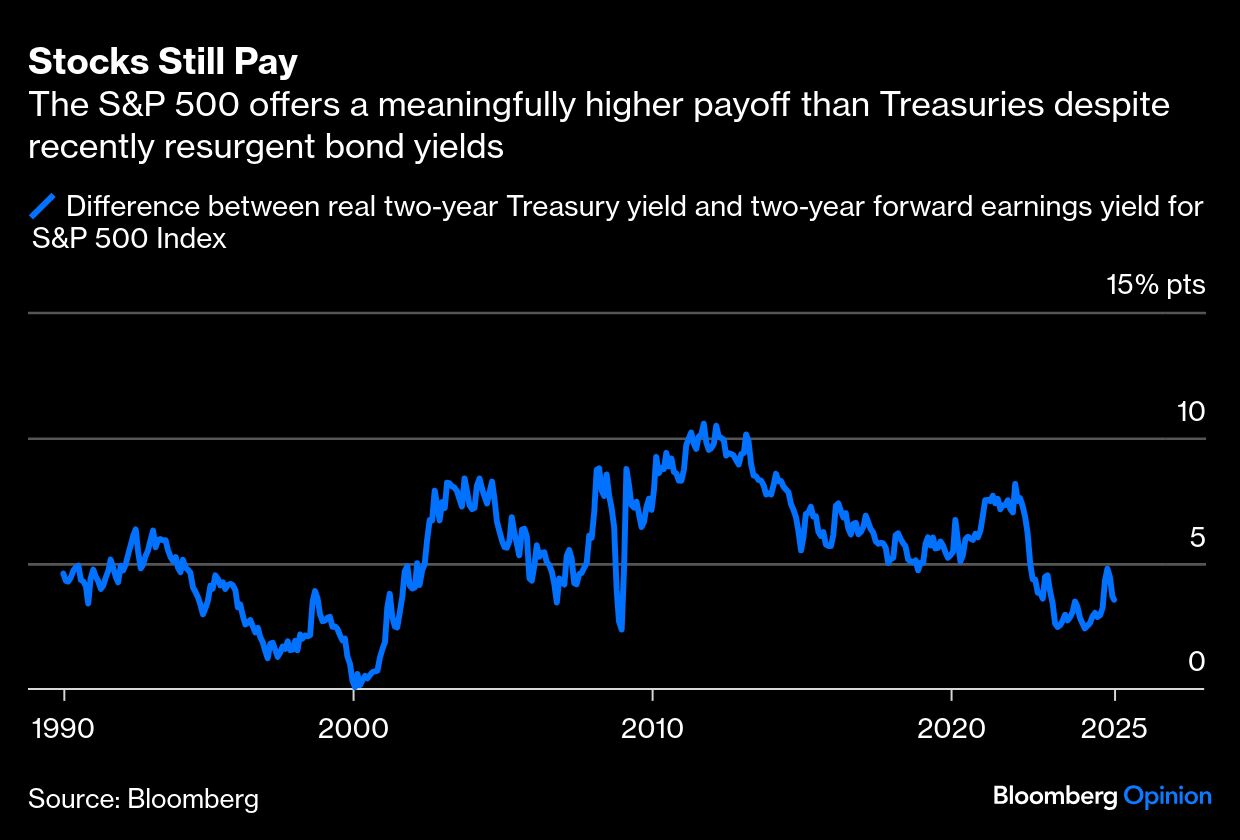
The S&P 500, by comparison, offers an earnings yield of 4.9%, based on Wall Street analysts’ consensus earnings over the next two years. The resulting expected premium over Treasuries of 3.5 percentage points — in finance speak, an equity risk premium — is lower than the historical average expected premium of 5.5 percentage points since 1990, but higher than investors might assume looking only at headline yields.













