“We have to return to a reasonable pre-pandemic level of spending,” says Republican US Senator Ron Johnson of Wisconsin, who doesn’t like the budget bill that passed in the House because it doesn’t reduce the $1.8 trillion federal deficit.
Given that the bill’s failure to reduce the deficit is due in part to its extension and expansion of the special tax treatment for non-corporate businesses that Johnson insisted on in 2017, which will cost an estimated $820 billion over the next decade, the senator does not make for the most credible of deficit hawks. But his suggestion of a return to pre-pandemic spending is intriguing.
Shrinking the federal government to its February 2020 size, adjusted for inflation, isn’t exactly rolling back the New Deal or the Great Society. It sounds reasonable. But what would it look like — or, put differently, what exactly has driven the big increases in real federal spending since February 2020?
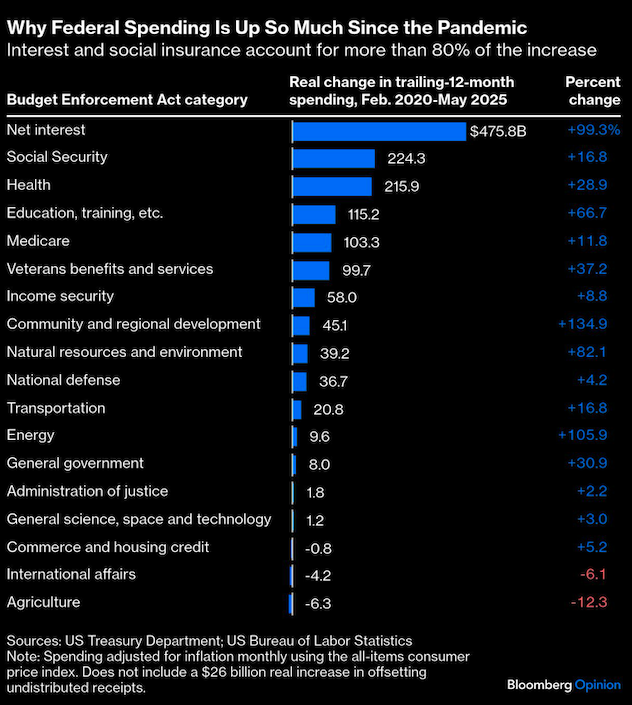
These numbers are as of the recently released Monthly Treasury Statement for May, with inflation adjustments by me. Trailing 12-month federal spending is up by $1.4 trillion in today’s dollars, or 25%, since just before the pandemic in February 2020. Get it back to February 2020 levels and the deficit mostly disappears. That is, of course, much easier said than done.
One-third of the spending increase is interest payments, which have doubled in real terms because pandemic spending programs drove up the federal debt, and interest rates are higher. That can’t just be wished away. Another 23% comes from the country’s two giant social insurance programs for the elderly, Social Security and Medicare, where real spending has risen roughly in line with enrollment as more members of the gigantic baby boom generation, currently 60 to 79, have entered the years of eligibility. That’s also not easily changed, and Republicans in the House and Senate are not proposing to do anything to change it, although the growth rate is at least expected to slow in a few years when Generation X starts hitting retirement age.
An additional 15% of the increase comes from the budget category labeled “health,” which is mainly Medicaid, the federal-state health insurance program for the poor, for which federal grants to the states have risen 25% in real terms since just before the pandemic, right in line with the overall federal spending increase. The category also encompasses an assortment of programs for those somewhat above the poverty line, such as refundable premium tax credits and cost sharing for health insurance — up 110% — and the Children’s Health Insurance Program, for which funding declined slightly after adjusting for inflation. Congressional Republicans are working to reduce Medicaid spending, with the bill passed by the House achieving this mainly by kicking people off the program and the tentative Senate bill including even deeper cuts.
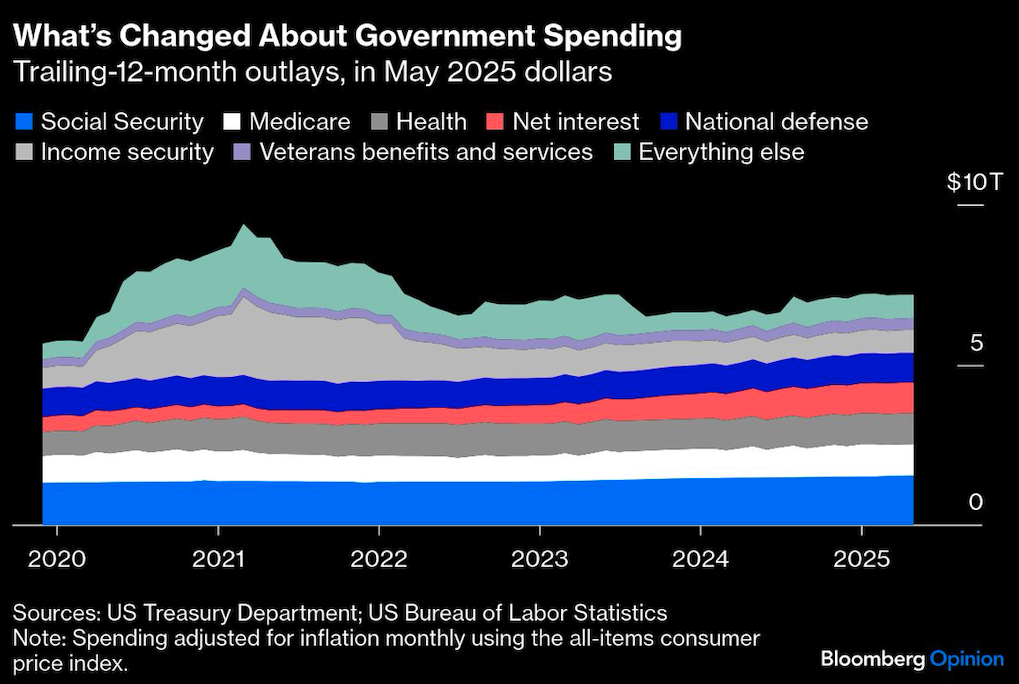
Interest, Social Security, Medicare and health together account for 71% of the spending increases. Add in veterans benefits and services, which are also mostly health care and are not slated for sharp cuts in current budget legislation, and that gets us up to 77%. What’s left? Here’s another way of looking at it, with real federal spending since 2019 broken down into the seven biggest budget categories and everything else.
There was a huge increase early in the pandemic in spending on income security — economic impact payments, unemployment insurance, the Supplemental Nutrition Assistance Program (aka food stamps), Temporary Assistance for Needy Families, etc. — that has since mostly subsided, with the increase since February 2020 now just under 9%. There was also a huge increase in the grab bag “everything else” category that has subsided less, with real spending still 39% higher than before the pandemic.
Summing up what has driven that “everything else” increase is tough, but here are some standouts:
Federal student aid: up $71 billion in May 2025 dollars, or 81%
Disaster relief: up $30 billion, or 174% (this falls under “Community and regional development” in the first chart)
Environmental Protection Agency state and tribal assistance grants: up $25 billion, or 505%
The EPA grant increase was the doing of the Greenhouse Gas Reduction Fund created by the Inflation Reduction Act of 2022. The Trump administration tried to terminate the grants in March; the courts are still deliberating over whether it can. The administration is also trying to dismantle the Federal Emergency Management Agency, which administers disaster relief, and the Department of Education, which administers student loans. One can be dubious of the wisdom of such actions and still acknowledge that these programs experienced some whopping spending increases over the past five years.
Again, though, the chief drivers of the overall increase in federal spending since February 2020 are elsewhere, and there seems to be no appetite in Washington for addressing any of them but Medicaid. US government spending remains relatively low, as a share of GDP, by affluent-country standards. If it were to follow the example of every other advanced economy on earth and adopt a national value-added tax, the US could quickly shrink the deficit. But that’s not going to happen this year, and Ron Johnson won’t see his wish for a return to pre-pandemic spending levels fulfilled either.
Gain clarity on H1 & strategize for the remainder of the year. Register now for the Midyear Market Outlook Symposium on June 26 at 11 am ET.
Bloomberg News provided this article. For more articles like this please visit
bloomberg.com.