Nvidia Corp. billionaire boss Jensen Huang, clad in his signature leather jacket, has been crisscrossing European capitals and sharing the stage with the likes of Keir Starmer and Emmanuel Macron as he pitches “sovereign” artificial intelligence, a vision of new data centers offering essential compute power within national borders rather than via dominant tech firms from abroad. But if there were prizes for irony, it’s a concept that might win a few.

Huang’s pitch has understandably struck a chord with leaders desperate for new sources of productivity gains and for ways to avoid falling terminally behind in a tech race dominated by the US and China. Recent announcements include a partnership with French AI startup Mistral to build a cloud platform powered by 18,000 Nvidia Blackwell chips and a Germany-based industrial cloud for European manufacturing built with 10,000 Blackwell chips. It’s not just Europe — Nvidia has cut big sovereign AI deals in the Middle East — but the Old Continent is where Huang sees computing capacity increase by a factor of 10 over the next two years. “It’s coming,” he said.
This doesn’t much look like sovereignty, though. From Nvidia’s point of view, the company is certainly positioning itself as a geopolitical actor, engaging directly with heads of state like Macron as the ultimate tech enabler to boost AI adoption. That’s good for Nvidia amid a wider Sino-American trade war that’s seen it lose $15 billion in Chinese sales due to export controls and as Europeans become warier of US tech providers like Alphabet Inc. and Microsoft Corp. Bloomberg Intelligence last month estimated sovereign AI investments could add $10 to $15 billion in annual revenue for Nvidia in a de-globalizing world.
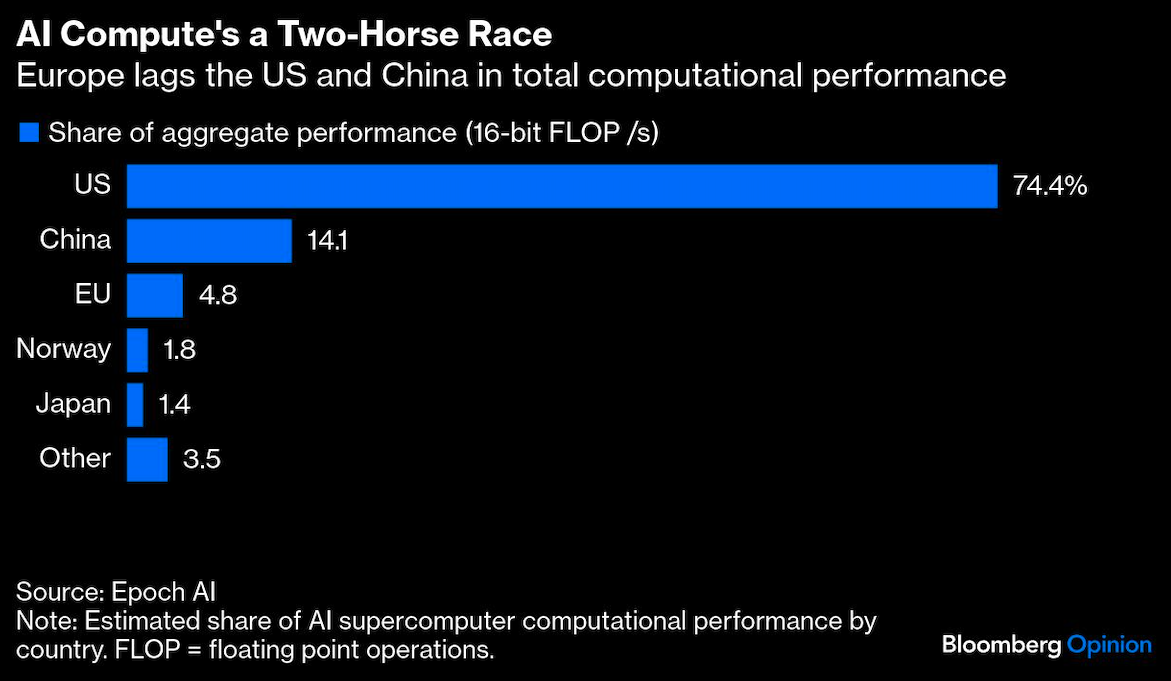
But from Europe’s point of view, we’re still a long way from the tech autonomy leaders like Macron want to offer anxious voters. The hardware and infrastructure powering these big AI projects are ultimately Nvidia’s, a US company with 80% market share whose dominance will be entrenched through chips that are updated or replaced every few years. To the extent that there is a European supply chain, it exists elsewhere, in the brainy engineers and open-source models offered by the likes of Mistral. But it remains to be seen if that will be enough to secure Europe’s AI future when US rivals are so dominant. Mistral’s €1 billion ($1.2 billion) in capital raised so far is a fraction compared with OpenAI’s; and as ambitious as its plans are, Europe today has just 4.8% of estimated global AI compute power, according to Epoch AI.
We’ve seen this movie before. France and Germany once pinned their hopes on a sovereign cloud to protect user data from the extraterritorial reach of the US and China. Today, US tech companies still account for around 70% of cloud services in Europe. And for every attempt to reduce dependence, such as the Danish municipalities quitting Microsoft, there’s an opposite move like the German military’s cloud deal with Google. In search, European tools promoted as alternatives to Google have relied instead on Microsoft’s Bing — so when Bing went down during last year’s global outage, so did they. Is it any wonder that Microsoft is now offering “sovereign cloud” services to Europe without a hint of irony?
Misnomers and fuzzy language aside, some will argue this won’t matter much if Huang’s vision of AI as an essential technology like electricity or the steam engine pays off. At last week’s Research and Applied AI Summit, a panel I moderated compared AI sovereignty to a national airline: The flags and operations are what count, not the origin of the aluminum tube and its engines.
But there have been tangible costs to not worrying enough about dependencies — like Russian natural gas or Chinese exports — and AI might be the same, according to University of Amsterdam researcher Leevi Saari. With tech still very much driven by globalized supply chains, outsourced labor and dominant vendors, what’s on offer today looks more like “sovereignty-as-a-service” — the wrapper of autonomy at high cost. After all, maybe it’s the existence of alternatives like Airbus SE that makes airlines so relaxed.
If AI sovereignty is a worthy goal, Europe will need to do more than come up with new wrappings for the same chips. It has advantages: talent, skills, companies like ASML Holding NV and an automotive-industrial base ripe for innovation. But what it lacks is an ecosystem with plentiful research spending, financing and end-user demand — the kind that helped US startups raise more than double the funding of their European counterparts last year, according to AVP. That won’t be changed in a day, but it should be part of any sovereign vision — as should investing in chip independence to secure “good enough” alternatives and diversify risk, according to Nathan Benaich of Air Street Capital. The alternative, he reckons, is digital colonialism. As China heads down its post-DeepSeek path and the US hugs its hemisphere closer, expect to see Huang’s leather jacket more frequently.
Gain clarity on H1 & strategize for the remainder of the year. Register now for the Midyear Market Outlook Symposium on June 26 at 11 am ET.
Bloomberg News provided this article. For more articles like this please visit
bloomberg.com.
Read more articles by Lionel Laurent