A potential regulatory shift in favor of the ETF industry is expected to shake up the business models of Wall Street brokers, with billions of dollars in revenue at stake.
Wirehouses and broker dealers risk losing between $15 billion and $30 billion a year in fees that they currently collect from the mutual funds they offer to customers, according to a report released Thursday by Cerulli Associates.
These losses are possible if the Securities and Exchange Commission allows mutual fund managers to add an exchange traded share class to the funds they operate. They have not been able to make this change previously because of a patent held by Vanguard Group, but that patent recently expired and the SEC has signaled that it is likely to approve some of the pending bids from competitors. Fund managers have been looking to embrace the hybrid structure en masse.
Financial firms that offer mutual funds to customers collect so-called shelf space fees from the asset managers who offer the funds in exchange for distribution and operational support. Exchange traded funds, though, don’t typically spin off these kinds of fees. If dual-class funds gain SEC approval, Cerulli anticipates the fees could dwindle for a wide range of industry players including the largest wirehouses, independent broker dealers and regional firms.
The analysis assumes that all of the existing mutual funds that are not already in tax-efficient retirement accounts or institutional share classes would convert into an ETF share class. While the researchers emphasize that would take “years to play out” and may not come to pass, they add that “it is worth noting that this development poses an outsized economic challenge” to broker dealers.
“I think it would be premature to estimate the volume of conversions, at this point, given where we are in the approval processes and where asset managers are in selecting which funds they’re going to actually attach an ETF share class to,” Chris Swansey, one of the authors at Cerulli, said in an interview. “We just want to say this is the overall revenue that is at risk, at stake for those intermediary platforms.”
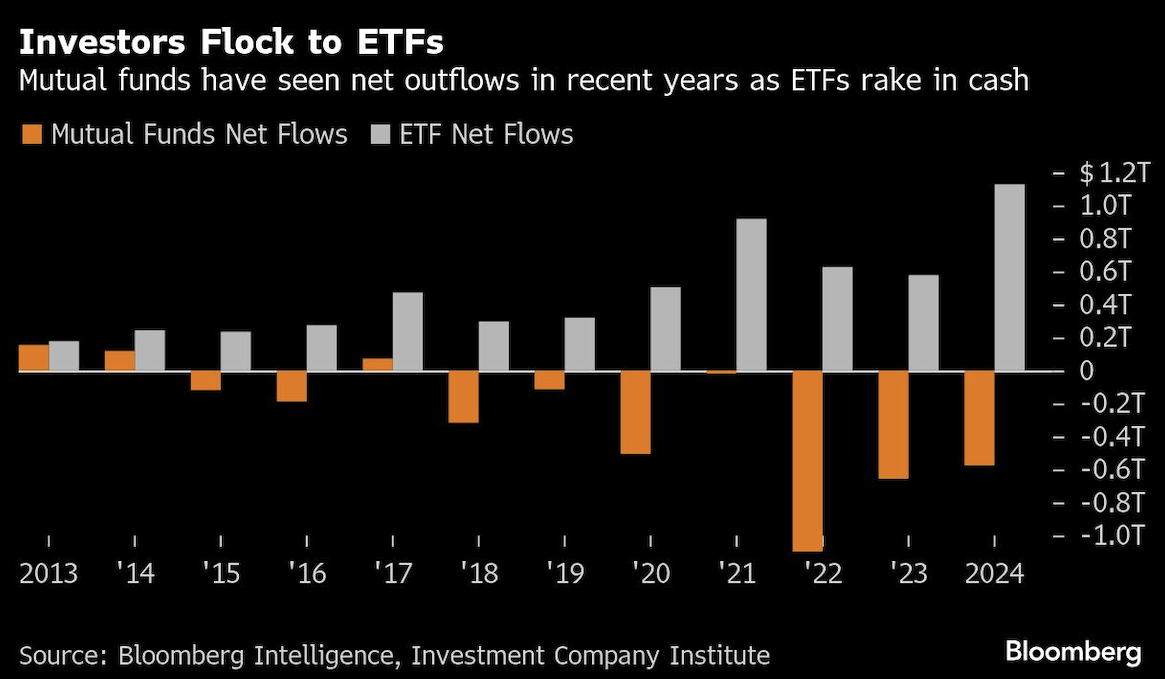
Trading platforms have already had to adapt their business models as investors continue to shift money out of mutual funds and into low cost, index-tracking exchange-traded funds. Fidelity has been pushing ETF issuers to give it a share of the revenues that the issuers take in from Fidelity customers.

The Cerulli researchers propose that one way for broker dealers to stem the potential blow from the changing fund landscape is to introduce similar revenue-sharing agreements with ETF issuers.
“There is significant revenue at stake here, but it’s also possible that the wealth managers find a way to turn a crisis into an opportunity and it may well result in greater revenue share requests across a wider variety of ETF products,” said Cerulli’s Daniil Shapiro, another author of the report.
Vanguard created and patented the dual share class design two decades ago, which ports the tax efficiency of the ETF onto the mutual fund. It helped Vanguard save its clients billions on taxes, and ever since the patent expired in 2023, asset managers have been vying for SEC permission to recreate the model. BlackRock, Fidelity and Dimensional Fund Advisors are among the many firms with pending applications.
A message from Advisor Perspectives and VettaFi: To learn more about this and other topics, check out some of our webcasts.
Bloomberg News provided this article. For more articles like this please visit
bloomberg.com.
Read more articles by Emily Graffeo