Fixed Income and Tariff Policy: Advising Clients in an Era of Uncertainty
Membership required
Membership is now required to use this feature. To learn more:
View Membership Benefits The views presented here do not necessarily represent those of Advisor Perspectives.
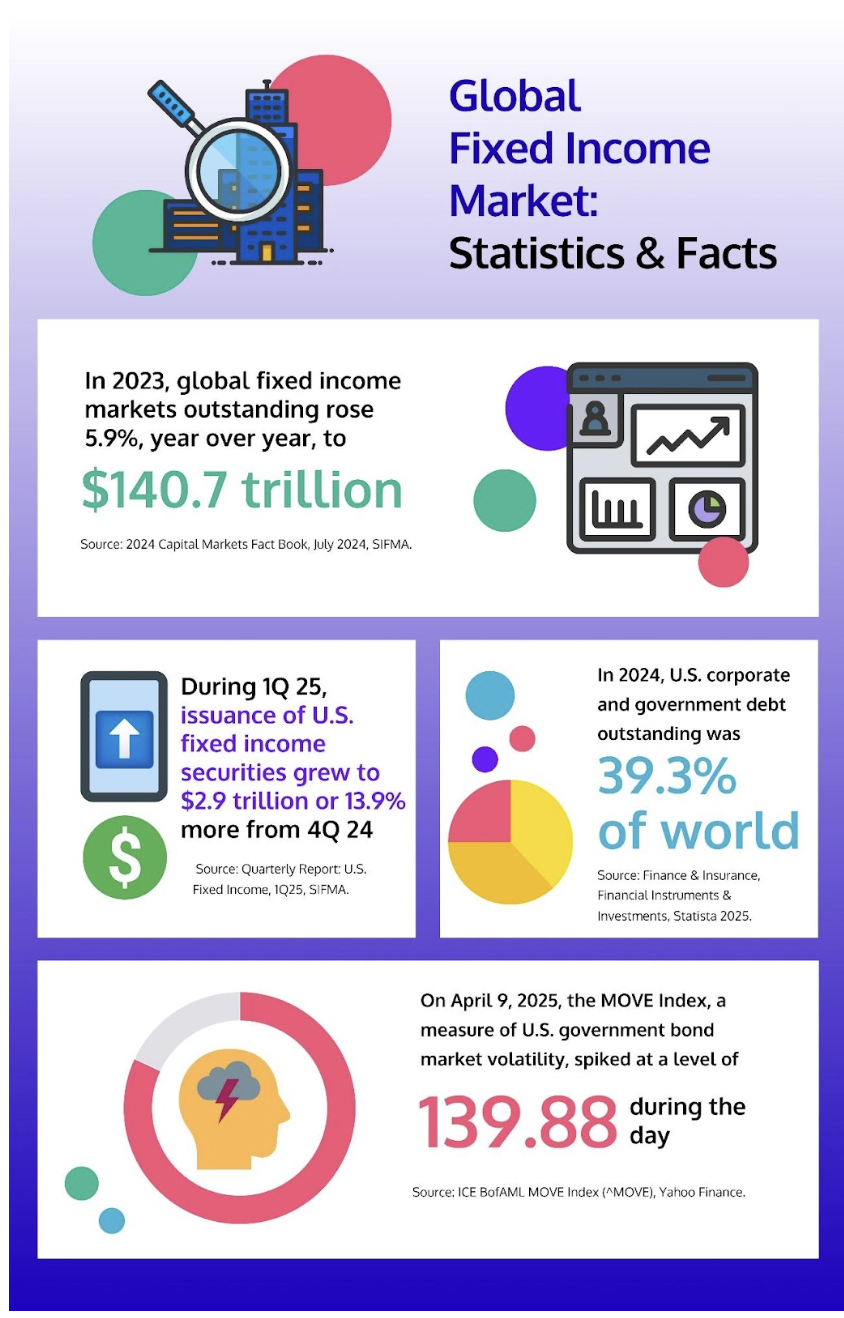
Unless you’ve been vacationing on a remote island, you are acutely aware of the dramatic equity index swings that followed President Trump’s April announcements about tariff policy revisions. The fixed income markets reacted in kind, as indicated by the large jumps in the ICE BofAML MOVE Index, also known as the Merrill Lynch Option Volatility Estimate. Similar to the CBOE Volatility Index, or VIX, MOVE measures volatility, but for Treasuries and not equities.
While tariff negotiations may well bear fruit eventually, investors today are trying to figure out the impact of changing trade pacts on GDP growth, interest rate levels, the value of the dollar, and the ability of the Treasury to refinance $9.2 trillion of our $36 trillion federal debt in 2025. Given its mammoth size — 39.3% of the global total — fluctuations in the U.S. debt market impact companies, individuals, and institutions.
Nervous Clients Need Advice
In the parlance of motivational speakers, when the going gets tough, the tough get going. Jittery clients want someone knowledgeable and calm to listen to them and then carefully explain the tradeoffs associated with selling, buying, or doing nothing with their bond or bond fund holdings.
According to Perry J. Green, CPA/PFS, CFP®, CFA®, CAP®, investor psychology is the hardest part of communicating with clients. As chief financial officer and senior wealth strategist with Waddell & Associates, he’s no stranger to market cycles, explaining:
Transparency is the cornerstone of any lasting client relationship. It’s important to reach out with updates instead of waiting to respond to questions. We’ve been contacting our clients to talk about their bond allocation relative to other asset classes. We chat about the likely impact of new trade deals on macroeconomic conditions. We affirm the amount of risk our high net worth and institutional clients are willing to take. We remove the politics from our discussions and instead center on the fundamentals such as the role of fixed income as a typical portfolio stabilizer.
Sean Walters, a certified association executive (CAE), has a different perspective as CEO of the Investments & Wealth Institute. His clients are financial advisors who seek advanced training and certifications such as the Certified Investment Management Analyst® (CIMA®), Certified Private Wealth Advisor® (CPWA®), and Retirement Management Advisor® (RMA®). Given his organization’s history of initially focusing on advisors to endowments, foundations, and ERISA retirement plans, Walters describes their training as logically emphasizing the governance perspective.
“Any discussion about fixed income investing depends on whether our members are managing other people’s money as 3(38) fiduciaries or acting as 3(21) fiduciary consultants. In either situation, our financial advisor candidates or certified professionals will no doubt take their clients’ demographics into question, along with their risk tolerance levels,” Walters said, noting that his firm sponsors topical educational webinars and conferences to help his clients communicate effectively with their clients during times of market turmoil. The organization’s May event will focus on high-grade fixed income trends, active investing, and taxes.
However, navigating choppy waters isn’t just about discussing investment theory and practice. Regulatory imperatives greatly influence what financial services firms with advisory clients can say publicly. Sean Cassidy, CEO of DKC, a global public relations, marketing, and government affairs firm, knows firsthand why financial advisors can’t go rogue with unfounded assurances.
“A volatile market requires message discipline, so as not to get out ahead of the changing landscape. Discussing facts and the pros and cons of issues are fair, but delving too deeply into hypotheticals or hyperbole will just cause problems. Time sensitivity matters,” he said.
DKC’s fast response team just published “A Business Leader’s Guide to Talking Tariffs,” in which they recommend the use of economic, foreign policy, and manufacturing experts to provide advisors with further credibility in their discussions with clients.
Steer Clear of Fixed Income Nerd Words
Bond investing and hedging with bond derivatives is, to some investors, a complicated jumble of risk measures that includes credit ratings, convertibility option features, duration, convexity, delta, gamma, and much more. The conventional portfolio modification wisdom is to proceed according to each client’s comfort level with the unknown. Advisors should calibrate their communication style to satisfy their clients’ specific information needs.
“We’ll spend our time discussing the composition of our model portfolios and potential adjustments as a function of market probabilities. For less experienced clients, we use plain language and infographics. We exclude jargon. We’ll talk in terms of how bonds might perform in the future, examining both bullish and bearish scenarios,” said Waddell’s Green.
“Regardless of the level of client sophistication, we always take their ultimate goals and constraints into account. We map back to the financial plans we’ve put together on their behalf. This helps to partially remove the fear of market jolts due to exogenous shocks,” he added.
Walters says the education provided by the Investments & Wealth Institute reflects its members’ ability and interest in garnering a deep knowledge about how financial instruments are priced and traded. He explained, “It’s fine to go deep and crunchy because our members are sharp. They have presented comprehensive analyses to investment committees and high net worth decision makers who ask complex questions. These types of clients expect serious answers.”
Understanding your audience is key, according to Walters. He recalled a recent speaker who had been well-received by another financial education membership group, but not so much with Walters’ organization. The speaker’s presentation was simply “too elementary.”
“Messaging needs to be simple and explanatory. It must take your specific audience into account. Public company shareholders will understand the complexities of tariffs and the resulting impact on the cost of debt because corporate executives talk about these issues during earnings calls,” said DKC’s Cassidy.
“An inexperienced investor will need hand holding. We recommend addressing economic uncertainty, regardless of audience, with transparency and humanity. Our reports provide data and insights that help guide the decision-making of our clients,” he added.
Tips for Financial Advisors
Perry tells his investment clients not to panic, reminding them that selling a position at a loss prevents them from realizing a gain if bond returns bounce back. He endorses radical openness with clients and a disciplined approach.
“Update their financial plan if needed,” Perry said. “Use that as a lodestar to guide rational thinking.”
Walters, a big fan of financial literacy at all ages, advocates peer-to-peer networking to help financial advisors improve their communication style and comfort level in dealing with nervous clients.
“Deploy technology tools to expand your investment IQ as appropriate. Break information you share with investors into manageable knowledge chunks. The only constant is change so we must prepare accordingly,” he said.
Cassidy, named one of the “Most Influential New Yorkers” by New York Magazine, tells senior executives, “Be in front of the issues. Don’t be on the back end of it. Don’t shift blame. Don’t hide from it. Be very, very transparent, not just now, but on an ongoing basis.”
After a productive career as a Wall Street trader, testifying investment expert witness, and university professor, Susan Mangiero, Ph.D., CFA®, MBA, MFA currently works as an independent financial journalist, ghostwriter, and content strategist. Her articles, books, and thought leadership work appear in more than 100 business outlets.
A message from Advisor Perspectives and VettaFi: To learn more about this and other topics, check out some of our webcasts.
Membership required
Membership is now required to use this feature. To learn more:
View Membership BenefitsSponsored Content
Upcoming Virtual Events View All












