Investors crushed the stocks of consumer discretionary companies on Thursday in response to President Donald Trump’s tariff announcement, making little distinction between home goods companies such as Williams-Sonoma Inc., apparel names including Nike Inc. or restaurants such as Cheesecake Factory Inc. The concern about consumers makes sense; tariffs will squeeze already stretched household budgets and put downward pressure on a labor market that was uneven at best.
Yet tariffs won’t affect every part of the consumption basket equally. Some categories, particularly automobiles, home furnishings and apparel, will bear the brunt of the levies, with prices on imported goods likely to soar (giving domestic producers an excuse to follow suit). Many consumer service categories, on the other hand, won’t see their costs go up much, if at all. This will be especially true for anything that’s local and labor or real estate intensive. Once the dust settles, consumers are likely to shift their spending from goods to services if tariffs remain in place at announced or similar levels.
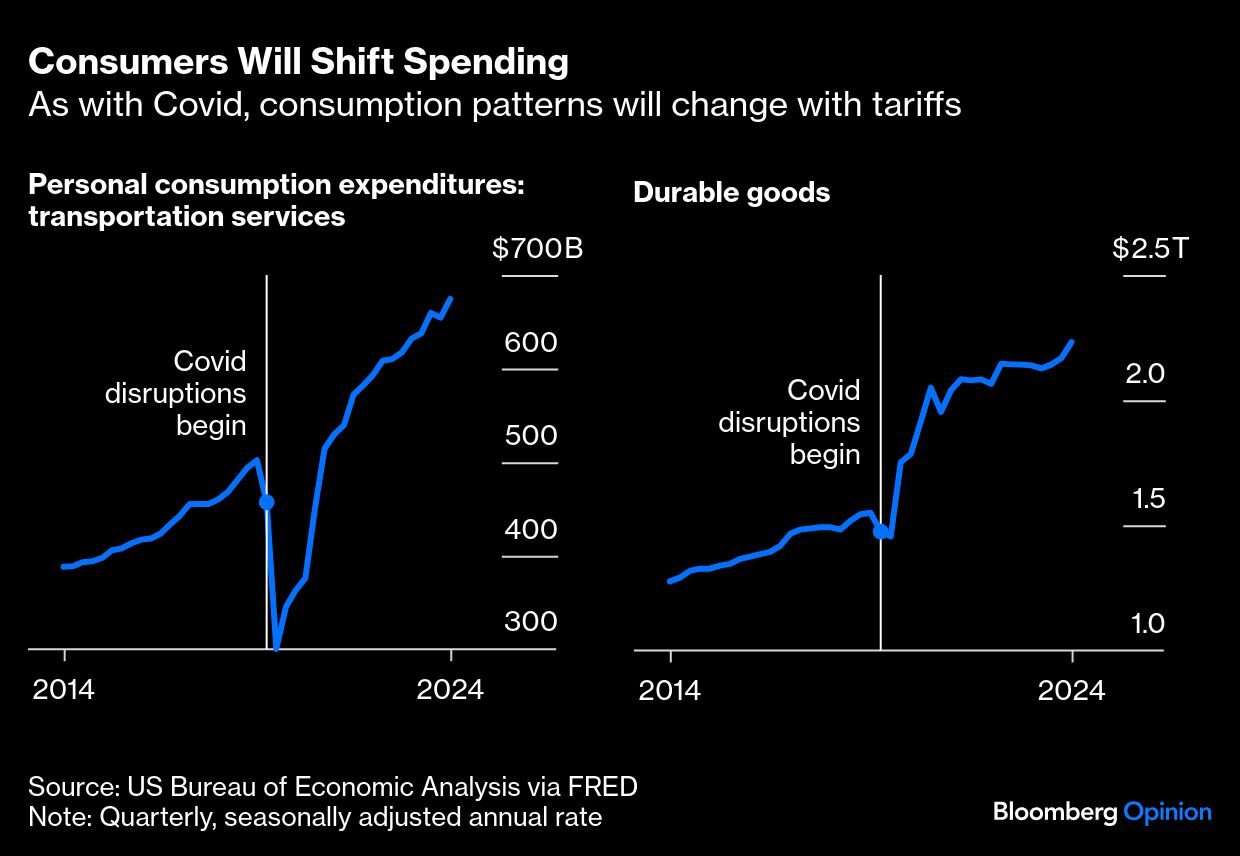
One way to think about this is as a reversal of what we saw in the middle of 2020 when consumers binged on goods but stayed away from dining out and travel during the early days of the Covid-19 pandemic. That shift was supercharged because spending on travel and going out fell sharply, leaving a bigger share for goods, and because fiscal support from the federal government gave households so much money. Between the end of 2019 and the third quarter of 2020, consumer spending on transportation services fell by 31% while it increased 13% for durable goods.
The shift was a curveball for investors and companies alike. Stocks of e-commerce companies surged as investors, already enamored with the secular trend of retail moving online, extrapolated the pandemic growth out well into the future. Companies built warehouses and hired as quickly as possible to meet demand, leaving them over-invested when spending eventually cooled after the pandemic boom. Supply chains were snarled in the process and economic bottlenecks emerged, resulting in inflation and disruption as the economy was forced to adjust to abnormal spending patterns.
How differently would a tariff-induced adjustment play out over the next couple of quarters?
Income growth is positive but modest, and there aren’t trillions of dollars of fiscal stimulus boosting spending. The overall consumption pie will grow slowly at best in nominal terms. Tariff-induced inflation likely means that growth will be negative in real terms.
But a move away from spending on imported goods that have surged in price should leave somewhat more money available for services than would be the case in a broad consumer slowdown. Take automobiles as an example. The average transaction price on new vehicles in 2024 was roughly $50,000. If prices rose $5,000 in response to tariffs and sales slumped to an annualized rate of 13 million, or about 2.5 million below the pace seen in 2023 and 2024, consumers would be spending $60 billion less on automobiles than in the pre-tariff days, with those savings available to be spent elsewhere. Similar dynamics could play out in home furnishings, where consumers currently spend roughly $500 billion on an annualized basis, and even smaller ticket items such as shoes or yoga pants might not seem as essential after big price increases.
This should make spending on services somewhat more resilient, particularly budget-friendly choices. Money from unbought tennis shoes can go to tickets for the latest versions of Jurassic World or Superman. Instead of buying a new sofa, Americans might choose to go to a baseball game or a bowling alley or an amusement park. Money spent on dining and experiences instead of goods might save the jobs of restaurant workers at the expense of auto workers.
When it comes to the impact of tariffs on consumers, there’s no reason to think the effect will be the same across categories. This isn’t like a gasoline price shock where demand is relatively inelastic and just means less money left over for everything else. Imported goods are going to go up in price while there will be no sticker shock for many services, making them look relatively more affordable to consumers who are already in a bargain-hunting mood. The White House believes that embracing tariffs will lead to a return of manufacturing jobs; ironically, the levies may end up sustaining the service industry at the expense of the goods sector.
A message from Advisor Perspectives and VettaFi: To learn more about this and other topics, check out some of our webcasts.
Bloomberg News provided this article. For more articles like this please visit
bloomberg.com.