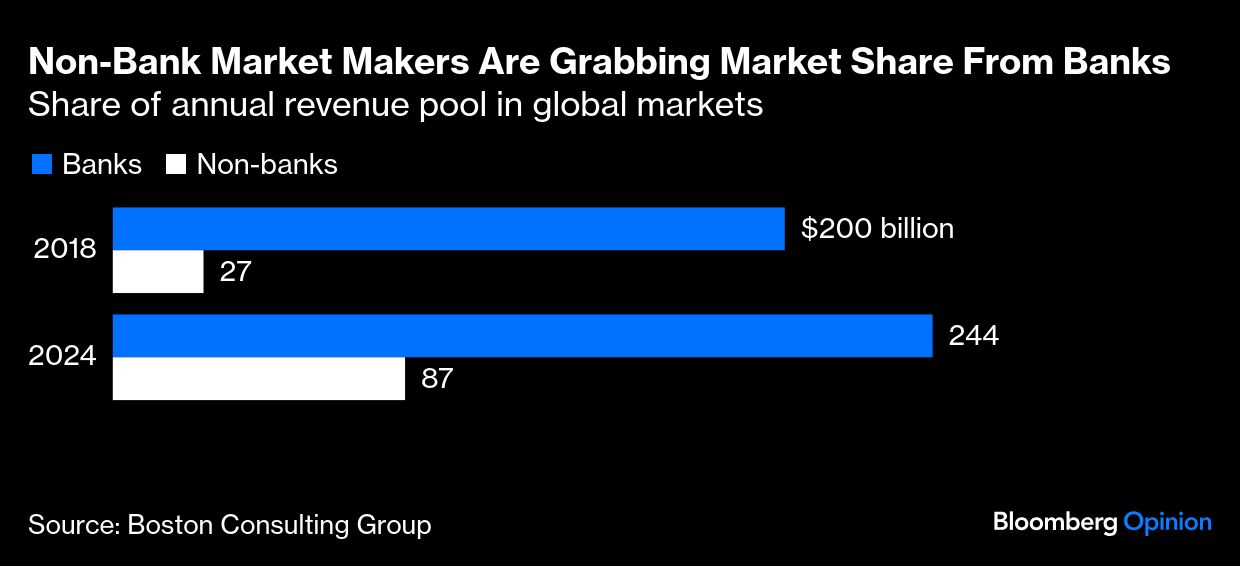
Electronic market makers like Citadel Securities LLC and Jane Street Group have been gobbling up market share from investment bank rivals, but to really get ahead they’ll need a helping hand. They might be about to get it from a surprising source: Some of those same banks.
HSBC Holdings Plc has had talks about outsourcing some of its bond trading operations to a non-bank market maker, Bloomberg News reported Monday. The bank wouldn’t confirm the talks or which areas might be affected. Such a deal would be a huge coup not only for the firm that won the contract, but also for the idea of outsourcing that’s catching the imagination of European bank bosses. However, there’s a long way to go to show it can work and a fair chance that the potential rewards won’t exceed the risks.
Trading of stocks, bonds and currencies is increasingly being done electronically and becoming a game of small margins where passing greater volumes through better technology is the surest route to profits. The banks with the biggest financial markets arms like Goldman Sachs Group Inc. and JPMorgan Chase & Co. invest billions in technology each year. Less profitable peers, especially in Europe, have struggled to keep up. It’s a gap that Ken Griffin’s Citadel Securities is hoping to fill after drawing up plans to offer trading services to banks last year.
HSBC isn’t alone: Many banks are talking about potentially renting trading capabilities from an outside firm, according to Christian Schmid, a senior partner at Boston Consulting Group. “Logically, you'd expect it to be smaller banks most, but it's some of the biggest banks that are showing more interest,” Schmid tells me.
Fixed income, or bond trading, is more suited to outsourcing because more of it is being done electronically in Europe than in the US and it is off-exchange, so banks need to run more and better technology of their own. European stock trading isn’t part of the discussions because it mostly happens on exchanges or within banks’ own platforms and there are bans on electronic market makers paying for order flow, which drives the business in the US.
Under new Chief Executive Officer Georges Elhedery, HSBC is looking to cut costs and get out of businesses where it has little competitive advantage or where the returns it makes are too thin. It is more focused on corporate clients than financial institutions, so it makes sense for Elhedery to think twice about making the investment required to maintain state-of-the-art trading operations.
But even if it cuts investment needs, HSBC might not actually be able to save much in ongoing costs. Banks mainly want to only get rid of the lowest margin trading desks, which typically deal in the most liquid, regularly traded bonds, and keep hold of market making where they can make more profits, for example all but the most liquid corporate debt. However, both activities use much of the same systems and administrative teams.
"Banks are thinking about outsourcing the lowest yielding business, like government bonds, but they aren't thinking enough about how much costs they'll actually be able to cut from their remaining trading systems,” Schmid tells me. “Doing it in a piecemeal way is tricky, banks will likely be left with stranded IT and other costs.”
Where banks have big fund managers as clients there’s another problem, too: Why would they keep trading through the bank when they can just go direct to the electronic market maker if that’s who’s placing the trades anyway? HSBC and others that are more focused on corporate clients might be less concerned about this, but then again they might not.

The non-bank market makers are still growing rapidly: Trading revenue at Citadel Securities overtook Barclays Plc of the UK and Deutsche Bank AG of Germany last year, Bloomberg News reported this month. But the biggest investment banks have fought back by offering more financing and higher margin, less standardized trading.
The kind of big outsourcing deals being explored by HSBC and others would be a step-change for high-tech upstarts in theory. Getting them signed in practice will be harder than it looks.
A message from Advisor Perspectives and VettaFi: To learn more about this and other topics, check out some of our webcasts.
Bloomberg News provided this article. For more articles like this please visit
bloomberg.com.
Read more articles by Paul J. Davies