Ever since the world was hit by a once-in-a-century pandemic, there’s been a lot of talk about “normalization.”
Federal Reserve Chair Jerome Powell talks about the normalization of aggregate supply conditions and the labor market.
Homebuilders talk about a return to normal interest rates and market conditions.
Hotel operators talk about the normalization of leisure and business travel.
And retailers of all types talk about the normalization of their product mixes (for example, Bath & Body Works Inc. has been selling much less hand sanitizer.)
Here’s the rub: we can’t roll back the clock to 2019’s economy, and nobody knows which “normal” we’re supposedly returning to (sanitizer sales notwithstanding.)
First, there’s the theory that we’re returning to a time before the late 1980s “peace dividend,” credited with ushering in increased global trade, cooperation and prosperity. In this version of the story, the defining features of the coming decade — much like the period from the US involvement in the Vietnam War to the fall of the Berlin Wall — will be a return to geopolitical conflict, recurring supply shocks and higher inflation.
Russia’s invasion of Ukraine brought the “end of the peace dividend” narrative into the mainstream, and it gained further attention with the outbreak of the Israel-Hamas war. Recently, hedge fund billionaires Ken Griffin and Bill Ackman have advanced their versions of the story, and it’s been cited as an explanation for the greater volatility in Treasury bonds.
A sustained period of conflict, of course, would be terrible for humanity, but it’s not clear how that would play for the US economy and markets.
Alarmists argue that it could significantly hamper the march of globalization — a major disinflationary force — but that’s a logical leap that hasn’t really materialized. For all Vladimir Putin’s belligerence, Russia doesn’t even crack the top 20 of US trading partners, and the wars in Ukraine and the Middle East have so far had only short-lived influences on energy markets.
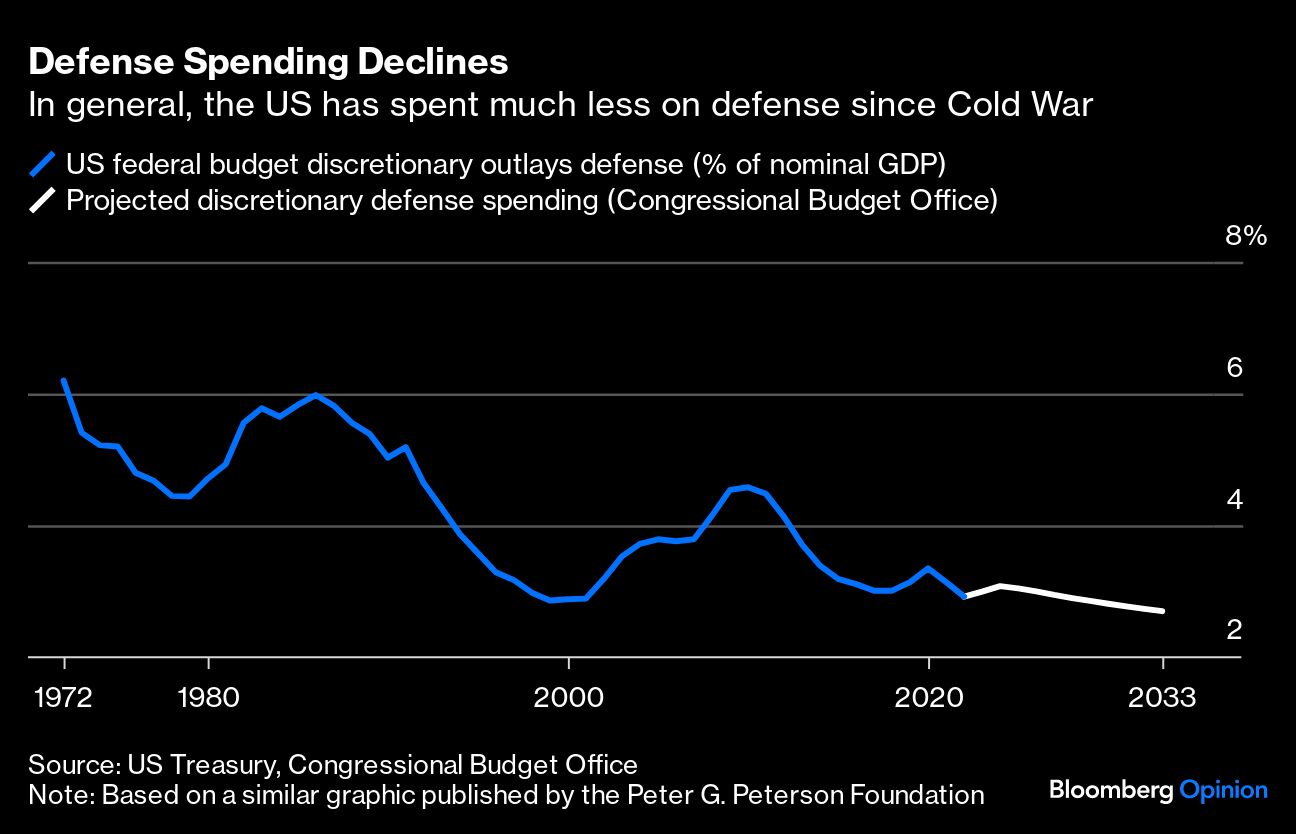
“Peace dividend” defeatists also suggest that the US may have to spend more on defense, exacerbating the deficit problem. That’s plausible, but the US already spends vastly more on defense than any other country and its defense spending as a percent of GDP has been relatively low and stable for the better part of three decades (except for an increase in the 2000s amid simultaneous wars in Iraq and Afghanistan.)
Aid sent to Ukraine hasn’t meaningfully changed that, and the Congressional Budget Office projects defense spending will continue to proportionally decline in the decade ahead. In other words, the economic implications of the recent conflicts may be exaggerated.
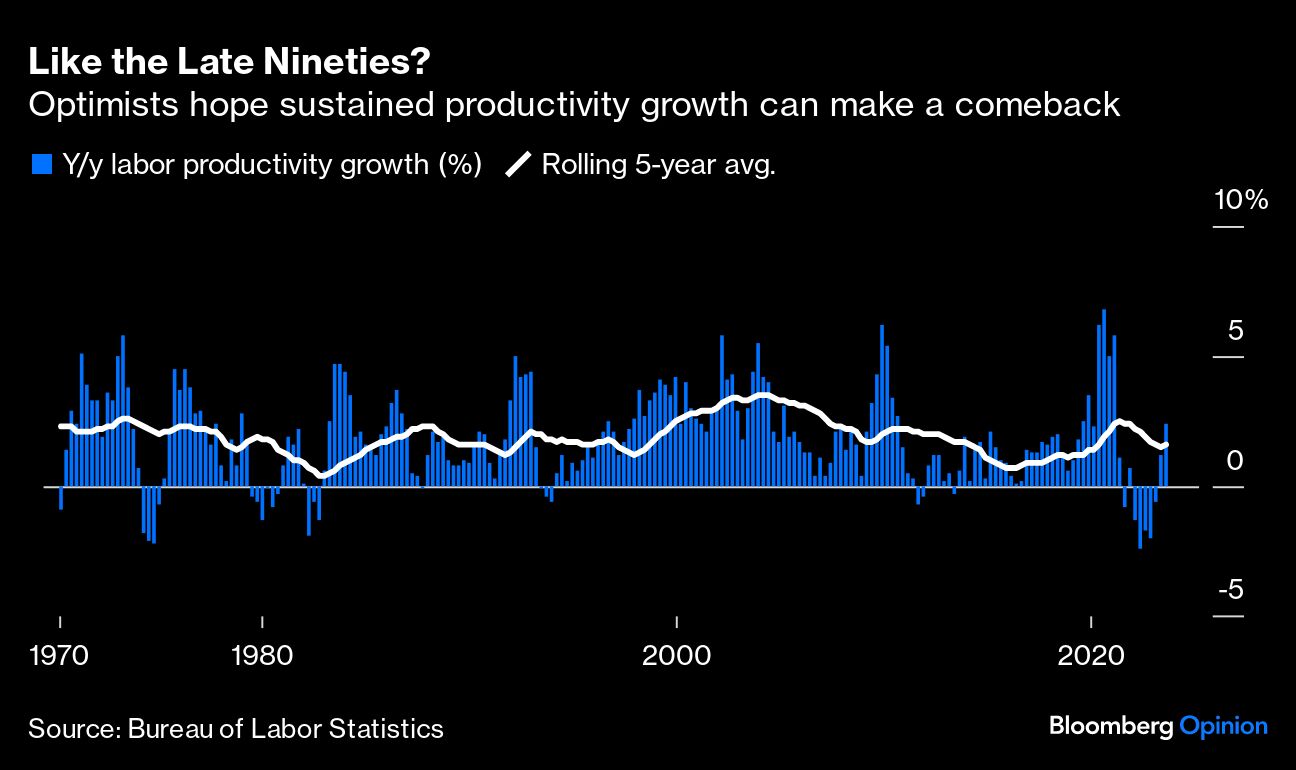
Another (more optimistic) take on the “new economic normal” is that it looks something like the late 1990s. That was a time of resurgent growth driven by increasing labor productivity. In the popular imagination, a 2020s productivity boom would look something like the one that accompanied the emergence of the internet, except with the proliferation of artificial intelligence instead of email and e-commerce.
That’s an appealing vision. If AI meets these lofty expectations, it’s easy to imagine how it could increase the output of paralegals, coders and any number of other knowledge workers, at least on a per-hour-worked basis (the jury is still out on how many of us will remain gainfully employed.)
Still, it could take years for those productivity gains to materialize and longer for them to seep into the macroeconomic data. For a bit of cold water, look no further than the first 20 years of the current millennium, when measured labor productivity growth was anemic despite the perception of remarkable technological advancement (e.g., the near-universal adoption of smartphones.)
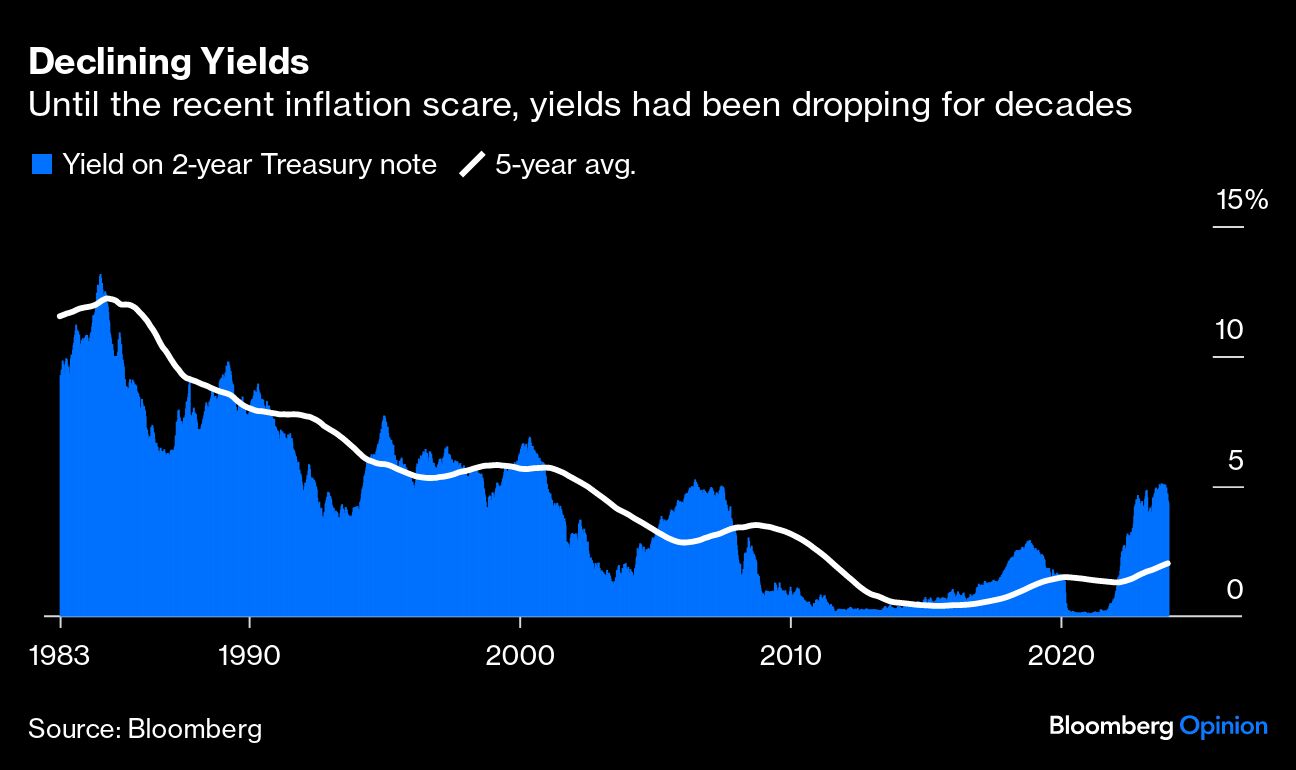
A third and final idea of the “normal” we’re now returning to is the world that we left behind in early 2020 when the pandemic began in earnest. For all of its problems, it was a time of low and stable inflation and subdued interest rates and everything that came along with those two features — including affordable mortgage payments and expanding stock valuations.
Some of that, of course, reflected that “peace dividend.” And low interest rates resulted from a stretch of good demographic luck (the Baby Boomer generation saving for retirements that are now under way) and demand from foreign governments and investors for “safe” Treasury securities in the wake of the financial crisis. Clearly, there are a lot of good reasons to question the durability of those trends.
So when corporate executives and policymakers talk about “normalization,” they should do a better job of defining normal. The US won’t revert to some carbon copy of the economy it left behind before the pandemic, nor is it about to reprise the 1980s or 1990s.
As for next year, my best guess is there’s room for measured optimism.
With inflation clearly receding, the Fed is likely to start cutting policy rates, helping improve long-slumping consumer confidence and defrost the housing economy. Workers hired in the frantic post-pandemic scramble for talent should continue to mature into their roles, resulting in further labor productivity gains (even without AI.) The median economist in a Bloomberg survey expects all that to add up to 1.2% annual growth in real GDP next year, but I wouldn’t be surprised if that underestimates the upside.
Meanwhile, global conflicts and the gaping budget deficit will probably fester without any alarming economic and market consequences.
In the long run, there’s considerably greater uncertainty, and we should all stop pretending that “we’ve seen this movie before.” The economy may well be fine, but it’s unlikely to return to anyone’s preconceived notion of “normal.”
A message from Advisor Perspectives and VettaFi: To learn more on this and other topics, check out our full schedule of upcoming CE-approved virtual events.
Bloomberg News provided this article. For more articles like this please visit
bloomberg.com.