Around the world, major cities are struggling with a severe crisis: Housing has become so expensive that it’s repelling skilled workers, undermining growth and even fomenting political extremism.
Greater New York City is among the most afflicted.
Once upon a time, the suburbia to the east of the city was a model of development. Nassau County, on Long Island, pioneered a construction boom that delivered inexpensive single-family homes to scores of workers, providing room for the metropolis to grow. Now it’s a model of dysfunction. As in places such as Los Angeles and San Francisco (but worse), almost nothing is being built to accommodate newcomers. Instead, rapidly rising prices are locking them out, and the working-age population is shrinking.
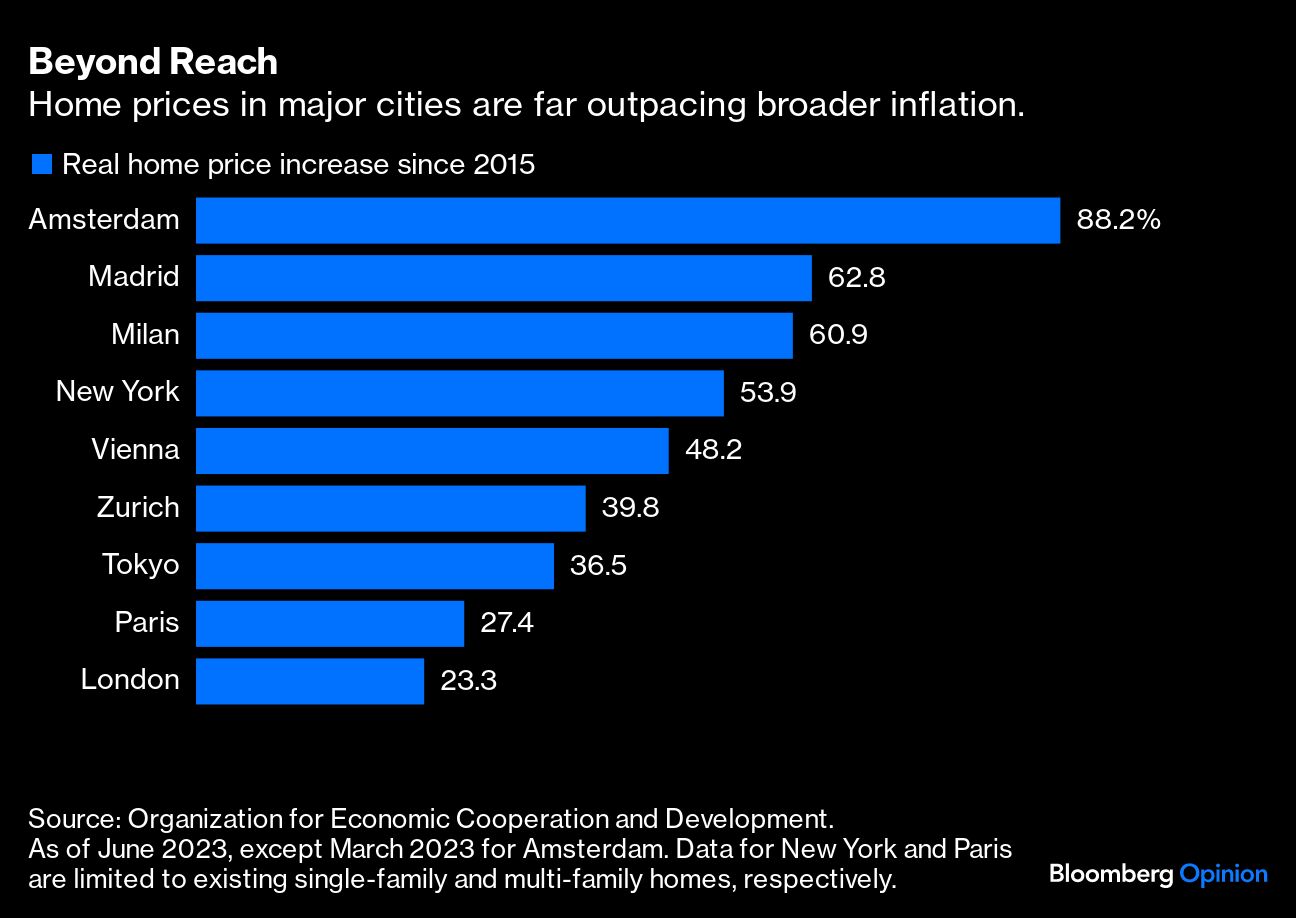
New York’s experience reflects a global malaise. Just about everywhere in the developed world, the challenge of securing housing in or near major cities is threatening to outweigh the opportunities they offer. Since 2015, home prices have soared 23% faster than overall inflation in London, and 88% faster in Amsterdam, bringing rents up with them. Students struggle to find any place to live, and young professionals are increasingly either staying with parents or moving away.
The drivers are many. In countries such as the US and the UK, local control over land use gives residents excessive power to resist new development, which they fear will harm property values and their quality of life. In continental Europe, waves of refugees from Ukraine and the Middle East have created added strains. Everywhere, higher construction costs and the advent of short-term rental platforms such as Airbnb have altered the balance of supply and demand.
Whatever the cause, the effects are dire. When people can’t afford to live in places where they can realize their full potential, economies suffer. In the US alone, the cost of this misallocation has been estimated at more than $2 trillion a year. Worse, the growing housing-wealth divide contributes to political polarization. Research on the UK suggests that as prices shoot upward, the homeowners who benefit lean increasingly to the right while renters lean further to the left, eroding social cohesion.
Knee-jerk responses such as price controls serve only to aggravate the problem. In Berlin, caps on rents have made apartments so scarce that potential tenants resort to bribery. In Stockholm, people wait years in the hopes of scoring a rent-controlled apartment. Those lucky enough to secure cheap dwellings have a powerful incentive to stay put, further limiting supply and stifling mobility.
Only one solution is guaranteed to help: Build a lot more. The right mix of policies — which might include removing regulatory obstacles, expanding financing options or shifting property taxation from buildings to land — will depend on the individual country. In New York, as in much of the US, progress will be particularly difficult. On Long Island, local opposition to development is so strong that even suggesting a new apartment complex is akin to political suicide.
New York Governor Kathy Hochul should get credit for trying. She wants to add 800,000 units over the next decade, focusing on multi-family development near public transport — an “upzoning” approach that has worked elsewhere and that, done right, can make room for more people without adversely affecting existing residents. Although she was forced to shelve the plan in the last legislative session, she has vowed to persist in the next.
It’s an effort worth supporting. If the state that is home to America’s largest metropolitan area manages to break its housing impasse, it could become a tipping point for the nation at large — and perhaps even an example worldwide.
Bloomberg News provided this article. For more articles like this please visit bloomberg.com.













