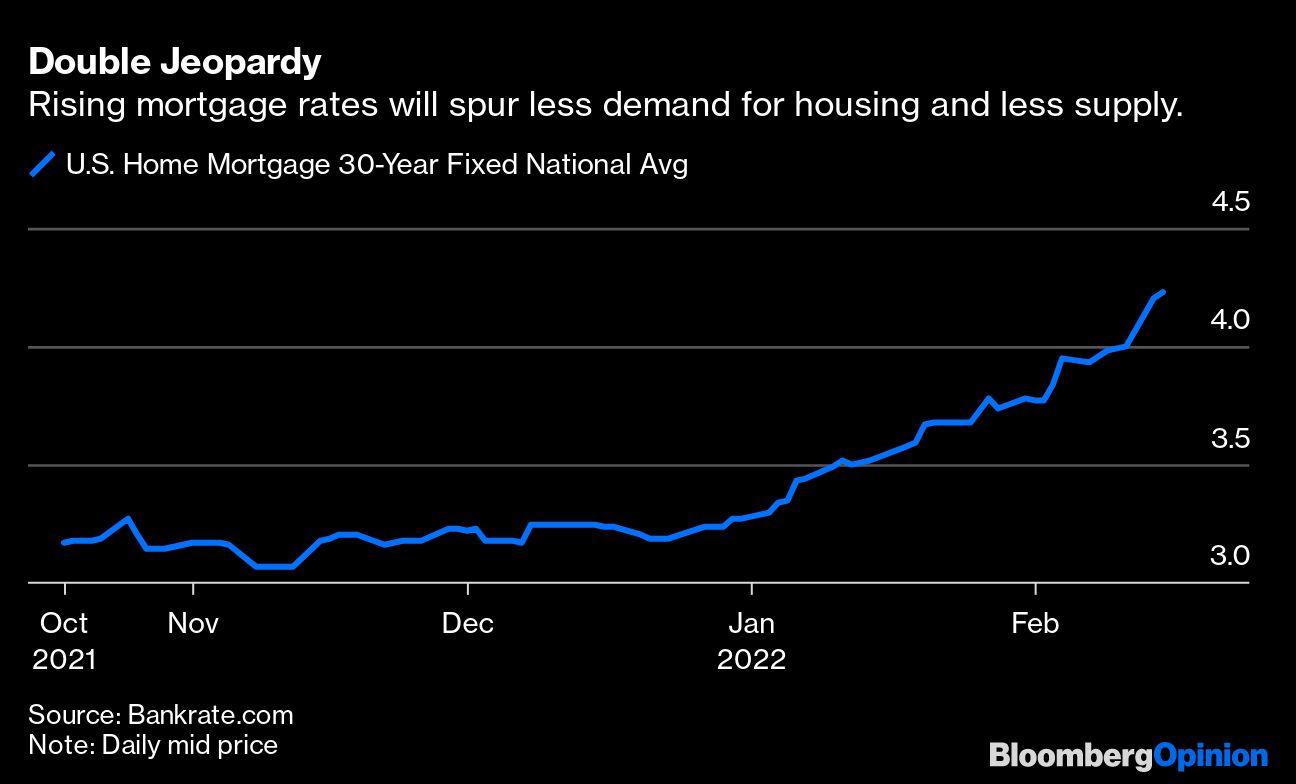
The surge in mortgage rates we've seen this year is making an already dysfunctional housing market even more uncertain. Higher lending costs will make housing less affordable, which should cool demand and at least slow price increases. But the more significant impact in a market struggling with historically-low levels of inventory is what it means for supply. Unfortunately, at a time when we could use more of it, we'll likely get less.
In just the first six weeks of 2022 we've seen a staggering rise in mortgage rates. An index published by Bankrate.com has 30-year fixed mortgage rates up by a full percentage point since Christmas.The only equivalent move since the mid-2000's was in the spring and early summer of 2013. For a homebuyer putting 20% down on a $350,000 house, going from a 3.2% mortgage rate to a 4.2% one increases monthly payments by almost 10%. All else equal, that should lead to some combination of lower demand, less home price growth or homebuyers downshifting to cheaper home options than they would have a couple months ago.
It's too early for any slowdown from higher rates to show up in housing data. Many homebuyers are working with mortgage quotes they locked in weeks ago and if anything, might be more motivated to buy a house with a rate that's now far below what’s currently available. But higher mortgage rates will be weighing on the market more heavily as we move into April. And while most attention may be focused on demand, the bigger impact might be supply.
Unlike in prior rate shocks, this one is coming at a very unusual time in the U.S. housing market. Home-equity levels are at records — most people who bought homes more than a year ago have a significant amount of wealth residing in their home. At the same time, many owners were able to refinance into a historically-low mortgage rate during the pandemic. (I refinanced into a 30-year mortgage at 2.875% last year.) This has implications for the important trade-up portion of the housing market.
Trade-up buyers already shared one problem with first-time homebuyers: a scarcity of available inventory. But the rise in mortgage rates creates another issue — the prospect of giving up a mortgage rate of 3% to take on a rate of 4% or more. A homeowner with a $300,000 mortgage at 3% who's thinking about trading up to a more expensive house will face the same affordability issues as a first-time homebuyer now that mortgage rates have risen to 4%. But selling their existing house and swapping into a higher mortgage rate will add another $3,000 a year to the price tag compared with their current loan.
So rather than move and give up their existing low rate, a more prudent option for many will be to stay in their current home and take out a loan to renovate or expand. This is bad news for the supply of entry-level stock as owners forgo selling and giving up a mortgage rate they may never see again, and instead turn their houses into "forever homes."
Homebuilders have problems of their own. They're already struggling with supply chain challenges and now have to wonder about the impact of higher rates on future demand. Shortages of products like garage doors have led to lengthening construction timelines, with completions sometimes taking as long as a year. Any homes that already are under construction will get finished, but how are homebuilders going to think about this when they decide whether or not to start new projects later this year?
Homes that are started in April might not be ready to occupy until April 2023. That's an eternity in a fast-moving housing market plagued by rising interest rates, high inflation and questions about future economic growth. Some builders might decide to curtail their production plans rather than risk delivering homes into a less favorable environment next year.
So higher mortgage rates should mean both less demand and less supply in the coming year. For existing homeowners who hadn't planned on moving any time soon, that's no big deal. But for those who have been hoping to see more buying options from accelerating construction and higher turnover, it's an ominous development.
Bloomberg News provided this article. For more articles like this please visit
bloomberg.com.