What is Good Government, and Why Is It So Rare and Precious?
Membership required
Membership is now required to use this feature. To learn more:
View Membership BenefitsNavigating between the despotic extreme of authoritarianism and the unbridled liberty of anarchism is the challenge of society in its quest for good government. A new book looks at the choices facing policymakers to achieve the proper balance and to improve the prospects of those countries outside the “narrow corridor” of effective governance that lies between those extremes.
Before economists were economists, they were called philosophers. (Adam Smith is the best-known example.) And, in that role, they focused not so much on production and consumption as on what John Laughland called “the mystery of state power.”1 They asked, “Why do people organize governments? How do they manage to collectively agree to give up part of their freedom to achieve some other goal, such as security or cooperation? Does this agreement bubble up from below or is it imposed from above? Does it work? Under what conditions are governments more helpful than harmful, and under what conditions are they the opposite?”
Those are big questions, and it takes authors of the stature of Daron Acemoglu, one of the world’s leading economists, and James Robinson, held in equal regard in the field of political science, to tackle them. Acemoglu and Robinson have done that in The Narrow Corridor: States, Societies, and the Fate of Liberty. It is an encyclopedic, provocative, and sometimes maddening book that is well worth reading – if you have lots of time. Readers with a more modest time budget should focus on specific sections, which I’ll summarize individually.
Many of us in the business world fret about the expansive and costly role of government and don’t fully appreciate what our lives would be without it. Thomas Hobbes, the 17th century philosopher (and economist!), said in Leviathan that without a strong, effective state, human life would be “solitary, poor, nasty, brutish, and short” and “a war of all against all.”2 (He had a knack for aphorisms.) Readers who have lived in modern failed states, where gangs, rogue soldiers, corrupt policemen, and thugs ruled, can relate.
Exhibit 1
The Benevolent Despot Rules Over a Peaceable Kingdom
(Frontispiece of Thomas Hobbes’ 1651 classic, Leviathan)
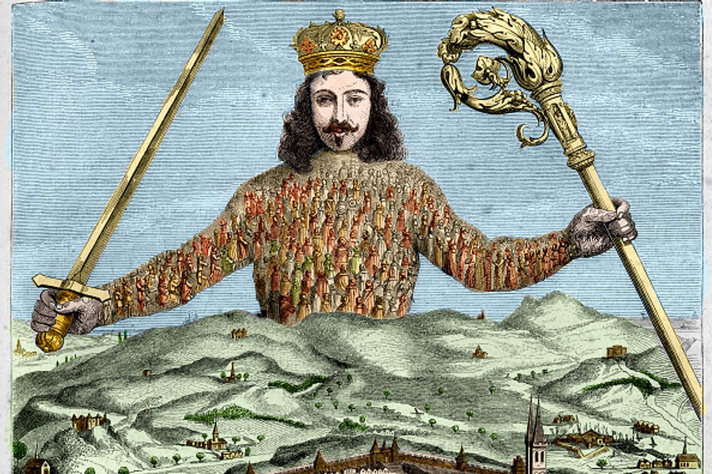
Note: The title is mine; the original artwork is untitled. Note that the ruler’s body is depicted as consisting of human faces, representing (I suppose) the body politic that gives him legitimate authority. (Note that the ruler looks a little like Charles I of England. King during Hobbes’ lifetime, Charles “lost his head’ in 1649.) Source: Detail of image from here
What is the optimum role of government – not just the optimum form, about which much has been written, but the right scope of its power? Acemoglu and Robinson argue that, to help more than it harms, it needs to stay within narrow bounds:
Squeezed between the fear and repression wrought by despotic states and the violence and lawlessness that emerge in their absence is a narrow corridor to liberty. It is in this corridor that the state and society balance each other out.
On first reading, I was reminded of Woody Allen’s wisecrack that “mankind faces a crossroads. One path leads to despair and utter hopelessness. The other, to total extinction. Let us pray we have the wisdom to choose correctly.”3
But it is not that bad, say Acemoglu and Robinson. The corridor is not so narrow as to be unachievable. Liberty has flourished in modern times and has not been totally lacking in any era. The important thing is to be keenly aware of where the boundaries are located and to be on guard when in danger of transgressing them.
In sum, they favor a strong state – not to oppose liberty, but as a prerequisite for liberty, contrary to the anarchic fever dream of a few radical libertarians. This strong state is not the despotic Leviathan of Hobbes but a “shackled Leviathan,” one constrained by rules, checks and balances, and the watchful eye of civil society.
The Red Queen
Originally just a playing card, the Red Queen is such a vivid character in Lewis Carroll’s Through the Looking-Glass that she turns up frequently in modern literature, most recently in the estimable Matt Ridley’s The Red Queen (about evolution and sexual selection) and now in The Narrow Corridor. After quoting the familiar passage about Alice’s Wonderland being “a slow sort of country… [where] it takes all the running you can do, to keep in the same place,” Acemoglu and Robinson write:
…[T]he state and society [have to run] fast to maintain the balance between them. In Carroll’s book all that running was wasteful. Not so in the struggle of society against the Leviathan. If society slacks off and does not run fast enough to keep up with the state’s growing power, the Shackled Leviathan can turn quickly into a despotic one. [But] [w]e need the Leviathan to keep on running too…for breaking down the cage of norms.
The Red Queen, then, is the race between the state and society, with each seeking to retain and increase its share of power. They need to continue running to stay in the same place (maintain a balance of power and stay in the corridor). But if one or the other runs too fast or too aggressively, it may cause a narrowing of or an exit from the corridor. That is why the dynamic described by the authors’ Red Queen metaphor is such a delicate balance.
What is the cage of norms? “The same norms that have evolved to coordinate action, resolve conflicts, and generate a shared understanding of justice also create a cage…[that] restricts liberty.” Among the worst examples of the cage are African slavery in the Americas and the brutal caste system that was traditional in India: these were socially accepted practices that were regarded as proper and necessary (by somebody). They could only be eradicated, and even then only partially in India, by state power.
Defining the corridor
Acemoglu and Robinson define the Narrow Corridor that supports liberty and innovation using the graphic shown in Exhibit 2, which depicts the general model. The Despotic Leviathan seeks total control and the Absent Leviathan allows anarchy, the war of all against all. Only the shackled Leviathan (the narrow and easily breached corridor between them) makes liberty possible. Prussia moved from within the corridor to the despotic side between the 15th and 19th centuries; Switzerland moved into the corridor in the High Middle Ages and has stayed there ever since; Montenegro, anarchic in the 19th century and then once again after the breakup of the former Yugoslavia, is moving in the right direction but is not quite there.
Exhibit 2
The divergent effects of an increase in the power of the state
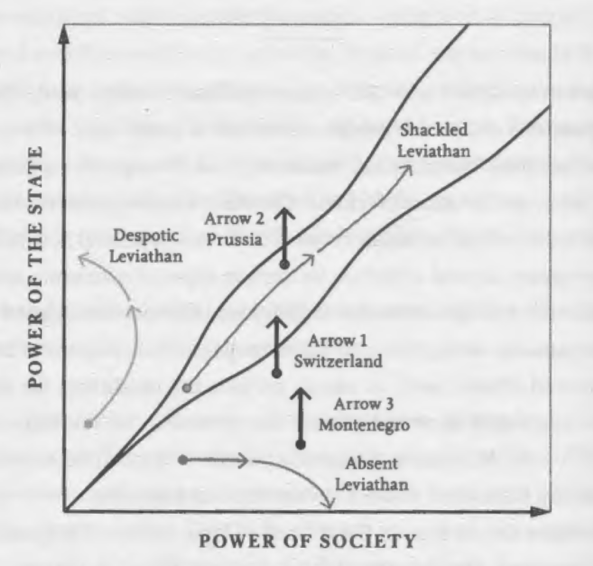
Source: Acemoglu and Robinson, The Narrow Corridor, page 268.
This is a helpful framework and can be used to characterize a regime anywhere in the world, in both location and direction. China has remained outside the corridor on the despotic side for eons, but has flirted with the edge of it in recent decades to the extent that economic progress has been strong and personal freedom granted to a limited degree.4 Still, it is not going to move into the corridor any time soon. Several Central European post-communist nations have moved from the despotic side into it and remained there. Colombia is moving into it from the anarchic side. South Africa moved decisively into the corridor under Nelson Mandela’s leadership, but is struggling to remain within it.
The United States and United Kingdom represent the balance between society and the state that the authors regard as optimal. (Remember that the next time you’re feeling down about the state of either country’s government.)
Begin at the beginning: Ancient and medieval times
A book about human nature and the relationship between the citizen and the state is bound to rely on history, although not with as much vigor as Acemoglu and Robinson. They begin at the onset of recorded history, with the Epic of Gilgamesh, Hammurabi, the Greek Bronze Age (the one before the dark age that preceded the more familiar age of Socrates and Plato), and so on through Roman times and the Middle Ages to modern (post-1500) times. When I said at the outset that the book can be maddening, it is because it provides too much information. Reading it is like reading an encyclopedia; you need to pick the sections that interest you the most and concentrate on those.
By page 152, the authors are up to the dawn of the Middle Ages, with Clovis’ ascension to the throne of what is now France – and, a little later in the book and 300 years later in time, Charlemagne. Both kings, the authors claim, led their realms “into the corridor,” sowing the seed of the idea that modern liberal democracy is not the only possible recipe for a tolerable amount of human freedom. They make the remarkable claim that modern freedom and prosperity have their origins in the forests of northern Europe at the end of the fifth century AD. It’s remarkable because the medieval history taught in school portrays this as one of mankind’s darkest moments, the descent of the formerly civilized Roman Empire into barbarism, illiteracy, and extreme poverty. The Dark Ages! What if that wasn’t so?
It wasn’t, Acemoglu and Robinson assure us. To be specific, they write, the “assembly politics of the [Frankish] long-haired kings” were the “first blade of the scissors” that would put early medieval northern Europe into the corridor. “The other blade,” they write, “came from the Roman Empire,” manifesting itself in the “lay institution” of the bureaucratic state and the “hierarchy of the [Roman Catholic] church,” which is a legacy of Roman imperial structure that persists to this day. Together, these institutions combined to create an environment that was admittedly short on liberty as we understand it today, but that, “[by] getting a foothold in the corridor, [would start] these societies started on a process that would gradually change all these things”: the servitude, feuding, and torture that we associated with medieval times.5
If you’re not interested in ancient and medieval history, skip to chapters 7 and 8 on China and India, or to “modern” European history in chapter 9. But the early stories are the best parts of the book. Antecedents are always revealing because, in human nature, there is nothing new. Whatever questions we have about our own time and our own problems, someone else has wrestled with the same dilemmas in an earlier and very different time. You think that the ugliness between the supporters of Donald Trump and the far-left Democrats represents a uniquely sharp division in political philosophies? The same social fault lines caused the Wars of the Three Kingdoms in England, Scotland, and Ireland between 1639 and 1651, and for that matter the war between the Maccabees and Hellenists in the second century B.C. that underlies the story of Hanukkah.6
The mandate of heaven and the broken people
China: Wealth and illiberalism
China is one of two dominant countries in the world, and we need to understand it better. Unsurprisingly, Acemoglu and Robinson help us to do that by starting in the 8th century BC, with the era known as the “spring and autumn” period. They write, “Chinese history took a very different path from that of Europe and one that created far less liberty. But it didn’t start out that way.” They then recount the contributions of Confucius, the leading thinker of that age, and his follower Mencius. The seeds of liberty are present in their works. Yet Chinese society evolved into one where the rulers claimed “that they had been given a mandate to rule from Heaven,” an authoritarian concept if ever there was one.”7 Within a millennium the warring states of China produced the greatest loss of life from conflict, relative to world population, in all of history. One-fifth of the world’s people perished between 184 and 280 A.D.
China is still an autocracy, despite many revolutions and political transitions – and, paradoxically, the country has made great progress, stunning actually, without embracing freedom. One suspects that liberal democracy isn’t in their genes (and isn’t strictly necessary for robust economic growth). Yet, the authors remind us, “Hong Kong and Taiwan, so close to China and cut from the same cultural cloth, have created societies that have demonstrated the powerful demand for liberty.” I concur with Acemoglu and Robinson that this demand for liberty is universally human – but China has not supplied it. After describing the intrusive “social credit” system being imposed in China, which is a social and economic reputation score based on the observed behavior of each individual, as well as the panopticon state that has been developed in Xinjiang (the land of the Uighurs), the authors conclude that “[f]or most, liberty with Chinese characteristics is no liberty at all.”8
India: Oppression and enlightenment
In liberal India, ruled until 1947 by the tolerant British and then led by the idealistic and revered Mohandas Gandhi, there are people whose hereditary livelihood is transporting human waste. Really. They are a sub-caste within the large group called Dalits, or untouchables; the meaning of “dalit” in their native language is not “untouchable” but “the broken people.” Who broke them? Not a despotic state, but the Absent Leviathan, which cannot protect the people from their own worst instincts and customs. They have been broken by the cage of norms.
India’s laws are enlightened. Untouchability is strictly forbidden, and every Indian is a citizen and equal under the law. Yet there are about 200 million Dalits today, more than 15% of the country’s population. How could this state of affairs exist? Acemoglu and Robinson are incredulous too: “You may be skeptical that this ancient social [caste] hierarchy could be so rigid as to determine people’s occupations in recent times. Who would enforce that?”
The answer is nobody. The web of ancient social relations, determining the roles and obligations of each group of people to each other, survives – to the extent that it does today – because the Indian state is too weak to destroy it and replace it with the web of voluntary, arm’s length, contractual obligations that characterize a free society. A Chinese wag said that China would always beat India in economic competition because China has one ethnic group and India has 40,000. It’s an exaggeration, but there is a grain of truth to it. Everything about India is mind-numbingly complex, and steering it into the corridor and keeping it there requires an act of heroism and genius that has only begun to take place.
The paper Leviathan: Latin America’s curse
One of the most interesting puzzles in world governance is the ongoing struggle of Latin America to achieve real prosperity. The authors call the typical Latin American state, to the extent there is such a thing, a “paper Leviathan” that has the trappings of a proper state apparatus and pretends to function as one but, by and large, does not. (An even more vivid image is the description by Dario Echandía, a mid-20th century Colombian politician, of the country’s government as “an orangutan in a tuxedo.”)
That sounds right for Argentina, sometimes called the world’s only formerly developed country. However, Latin America is a varied place and the failure of the state to function does not apply equally everywhere. The authors go into detail on the divergent paths of Costa Rica and Guatemala,
…[which] were initially similar. Both countries were still under the despotic control of the Spanish colonial state until 1821. But in the next hundred years they diverged as sharply as any of [our other] examples… By 1882 Costa Rica was holding regular and peaceful elections…[and] by 1930, two-thirds of all adults could read and write.
In Guatemala, by contrast, the authors describe the brutalized lives of the indigenous people (who form a large majority) in the words of the Nobel Peace Prize winner Rigoberta Menchu, whose grandmother
…had to give away her eldest son [Menchu’s father]…to another man so he wouldn’t go hungry… He lived with the ladinos (whites) for nine years but learned no Spanish because he wasn’t allowed in the house… They found him repulsive because he had no clothes and was very dirty.
The story degenerates from there, ending in civil war, torture, and disfigurement. So, why such divergence between two nearby and physically similar countries? “The answer,” Acemoglu and Robinson write, “is related to coffee… The state-building incentives of the coffee boom at the end of the 19th century…created a powerful Despotic Leviathan there. In Costa Rica…, a small coffee-holder economy [instead of vast estates] [was] bolstered by public services and improved property rights in land.” What a difference a few twists and turns of history make.
Given its part-European heritage and wealth of natural resources, Latin America has struggled more than one would expect to join the fully developed world. A lack of effective government is the chief reason. Fortunately, that’s a problem that can be fixed. Unfortunately, such change comes very slowly, if at all.
Acemoglu and Robinson go into similar detail on the obstinately illiberal Muslim world, which has a glorious ancient history and which began to modernize several times in the recent past, but which has regressed; Nazi Germany; and, oddly, Ferguson, Missouri, where the authors’ analysis of recent clashes between blacks and whites reflects their basic theme that state power is only helpful when it remains within the narrow corridor. While the United States is, in their view, an example of the properly shackled Leviathan, sometimes it strays, with tragic consequences.
Once upon a time in the West
In this review, I give short shrift to modern Western civilization because it is the aspect of the world that is most familiar to readers, and because Acemoglu and Robinson do not give it a particularly special place in their storytelling – they are more interested in the whole world and the richness of its history. But they do have something to say about our own civilization and time.
In their Chapter 15, “Living with the Leviathan,” the authors begin by describing “Hayek’s mistake.” His mistake, expressed in his influential Road to Serfdom, was to regard the move toward a more socialistic society as a one-way street to totalitarianism.9 What Hayek did not consider was the Red Queen effect, resulting in a pushback from society that keeps the Leviathan shackled as it tries to expand its reach. Thus, the authors, assert, Britain and much of Europe has remained free while adopting substantial aspects of socialism. “And…some of these dynamics played out in the United States as well,” they remind us.
We have seen this see-saw effect at work in Sweden, Canada, and many other countries. A large expansion of the state is followed by retrenchment, usually brought about in the name of fiscal responsibility. These countries have retained a very high degree of personal liberty through these transitions.
Acemoglu and Robinson are also concerned about the hot issues of today: inequality, the misbehavior of Wall Street, and the large size of top corporations. Let’s focus on inequality. They begin by agreeing with the widespread view that greater inequality in the developed world is due to globalization and technology; a decrease in the wage of low-skilled workers in rich countries is exactly what economic theory predicts. They also acknowledge the tremendous benefits of globalization to those in the developing world.
Their prescription is an interesting, centrist view rooted in their Leviathan analysis. They write:
[One] challenge is related to trust in institutions. The Shackled Leviathan doesn’t just need a balance of power between state and society. It also needs society to trust institutions. Without trust, citizens won’t protects these institutions from the state and the elite, and the Red Queen becomes much more zero-sum.
The Red Queen is zero-sum when the state and society are at loggerheads with no moderating influences. What happens in that case? An exit from the corridor, a civil war, Nazism or Communism, or some other “ism” that demeans human life and destroys prosperity.
How are we to avoid this? The authors draw an example from Sweden, not today’s Sweden but that of the Great Depression of the 1930s, which
…entailed greater involvement and empowerment of the state, while society also became more capable and better organized to control the state. This societal mobilization was bulwarked by a new coalition supporting the new institutional architecture.
These are broad generalities, but helpful in principle: we know what direction to try to go. The authors express concern about
…the response of many Western nations today, [which is] closer to Weimar Germany’s than Sweden’s with the elites fighting to defend their advantages and those in the most precarious positions succumbing to the allure of autocrats, and polarization and intransigence becoming the order of the day.
My concern too! Yet the authors’ discussion takes an optimistic turn:
…the Red Queen is more likely to get out of control when the corridor is narrower. Here the United States and many other Western nations are in a better situation because their diversified economies built on manufacturing and services, very limited role of coercion…, lack of dominant groups diametrically opposed to democracy (like the Prussian landed elites), and their recent history of uninterrupted democratic politics translate to a wider corridor.
In other words, we have more room for error than, say, Weimar Germany. Still, the authors warn, “the Red Queen can get out of control even in a wide corridor if it turns resolutely zero-sum.”
The authors conclude by recounting the three pillars of Swedish recovery from the Great Depression without slipping out of the corridor: (1) “the whole project was built on a broad coalition composed of workers, farmers, and businesses”; (2) the government intervened to stimulate the economy and create a generous welfare state without taking the economy over; and (3) on the political front, “engineer compromise and find ways of building a broad coalition to support the Shackled Leviathan and the new policies.”
We can learn from history. While I don’t agree with every one of Acemoglu’s and Robinson’s policy prescriptions, they are well argued and impressively supported with historical knowledge and sophisticated analysis.
Insights for investors
It’s difficult to apply such a broad-based, world-historical theory to investment decision-making, but let’s try. Many investors actively allocate assets (hold non-benchmark weights) by country, region, or level of economic development. If one accepts Acemoglu and Robinson’s thesis, they should invest more in countries that are moving toward the corridor and less in those that are moving away from it. This information is unlikely to be completed reflected in stock prices or bond yields, so investors may benefit from performing such an analysis.
Countries that are firmly within the corridor are usually considered developed and are priced as such, but there are exceptions. Japan is still in the wake of a 30-year secular bear market and has P/E ratios near the bottom of its own historical range (although high compared to some other countries). Countries such as France and Italy are priced for continued economic hardship although that is by no means a foregone conclusion. All of these countries are in the corridor and have the potential for – but, obviously not the guarantee of – renewed growth.
Countries entirely outside the corridor should not escape investors’ notice. Frontier-market funds explore opportunities in places like Bangladesh, Vietnam, and Nigeria, and find some great companies at low prices. It is not impossible to imagine some of these countries moving decisively toward the corridor, as South Korea, Taiwan, and several countries in eastern Europe did in past decades, and offering very high returns to investors.
Conclusions
The Narrow Corridor provides an effective counterpoint to the bubbly techno-optimism of my own book, Fewer, Richer, Greener, in which I predict that continued economic enrichment and a leveling off of world population will produce tremendous human and environmental benefits. Readers need to know both sides of this story. Technological progress may proceed more quickly in states that are within the corridor, but it will proceed at some rate even if the precepts of The Narrow Corridor are not followed. Even the stifling atmosphere of medieval Europe and China produced some innovation.
Moral progress is more difficult, but it happens. Jefferson’s Enlightenment-inspired America used to practice one of the worst forms of chattel slavery ever known; now slavery is repugnant everywhere, including where it remains as a relic. The legal status of women in liberal Victorian Britain was appalling: women could not own property, leave their husbands, or even keep the pay from their own labors, which had to be turned over to the man of the house. Such laws seem bizarre today. (The actual lives of 19th-century British women were not as bad as their legal standing suggests.)
Yet the continuing story of man’s inhumanity to man, in every age and in every part of the world, leaps from each page of The Narrow Corridor. It is only through the careful weaving between the hazard of oppressive government and the trap of anarchy that we can realize our full humanity. And that is such a difficult task that only a few societies have accomplished it, none of them perfectly. We have a great deal more weaving to do.
Larry Siegel is the Gary P. Brinson Director of Research for the CFA Research Foundation and an independent consultant. Prior to that, he was director of research in the investment division of the Ford Foundation. His book, Fewer, Richer, Greener was published by Wiley in 2019. He may be reached at [email protected] and his web site.
1 Laughland, John. 2008. A History of Political Trials: From Charles I to Saddam Hussein. Long Hanborough, Witney, Oxfordshire, UK: Peter Lang. Laughland is a British political scientist. The phrase “mystery of state power” has been in the wind for a long time; Laughland’s use of it is simply the most accessible.
2 Hobbes, Thomas. 1651. Leviathan: or, The Matter, Forme and Power of a Common-Wealth Ecclesiasticall and Civil. The “war of all against all” is scattered through his works in both English and Latin (bellum omnium contra omnes), but appears in Leviathan in modified form: “a perpetuall warre of every man against his neighbor” (and variations thereof). You get the idea. It’s not pretty.
3 Allen, Woody. 1979. “My Speech to the Graduates.” New York Times (August 10), Section A, Page 25.
4 In Progress [2016], Johan Norberg writes, “The Chinese people today can move almost however they like, buy a home, choose an education, pick a job, start a business, belong to a church (as long as they are Buddhists, Taoist, Muslims, Catholics, or Protestants), dress as they like, marry whom they like, be openly gay without ending up in a labor camp, travel abroad freely, and even criticize aspects of the Party’s policy (although not its right to rule unopposed). Even ‘not free’ is not what it used to be.” Muslim freedom has suffered recently in Xinjiang, but it is not illegal to be a Muslim in China, while it is illegal for a citizen not to be a Muslim in the Maldives.
5 These assertions by Acemoglu and Robinson give some support to the mythical origin of British liberty as having been introduced by the 5th-century Anglo-Saxon invaders Hengist and Horsa (whose names mean, roughly, “horse” and “horse”), of whom Thomas Keightley wrote in 1837, “[t]he love of liberty was a leading trait in their character; their obedience to their chiefs was free and voluntary; their religion…was no slavish superstition… [They] held the female sex in honour, and nowhere was valour seen to pay homage to beauty as in the forests of Germany” (History of England, Part I). I have always thought this view to be silly Anglo-Saxon chauvinism, but maybe there’s something to it.
6 These points were made by Curtis Yarvin (the Three Kingdoms) and Christopher Hitchens (the Maccabees) respectively, not by Acemoglu and Robinson.
7 The European “divine right of kings,” asserted not that long ago (by James I of England in the early 1600s), is remarkably similar.
8 There is a racial component to the oppression of the Uighurs. Basically white, this Turkic ethnic group is visibly distinct from almost all other Chinese, who include nonwhite Muslims that receive much better treatment. Ironically, Uighurs are also much in demand as models, because their partly Caucasian appearance is considered exotically beautiful in Han China.
9 Hayek, the authors remind us, never opposed “all government intervention or social insurance.” Some rigid libertarians, citing Hayek as an influence, thus misrepresent his position. See Hayek, Friedrich A. 1960. “Why I Am Not a Conservative,” in his The Constitution of Liberty, Chicago: University of Chicago Press. Available at https://fee.org/resources/why-i-am-not-a-conservative/
Membership required
Membership is now required to use this feature. To learn more:
View Membership Benefits