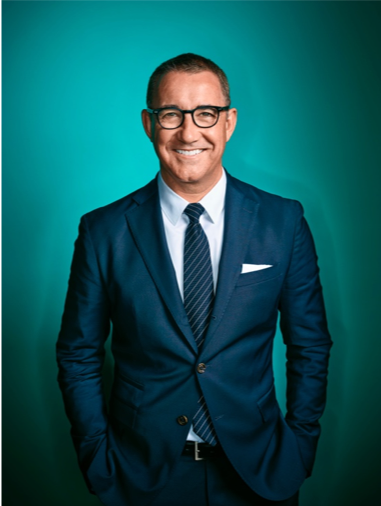
 Joe Duran is the CEO and a founding partner of United Capital, one of the largest independent wealth management firms in the country, and the nation's first and largest financial life management company. Under Joe's leadership, United Capital has developed high-tech, client-engaging tools like MoneyMind and Honest Conversations, as well as FinLife Partners, a white-label service for third-party advisors to use United Capital's platform. Joe earned his undergraduate degree from Saint Louis University and MBAs from UC Berkeley and Columbia University. He earned his Chartered Financial Analyst designation in 1997.
I spoke with Duran at The MarketCounsel Summit in Las Vegas on December 4.
What is the difference between wealth management and financial life management?
Wealth management is investment management and planning.
Financial life management is the intersection of life and money; it's providing guidance and advice over people's entire financial life. It goes beyond investing and planning to talk about people's lives and the intentions behind their money. We want to make sure they're making choices with their money and how they spend it, not just with how they invest it.
Financial life management also recognizes that people want transparency and control over their own money, and at the same time they want access to their information beyond office hours.
Regrettably, most wealth managers only care about the investing side of the equation.
You’ve written about how artificial intelligence will change the industry. Yet advisors are notoriously slow to adopt new technology. When will this happen?
For us, it’s going to happen by the end of 2019.
For the rest of the industry? Who knows.
It’s unimaginable how the slower adapting advisors will ever get to AI. I don't know how many of them will even care to, because many think they're smarter than any machine. Even though everything they do every day has AI embedded in it – whether they're filling in an email, going to Netflix or going to Amazon – AI is telling them what to look for. They’re going to be very slow as adopters.
In your podcast with Michael Kitces you talked about how you instill a culture that your employees don’t work for you; they work for your client. Why does this matter when it comes to building a world-class firm?
Often the temptation, especially as companies get bigger, is that in order to get paid well, you have to sacrifice the client in order to do well for the business. You see it in insurance companies and other big corporations all the time. In order to get ahead, you have to do well by the company, and in order to do well by the company, you have to screw the client.
That doesn't work in a fiduciary environment. For me, as the guy at the top who started this company, I make sure you get paid by doing well by clients. We must do well as a company too, otherwise we won't be able to serve those clients. But usually when companies get bigger, the order gets reversed.
What are FinLife Partners and FinLife CX? Why have you offered your “secret sauce” to other advisors?
Because the mission of our company is to improve as many lives as humanly possible, that means that we shouldn’t stay constrained to only our direct clients and the advisors who have joined us.
We have 89 offices, but there are tens of thousands of advisors who we are never going to acquire, who are never going to be culturally the right partner for us, but who are people who really want our tools and systems.
It was a business and a mission decision. I can get bigger, I can go global and I can go to clients I will never see. We've become the de facto standard in financial life management, because no one else is doing what we've done.
Are advisors adopting quickly enough to future proof their business? What are some examples of how they’re able to bring on sustained growth?
The revenues of our first firm, which joined us in Cincinnati about 18 months ago, have gone from about $3.5 million to approximately $5 million.
That advisor introduced FinLife to all their clients. He never did any of it himself; he had all of his junior advisors introduce it. The response from the advisor was uniformly and wildly positive: the firm’s organic growth has gone up, advisors are learning more about their clients and they charge more than they used to. So, it's hard to imagine that these results are uninteresting.
The most successful firm we've acquired went from $5.7 million to approximately $20 million in annual revenue. What we see is, if you institutionalize the relationship, which is in the tools and systems we have, you're going to grow faster, have higher profit margins and help your clients live richly.
I’d like to talk about the future of large planning firms such as United Capital. Your firm has been mentioned as a candidate for an IPO at some point. What is your long-term goal for United Capital?
I want to change the industry. I want to be a $100 billion RIA in the next three to five years. At that point, we will be big enough that we can do whatever we want.
I don't know that going public is the right move, since we're a fiduciary.
Public companies tend to be forced to do things that maybe are not great for the consumer. But what I do know is that the biggest and most important thing is that we continue to grow and expand and change the world. How big we become is really up to us.
Recent acquisitions in the industry and the resulting elevated compensation level amongst management have led some to question whether this creates a conflict of interest. Are you concerned about this industry trend and how it may impact advisor incentives in the future?
Anyone who sees my compensation frankly chuckles at what it is compared to what it normally would be for somebody in my position.
The reality is, if you're transparent, if you don't hide anything, people aren't going assume you're up to some shenanigans.
We share our financials and our revenues. That's something you'll see very few firms have the nerve to do.
Of course there will be lots of people in the industry who do bad things because they're in a trusted position, and I can't do anything about them. I can just do something about my company, and make sure we're acting as really good people in the best interest of our clients.
Marianne Brunet is an economic analysis manager at Advisor Perspectives.
Read more articles by Marianne Brunet
 Joe Duran is the CEO and a founding partner of United Capital, one of the largest independent wealth management firms in the country, and the nation's first and largest financial life management company. Under Joe's leadership, United Capital has developed high-tech, client-engaging tools like MoneyMind and Honest Conversations, as well as FinLife Partners, a white-label service for third-party advisors to use United Capital's platform. Joe earned his undergraduate degree from Saint Louis University and MBAs from UC Berkeley and Columbia University. He earned his Chartered Financial Analyst designation in 1997.











