These are tough times for lovers of freedom and democracy. After a quarter-century of spectacular progress following the fall of the Berlin Wall, liberal democracy has yielded to autocracy in a variety of countries1. And, even in thriving democracies such as the United States, voters are embracing populism in reaction to perceived economic stagnation, widening income disparity, and disruption of traditional jobs and ways of life by new technology. Among the populist ideas that have gained currency are hostility to free trade, a sharp reduction in immigration, the redistribution of income, and nationalism bordering on jingoism.
Dambisa Moyo doesn’t like it, and neither does Ian Bremmer. Moyo is a Zambian-born development economist who has risen to the forefront of global policy discussions. She has recently published a book, Edge of Chaos, arguing that populism should be combated through a renewed commitment to economic growth and a radical set of reforms to voting institutions. A resolute capitalist, Moyo believes that “the imperative is growth” and that, with patience and good policies, prosperity (not equality!) can be had, to a greater or lesser degree, by all.
Ian Bremmer, an American professor and geopolitical consultant, adopts a slightly more pessimistic tone in Us vs. Them: The Failure of Globalism. He cautions that populism will impose substantial costs on society. Bremmer recommends very conventional remedies, addressing the root causes of populism, in his view the delivery of the benefits of globalism to some while leaving out others – “winners and losers.” These remedies approximate the platform of the Democratic Party, although Bremmer says he is “neither a Democrat nor a Republican.”
The world according to Dambisa Moyo
Capitalists tend to be optimists, and as such it’s out of character for Moyo to focus on the “hurricane headwinds” that she says are inhibiting growth and progress. (In a very necessary earlier chapter, “A Brief History of Growth,” Moyo recalls how the world came to be prosperous, albeit unequally.) Among the headwinds are excessive public and private debt, scarcity of natural resources, overpopulation, climate change, an aging society, slowing productivity growth, income inequality, competition from robots, and declining educational achievement. Oy!
She’s mostly right about debt; and the world’s educational systems are, on average, unimpressive. But some of Moyo’s other concerns are misplaced. For example, it’s hard to be seriously exercised about overpopulation and aging at the same time – the two forces work in opposite directions. The population explosion is now mostly confined to Moyo’s native Africa, so it is arguably still a problem there.
But fertility rates in most of the rest of the world are way down, in many cases to below replacement rate. This is true in surprising locations, such as Brazil and Iran, as well as in the better-known cases of Japan, China, and the European Union. As a result, the biggest demographic concern in most developed and many developing countries is a shortage of young, taxpaying workers and a surplus of tax-consuming older people. Moyo mentions the aging problem in passing but isn’t really focused on it.
Infected with the virus of gloom, Moyo makes some wrongheaded claims about economic decline that seem to emanate from Donald Trump’s rhetoric:
As real wages have declined over the past several decades across much of the developed world, and many metrics that measure living standards (for example, health care and education outcomes, quality, and access), the case for focusing on the absolute rather than the relative has mounted.2
(Moyo is not a Trump supporter.3) Contra Moyo, there is overwhelming statistical evidence of increases in income and wealth, life expectancy, and many other metrics of well-being in most places in the world, including relatively stagnant regions such as Japan and continental Europe. Real wages and living standards are down in some “sunset” industries, but that performance is not representative and she should not portray it as such. Because Moyo is a serious contributor to the dialogue on growth and productivity, I hope she gets over the virus soon.
The world according to Ian Bremmer
Bremmer’s book is subtitled “The Failure of Globalism.”
What failure?
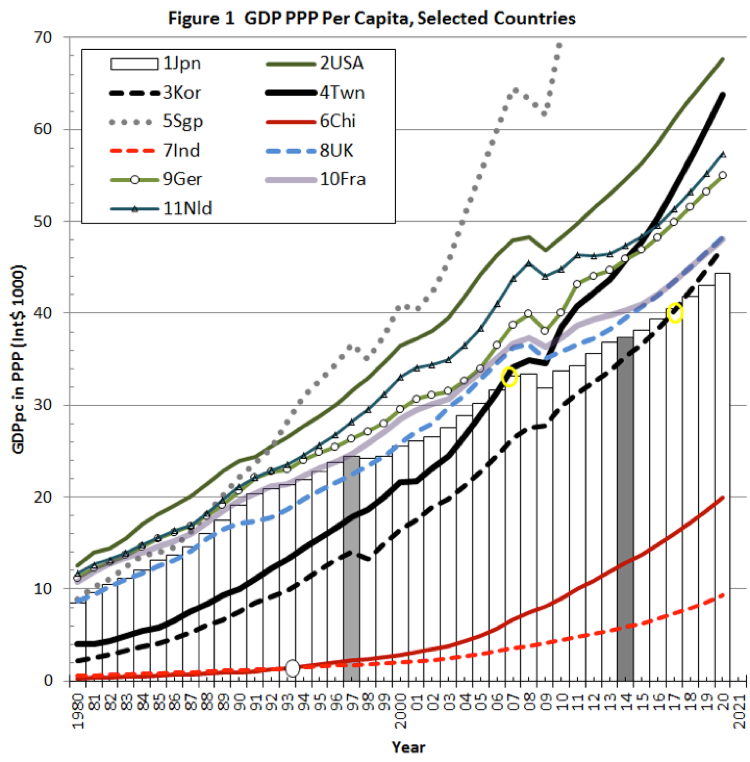
Globalism has succeeded beyond anyone’s wildest dreams, bringing hope and prosperity to parts of the world that have been left behind for centuries. China is the best example. Per capita GDP in that country rocketed from a medieval $1,635 in 1976 to a snappy $16,600 today – about the U.S. level before the 1929 crash – with both numbers expressed in today’s dollars and purchasing power parity (PPP)-adjusted. Reflect on this for a moment: these are averages across 1.3 billion people. That is a lot of growth and improvement in standards of living, the greatest feat of wealth creation in human history, and attributable in large part to globalism.
Meanwhile, the United States, the “donor” country (because it runs a persistent trade deficit, and because it is the source of much of the technology used in developing countries), experienced a rise over the same period from $32,534 to $62,150.4 Figure 1 shows the path of PPP-adjusted per capita GDP for selected countries and regions, including projections to 2021 by The Diplomat, an Asian economic newspaper.
Source: https://thediplomat.com/2016/07/how-bad-is-taiwans-economy/. Abbreviations: 1-Japan, 2-United States, 3- South Korea, 4-Taiwan, 5-Singapore, 6-China, 7-India, 8-United Kingdom, 9-Germany, 10-France, 11-Netherlands. Dollar amounts are nominal.
But “globalism has failed as an ideology,”5 says Bremmer.
OK, give it back.
If the Chinese, Indians, Indonesians, Brazilians, Turks, or Israelis (Israel was once a poor country) want to live at a 1976 standard of living, that’s not what they’re telling us. Maybe it’s Americans, and those similarly situated in developed countries, who do.
How good were the good old days in the U.S.? American life in our bicentennial year was not terrible, but it wasn’t the Eden of some people’s memory. The national average wage was $9,226; that’s $40,484 in today’s money. The average wage today is $48,642 – and, with shrinking numbers of residents per household, a given wage earner does not have to support as many people as he or she used to.6 (I’m using wages instead of per capita GDP because wages more accurately reflect ordinary workers’ experience; per capita GDP grew faster.) Housing is the most visible form of wealth, and living space per person has nearly doubled since the 1970s. Pension coverage has declined, but financial asset balances have grown hugely.
We do not want 1976 back, and the rest of the world does not want to give it back. We are better off now.
If globalization has succeeded as a policy, though, Bremmer may be right that it has failed as an ideology. A policy that does not have widespread public support may indeed be threatened by populist, that is, anti-globalist, tendencies in the global electorate. After a couple of generations of globalization, a large number of people are still – or newly – disappointed with their station in life, and populists hawking easy cures for that disappointment have been elected in the oddest places, including the United States. But if globalization is to stop or be reversed, the price to be paid will be awful, as both Moyo and Bremmer recognize.
Bremmer puts huge numbers on the idea that automation will destroy jobs:
Automation and innovations in machine learning threaten 47% of all jobs in the United States…65% in Nigeria…69% in India…and 77% in China… That’s a lot of personal upheaval involving very large numbers of people. [T]he point is not that all those jobs will disappear. It’s that, even if one job is simply replaced with a newer type…, the transition will be brutally difficult on a historically unprecedented scale.
Perhaps these fears are justified. But how many jobs were threatened by the transition from labor-intensive agriculture to mechanized agriculture? Nearly all of them. Wasn’t the transition brutally difficult? Does that mean we shouldn’t have done it? How many billions of people wouldn’t be eating if we hadn’t? How many would still be doing backbreaking work on the farm?
Bremmer has a tendency to sugarcoat: Putin is a “smart, charismatic leader” and “inequality was sharply reduced” under the Venezuelan dictator Hugo Chavez. Possibly out of fear of offending, he occasionally misses the essence of a situation. Venezuelans do not throw rocks at government buildings because they disapprove of “the ruling party’s control of the country’s courts.” They throw rocks because their government is starving them. Unlike the other countries on Bremmer’s list, Venezuela really is in desperate trouble, entirely of its own making; its neighbors, Colombia and Brazil, are thriving.7
What to do?
Both books are structured, as many policy works are, by first presenting a set of problems and then suggesting a set of solutions. Bremmer and Moyo don’t disappoint. They are full of ideas for solving the problems that have caused many of us to flirt with populist leadership and economically dubious policies.
Moyo’s fix for democracy: Don’t let people vote
A celebrated champion of capitalism and free markets, Moyo is cavalier when it comes to reforming the political process. “Democracy must adapt or further decay,” she declares. Adapt how? By becoming an elective aristocracy. She sets forth “ten radical reforms.” Among these are minor tweaks such as incentive pay for politicians (you can be sure the targets will be met, or will appear to be), term limits, longer terms, anti-gerrymandering provisions, compulsory voting, and requiring candidates to have non-political experience.
But Moyo turns undemocratic when she advocates minimum qualifications for voters, and extra votes for those especially qualified (seriously):
Voters must be nudged toward the right long-term policy choices… This might extend to requiring voters to meet minimum requirements for knowledge of key public policy issues… Weighted voting [would enhance] the voting status of highly qualified individuals…, effectively [creating] three tiers of voters: the unqualified, the standard qualified, and the highly qualified voter [who would get extra votes].
John Adams, who was the most conservative of the Founders and who opposed broadening the franchise beyond white male property owners, would be proud. Restoring the elective aristocracy of Adams’ time might produce better government, but it’s unfair and will not pass muster in a country founded on the principle of governments “deriving their just powers from the consent of the governed.”8
Phooey. We all think we know what’s best, and suspect that others are venal or foolish, so aristocracy has a natural appeal. But a democracy that can only be saved by disenfranchising a large fraction of the population is not worth saving. Moyo should go back to the drawing board.
Bremmer: Ease the pain of transition through social programs
Bremmer’s toolkit of solutions is much more conventional than Moyo’s and, as such, has a better chance of being used. (Whether it works or not is another matter.) He opines:
Rewriting the social contract to help people survive and thrive in dangerous times also means rethinking assumptions about the purpose and content of education… It means fundamental changes in the way that governments collect taxes. It means preparing people to compete and succeed in a fast-changing economy and providing for their most basic needs when they don’t or can’t. It means welcoming creative thinking… [and] work[ing] with private companies and institutions.
This set of recommendations, while reasonable, could have come out of the mission statement of almost any foundation, Washington think tank, or even a recent presidential administration. It is what many in government are already trying to do. I was hoping for more.
Economic statistics misused
Both authors make extensive use of economic data without caring much about getting them right. International standard-of-living comparisons should always be made using PPP exchange rates, not market exchange rates. PPP rates reflect the different cost of living in different countries. Both books ignore this analysis, exaggerating rich-poor differences: “[Nigeria’s] per capita income is $2,200,” writes Bremmer, referring to that country’s income converted at market rates. Its per capita income, converted at PPP, is $5,900; that is, an average Nigerian can buy what one could buy in the United States with an income of 5,900 U.S. dollars per year. It’s not a large amount of money, but it’s better than $2,200.
The same flaw affects the reporting of conditions in richer countries. For example, Bremmer states that GDP per capita in China is $8,123,9 the nominal rate, but PPP GDP per capita is a much more respectable $16,600, as I noted earlier. It is thus about half as wealthy as the bottom tier of rich countries, such as Portugal.
Moyo does something similar. Cote D’Ivoire’s PPP GDP per capita is $3,693, but she cites the market-rate figure of $1,398.69. The fake precision, 69 cents, is an indication that the statistics have been compiled carelessly – or that she has an economist’s warped funnybone. (A well-known joke among economists is that they quote macroeconomic statistics to two decimal points to prove they have a sense of humor.)
Moyo’s use of data to describe change through time is even sloppier. “During the past fifty years,” she writes, “U.S. income levels have risen thirty times.” The correct number is 15.7 times in nominal terms, and 2.2 times in real terms.10 But, earlier in the book, she wrote that “economic growth helped drive U.S. living standards throughout the twentieth century. Incomes rose thirty times…”
Which is it, 30 times in a century, or in a half century? The answer is neither; over the twentieth century (1900-2000, not 1900-2018), incomes rose about 152 times in nominal terms, or seven times in real terms. “[A]nd hundreds of thousands of Americans were moved out of poverty,” she continues. It was tens of millions.
Do rich Londoners live forever?
Large rich-poor spreads make good press, but need to be reported accurately. Moyo naively quotes a University College of London study saying that:
[T]here is a difference in life expectancy of 20 years between those born in central London near Oxford Circus and others born farther out on the rail line. Newborns around Star Lane have a life expectancy of 75.3 years – a dramatic contrast to the 96.4 years projected for those near Oxford Circus.
While the study does indeed say this, the claim is ridiculous. There is no magic corner in affluent west London where a newborn can expect to live to 96. Moreover, the Bangladeshi residents of Star Lane could have only expected to live to 72 if they had remained in Bangladesh, so maybe living in Star Lane conveys a benefit, not a detriment.
Globalists should try harder
Despite my many complaints, these are mostly good books. Of the two, Bremmer’s is written with more verve and style. Moyo’s writing, while clear enough, is a bit bland. But Moyo’s book has more economics in it, and may appeal more to investors and their advisors. Readers who are concerned about populism and its costs will benefit from reading both volumes, which are short and easily comprehended.
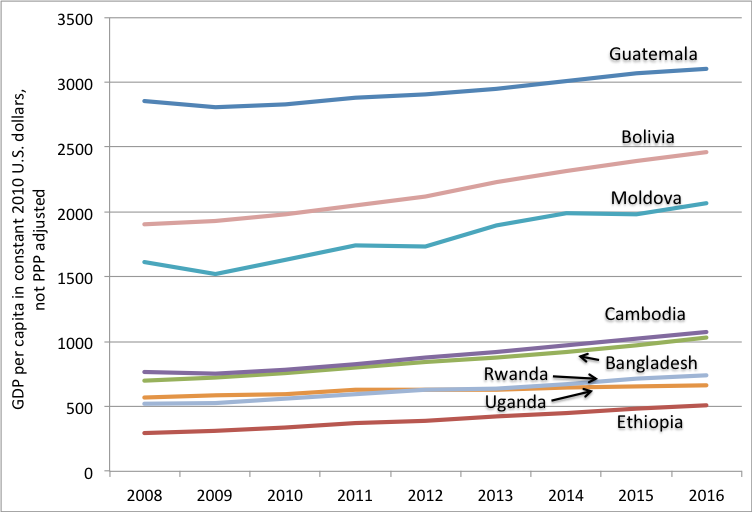
Figure 2 shows recent per capita GDPs, in constant (2010) dollars, for a group of countries I selected because they are commonly perceived to face desperate conditions. The numbers are not PPP adjusted – sorry! (I couldn’t get the data.) The countries are mostly beyond the frontier of portfolio investment; that is, except for Bangladesh, they aren’t even in the MSCI frontier or emerging markets indices. But they are mostly growing at robust rates. This cannot happen without access to global capital, goods and labor (migration) markets. It cannot happen without globalism. Despite rapid growth rates, these countries still rank among the world’s poor and thus need economic growth the most.11
Figure 2
GDP per capita, constant (2010) U.S. dollars, not PPP adjusted, of selected less developed countries, 2008-2016
Source: tradingeconomics.com. Diagram constructed by the author.
If globalism has succeeded as a policy but failed as an ideology, globalists should try harder to convince people that it is the best way forward. Leadership matters. Greatness in salesmanship and persuasion can be a profound force for good.
Lincoln ended slavery after none of his predecessors could. Teddy Roosevelt sold a booming young country on conservation. Franklin Roosevelt changed our conception of what government should do, persuading many reluctant Americans to give up a much larger fraction of their earnings for the common good. Kennedy forged a centrist path that would inspire at least two generations. Reagan reminded us of the forgotten virtues of capitalism.
What we need is another great leader, a champion of global progress, who, as was said about Churchill, will “mobilize… the English language and sen[d] it into battle.”12 The battle is for progress and cooperation and against ignorance and fear as we lead the world into sustained economic betterment – not withdraw from it. It has been done before and can be done again.
The remedy for uninformed voters is not to restrict the franchise but to limit the power of government. A constitutional republic in which the government has modest and enumerated powers cannot easily be led astray by greedy or foolish voters.
Populism is a natural – but fantastically destructive – reaction to technological change that enriches those with brain power at the expense of those who work with their hands or their aching back. People are not equally endowed at birth with the native ability to rise to the top in a technologically advanced society, but most can learn valuable skills. We need to provide those learning opportunities. And, we must make sure that, when providing for those most in need, we do not remove the incentive to provide for oneself and make a contribution to the strange and exciting new world in which we find ourselves.
Laurence B. Siegel is the Gary P. Brinson Director of Research at the CFA Institute Research Foundation and an independent consultant. He may be reached at [email protected]. His web site is http://www.larrysiegel.org.
1 Hungary and Poland, for example
2 Immediately after this quote from p. 71, Moyo cites a number of examples of slowing (but still positive) productivity growth rates in important countries on pp. 72-73. If productivity, typically measured by GDP per capita, is growing, albeit more slowly than it did at some past time, it’s hard to see how economic conditions are broadly getting worse. GDP per capita would have to actually decrease for that to be the case, but that only happened during the global financial crisis, and it has recovered almost everywhere – Greece and Venezuela being notable as exceptions.
3 In an interview with Andy Serwer, Moyo said, “Just to be absolutely clear, I’m not saying I’m a big supporter of Donald Trump nor am I saying I’m a supporter of any of the things that he has come out and said that I think most of us find abhorrent … living in the 21st century,” https://finance.yahoo.com/news/dambisa-moyo-trump-interview-at-davos-214511092.html. But she also said, "Maybe Trump is the shock we need so we can make more equitative decisions and not favor just a little group of people,” https://www.youtube.com/watch?v=Q-K_bYQ11DE. A reasonable conclusion is that she supports some of Trump’s policies but opposes him more generally.
4 Again, both numbers in today’s money. Source of 2018 data: http://www.imf.org/external/datamapper/NGDPDPC@WEO/OEMDC/ADVEC/WEOWORLD/USA
5 https://twitter.com/Breakingviews/status/998565489419935744
6 Source: Social Security Administration, National Average Wage Indexing series. Per capita GDP grew faster than wages because part of the labor share has gone to bonuses and benefits (health care being much more expensive today than it was in 1976). The rest of the increase has gone to corporate profits and to government (mostly transfers). Some of the money paid in taxes to governments comes back to workers in the form of public services and government benefits. In addition, after accounting for transfers, consumption by individuals has grown more quickly than wages.
7 While Brazil has been in a recession or depression for a couple of years, there is every reason to think that is temporary. Brazil’s long-term growth rate has been high.
8 Declaration of Independence.
9 World Bank data; IMF data are slightly higher.
10 Using per capita GDP (not wage) data. Historical nominal GDP from Angus Maddison, https://www.rug.nl/ggdc/historicaldevelopment/maddison/?lang=en; historical CPI from Robert Shiller, http://www.econ.yale.edu/~shiller/data.htm.
11 Syria will also eventually recover and grow. Iraq is starting to, and once war-torn Bosnia is in pretty good shape. One never knows about Afghanistan.
12 Darkest Hour (movie).
Read more articles by Laurence B. Siegel
 These are tough times for lovers of freedom and democracy. After a quarter-century of spectacular progress following the fall of the Berlin Wall, liberal democracy has yielded to autocracy in a variety of countries1. And, even in thriving democracies such as the United States, voters are embracing populism in reaction to perceived economic stagnation, widening income disparity, and disruption of traditional jobs and ways of life by new technology. Among the populist ideas that have gained currency are hostility to free trade, a sharp reduction in immigration, the redistribution of income, and nationalism bordering on jingoism.