Liquid alts are complex and expensive, so it is natural for advisors to ask if they worth the time and trouble. In this article, I answer this question with clear definitions, comprehensive data and a robust framework for portfolio construction. I evaluate returns with special emphasis on 2014, when managed futures (notably the AQR Managed Futures Strategy Fund - AQMIX) soared and the largest global macro fund, MainStay Marketfield (MFLDX), stumbled.
I use Lipper’s classifications for liquid alternatives. Lipper defines liquid alts as strategies with low correlations to traditional asset classes. Lipper excludes MLPs, REITs and TIPS, as well as direct ownership of commodities and precious metals. Lipper does include leveraged and inverse ETFs as liquid alts in dedicated short bias funds, even though one could argue that these are not truly “alternative.”
I assume that the key role of liquid alts is long-term diversification via non-correlation to traditional asset classes, specifically equities and fixed income. Liquid alts can diversify a portfolio of traditional assets classes that are readily available via ETFs and passive funds. The data shows that fee-based advisors are especially interested in using alts to provide diversification. This partly reflects the challenges of Retiring in a Low-Return Environment, which were described in a recent article by David Blanchett, Michael Finke and Wade Pfau.
Lifetime income
As Blanchett and his co-authors aptly noted, low interest rates and low prospective investment returns force advisors to challenge the conventional assumptions of retirement planning like safe withdrawal rates (SWR). I would go a step further and say that lifetime income is among the greatest unsolved problems in finance, at least from the perspective of retirees. Lifetime income solutions must address longevity risk, volatility drag and sequence-of-returns risk, and the income solutions must do this in a low-return environment.
There are a variety of investment approaches that address the challenge, ranging from deferred-income annuities to dynamic withdrawal strategies. The thought leaders on Advisor Perspectives and APViewpoint have written extensively about these approaches, and I defer to their expertise. I will add to the discussion by taking a look at liquid alts.
Portfolio construction
Very few liquid alts live up to the hope and hype that is rampant in the mutual fund industry. After reviewing hundreds of funds for Alts Democratized, it became quite clear that most promise alpha and non-correlation, but most deliver beta and correlation. The correlation of these funds to traditional asset classes is particularly unfortunate because volatility management is extremely challenging in the current market environment.
Here are my assumptions for constructing a portfolio using liquid alts:
Low-cost core: The core exposures to stocks and bonds could be ETFs, passive funds or some other approach (Dimensional Fund Advisors, managed accounts, individual stocks and bonds, etc.) depending on the advisor and the size of the account. My key assumption is that liquid alts complement what the advisor is doing in the core of the portfolio; you cannot blindly add alts to the mix.
Opportunistic satellite: Liquid alts would be in a satellite consisting of 0% to 20% of the portfolio, depending on the client’s goals, the advisor’s value proposition and the firm’s due diligence. If the proper framework is not in place, liquid alts do more harm than good.
-
Cost-effective at the portfolio level: Liquid alts generally have higher fees than other mutual funds Unfortunately, the expenses for most liquid alts are not justified because they fail to deliver either uncorrelated returns or significant alpha versus a benchmark. But there are a few asset sub-classes that are attractive as portfolio diversifiers. Managed futures is the best example since it has delivered uncorrelated returns that are attractive in a low-return environment. Managed futures funds should be evaluated by their ability to mitigate volatility. Additional research would be necessary to quantify the degree of volatility reduction, the net costs to the client, and a comparison to other asset classes, including cash. But advisors should not look at the costs of an investment product in isolation of the benefits it provides, especially if those benefits cannot be realized in an ETF or passive fund. This is why I say advisors should focus on expenses at the portfolio level rather than the product level.
-
Diversifying equity risk: Stocks are part of the core holdings in retirement portfolios. To counterbalance equity risk, fixed income has historically been the go-to asset class. But given current levels of credit and interest-rate risk, bonds could prove to be an expensive form of insurance. So the need for volatility management creates high demand for uncorrelated assets
.
Do liquid alts deliver?
After reviewing over 900 funds across each Lipper classification of alternative funds, it is clear that the vast majority do not deliver a risk/return pattern that is uncorrelated with broad market factors. Factor analysis shows that equity beta drives returns for most funds, as it does throughout the mutual fund industry. No surprise there.
Nevertheless, there are funds that have demonstrated attractive risk/return profiles, especially in managed futures (which tend to be uncorrelated to equities) and alternative fixed income (since the bond market has capacity to absorb new strategies). Of particular interest are funds that have low drawdowns and low correlations, as these help offset equity risk.
Among liquid alts, does alpha persist? Can advisors reliably identify it in advance? My research focuses on diversification via long-term non-correlation, and alpha is not my primary screening criteria. I do not attempt to determine whether liquid alt funds are likely to deliver alpha.
Another value of diversification is that a small alts position can keep clients in equities throughout the market cycle. Clients need stocks for long-term growth, but the volatility of stocks can be difficult for retirees to accept. So liquid alts add value by helping prevent clients from bailing out during bear markets.
This assumes the advisor is using liquid alts effectively. My experience has shown that most advisors chase performance, and this behavior extends to liquid alts. It is very hard to sell the concept of diversification during a bull market, so the education of advisors and their clients is critical to effective usage of non-correlated strategies like liquid alts.
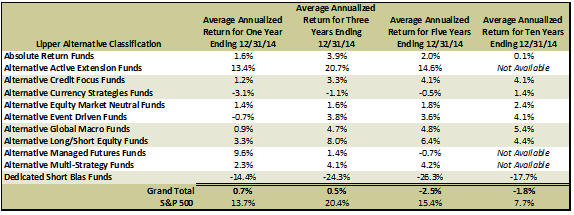
Exhibit 1 offers a quick summary of long-term returns for every Lipper classification of liquid alts.
Exhibit 1: Historical Returns for Liquid Alts:
Lipper Alternative Classifications as of 12/31/14

Let me add a few caveats to this summary:
Classifications can be misleading. The performance of liquid alts requires granular analysis within each classification of each fund. There are simply too many funds that are misnamed and misclassified.
Aggregating returns is misleading. It is common to see aggregate “average” returns for liquid alts, similar to a hedge fund index. But it is confusing to aggregate the performance due to:
-
Factor exposures: Different classifications have different beta exposures. For example, dedicated short-bias funds have leveraged negative equity beta while alternative-active extension funds have positive equity beta.
Weightings: Returns should be also evaluated on an asset-weighted basis, and not on an equally weighted basis (which is the methodology used in Exhibit 1).
-
Benchmarking against stocks is ambiguous. Evaluating the performance of liquid alts raises issues about appropriate benchmarks. The correlations of liquid alts vary widely, though my research has shown that liquid alts often have high correlations to stocks regardless of the fund manager’s claims. Exhibit 1 includes the S&P 500 to put historical returns in perspective.
This return data is merely a starting point, and fund manager due diligence requires many more steps in the research process.
With these caveats considered, two notable trends stood out in 2014 performance: a rebound in managed futures and a disappointment within global macro.
Managed futures rebounds
Way back in 2008, alternative managed futures funds rose 8.3%, compared to a 37% drop in the S&P 500. This sparked a burst of interest among investors. Unfortunately, this performance was followed by a string of weak years during the bull market, and many investors concluded that managed futures were a “bear market hedge” rather than a portfolio diversifier.
The picture changed dramatically in 2014 when alternative managed futures funds rose 9.6%. This reflected the success of trend-following strategies in metals, energy and currencies as described in this review of 2014 performance from Attain Capital.
For additional color on the recent performance of managed futures, I spoke to Brian K. Hurst, principal at AQR Capital Management, LLC on March 4. Hurst is a member of the fund management team for the AQR Managed Futures Strategy Fund (AQMIX, AQMNX, and AQMRX). Those share classes had $6.9 billion of assets on 12/31/14, making this the largest managed futures mutual fund by a wide margin. In fact, the AQR Managed Futures Strategy Fund had 47% of all assets in Lipper’s classification that tracks alternative managed futures funds.
Hurst spoke of the 2014 performance of managed futures. He said:
The first quarter of 2014 was difficult for managed futures since a lot of the trends of 2013 reversed direction in early 2014. Later on in the year, there were a number of profitable developments. The trends turned positive for fixed income (especially in Europe), and we had a positive trend for the US dollar. 2014 also saw negative trends in commodities, especially energy. Managed futures strategies were able to capitalize on these trends whether the price movements were positive or negative.
Equity markets were a detractor in 2014 for us. The selloff early in the year after the rally in 2013 and the choppy equity markets later in October and December led to losses. The whipsaws in equities tend to hurt trend-following strategies.
Despite the rebound in 2014, the annualized five-year returns for alternative managed futures funds is now -0.7%. If nothing else, the unpredictable performance of managed futures shows that investing successfully in liquid alts requires an understanding of trend-following return patterns and patience with the strategy when it is out of sync with the market.
MainStay Marketfield offers a cautionary tale
The alternative global macro funds classification rose a mere 0.9% in 2014, a disappointing performance in a year when the S&P 500 gained 13.7%. Global macro funds typically have a wide dispersion of returns, since most funds are unconstrained by asset class or geography. Returns in 2014 ranged from a low of -14.5% for Old Westbury Real Return Fund (OWRRX) to a high of 18.7% for SEI Institutional Investments Dynamic Asset Allocation Fund (SDLAX).
Regrettably for many investors, the biggest global macro fund was also one of the worst performers in 2014: The MainStay Marketfield Fund (MFLDX) fell 12.3%. Of the 95 primary share classes that Lipper tracks in this classification, MFLDX came in next to last, right behind OWRRX. MFLDX aims for “volatility that is lower than that of the broad equity market” over a full market cycle, so it was quite a surprise to see a 12% drop in absolute terms, and a 26% shortfall when compared to the S&P 500.
MainStay Marketfield has a top-down approach, and as the assets have grown the fund’s thematic approach has become more pronounced. MFLDX used to emphasize small-cap stocks, but in 2012 the fund was acquired by MainStay, part of New York Life Investment Management. MFLDX grew from about $2 billion to over $20 billion, and the large inflows forced MFLDX to focus more heavily on ETFs and large-cap stocks. MFLDX had $13.3 billion in net flows in 2013 alone, and this has created new challenges for the fund.
MFLDX had a strong track record prior to 2014, with returns of 16.9% in 2013 and five-year annualized returns of 15.6% (as of 12/31/13). The fund also had lower max drawdowns than the S&P 500 over the five years ending in 2013, and this attractive combination of risk and return helps explain the large inflows. (The marketing and distribution capabilities of New York Life didn’t hurt either.) But the weak performance in 2014 led to outflows of $7.9 billion.
Capacity issues are common for both mutual funds and hedge funds, and often lead to style drift. In all fairness to the portfolio manager, however, there may be other issues at play. The outflows from MFLDX may have reflected confusion over the objectives of the fund. Given the fund’s track record, advisors probably perceived it as a classic long/short fund rather than as an aggressive global macro fund.
The 4Q 2014 factsheet from MainStay Marketfield described MFLDX as “seeking low-volatility absolute returns in excess of broad equity indexes.” This goal, along with the fund’s mandate to “go-anywhere” in the quest for returns, is a good description of a global macro fund. If that is the case, advisors should not be surprised when investment performance varies widely from the benchmark. (Lipper recently reclassified the fund as global macro while Morningstar still puts MFLDX in the long/short category.
Bottom line: Advisors expected long/short stability and they got global macro volatility.
Lessons from MainStay
The travails of MainStay Marketfield serve as a cautionary tale for advisors about the use and misuse of liquid alts. Here are some lessons:
Capacity: Massive fund flows are a red flag that a fund may experience capacity issues. This dilutes its source of alpha or leads to style drift as the manager scrambles to invest the funds. In the case of MainStay Marketfield, the portfolio manager simply made unsuccessful bets in 2014, and this may soon reverse. Time will tell.
Confusion: The massive flows into MFLDX suggest that some advisors did not understand what they were buying. The fund’s mandate and its top-down approach clearly make it a “go-anywhere” fund, and managers with this approach will have good and bad years; there is no way to predict this in advance. The confusion over MFLDX is not surprising since liquid alts are inherently complex. But advisors should avoid products if they don’t understand the strategy, and they cannot blithely assume that the product classification accurately summarizes the risk/return profile of the fund.
Chasing performance: The flows in and out of MFLDX also suggest that many advisors did not perform sufficient due diligence and may have simply chased performance. This tendency affects investors across asset classes, strategies and investment vehicles, but it is especially dangerous in liquid alts since investors can easily get whipsawed by volatility that is normal for the strategy.
Client education: Most clients do not really “get” the concept of diversification. They want relative returns in bull markets and absolute returns in bear markets. Those clients are not suitable for liquid alts since they will put pressure on the advisor to sell when performance is poor. Client education is difficult to execute; suitability and sophistication are not easily assessed. But advisors should do their best to determine whether clients really understand what diversification entails.
-
Excessive trading: Liquidity is not always a good thing. Just because a product can be traded does not mean it should be traded. A global macro strategy such as that at MFLDX aims for excess returns over a full-market cycle, so it makes no sense to sell after one bad year. Unfortunately, the liquidity of open-end mutual funds encourages excessive trading when a strategy lags the market or the benchmark.
Are liquid alts worth it?
I offer a qualified yes. If the advisor is willing to do the research and due diligence and has a realistic expectation of what these products can do, liquid alts serve a valuable role in a portfolio. On the bright side, many advisors rely on third-party research teams for advice, and gatekeepers are beefing up their research efforts on liquid alts since they believe that clients benefit from long-term diversification via non-correlation.
Advisors are right to be skeptical about most liquid alts. But selective usage can reduce volatility and prevent clients from bailing out at the bottom of a bear market. Liquid alts are one way for advisors to help clients and build a sustainable competitive advantage in their wealth management franchise.
Robert J. Martorana, CFA has been an investment professional since 1985. He owns Right Blend Investing, LLC, which focuses on institutional research of liquid alternatives. He is the co-author of Alts Democratized. The author has a position in MCFAX.
Read more articles by Robert J. Martorana, CFA