The Shiller P/E Enters Rarefied Air
Membership required
Membership is now required to use this feature. To learn more:
View Membership BenefitsAdvisor Perspectives welcomes guest contributions. The views presented here do not necessarily represent those of Advisor Perspectives or of Capital Advisors, Inc.
The domestic stock market cannot deliver a sustainable double-digit return without entering a speculative bubble, based on historical data reflecting correlations between the level of the Shiller P/E and subsequent outcomes in the stock market over the past 134 years. Conditions are ripe for a speculative bubble in the domestic stock market in 2015, and investors should reduce risk in their portfolios in stages during the coming year.
Investors should expect below-average returns from the domestic stock market over the next five to 10 years. Indeed, to expect anything more than mid-single digits requires an assumption that stocks will enter a speculative bubble. The reason is valuation. From today’s valuation level the only way to sustain significant upside is to assume a future valuation multiple that would put the stock market into bubble territory.
The S&P 500 Index was recently trading at a cyclically adjusted price-to-earnings ratio, or “CAPE,”1 of 27.3, meaning the stock market is priced at more than 27 times the 10-year average earnings of the underlying companies in the index. This is highly unusual. Out of 1,608 monthly observations between January 1881 and December 2014, the CAPE for the U.S. stock market has measured 27 or higher just 88 times. That is a frequency of only 5.5% throughout this 134-year period.
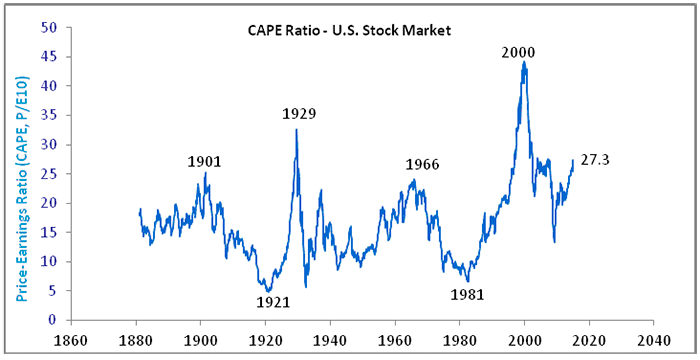
- The source for all references to the CAPE, including the graphic above, is Robert J. Shiller: http://www.econ.yale.edu/~shiller/data.htm
The level of the CAPE is important because valuation is a key driver of future returns in the stock market. The higher the valuation multiple today, the harder it is for stocks to sustain a strong advance in the future. With U.S. stocks already trading within the highest 6% of their historical valuation range, there is little opportunity for further improvement. In other words, the next material change in market valuation has a 94% probability of being lower.
This does not mean the stock market has a 94% probability of going down. It’s the valuation multiple that is vulnerable. This matters a lot for investors because it is very difficult for stocks to deliver an adequate long-term return if the valuation multiple drops materially during the investors’ holding period.
Consider the following hypothetical situation: If you assume corporate earnings can grow approximately 5% per annum over the next 10 years, the future value of the stock market will depend on the valuation multiple 10 years out. The estimated price target for the market index can be combined with the current dividend yield to produce a rough estimate of the annualized return for the next 10 years.
| U.S. Stocks Impact of Valuation Changes Hypothetical 10-Year Illustration | |||||
|---|---|---|---|---|---|
| Beginning CAPE |
Earnings Growth |
Dividend + Yield |
Ending +/- CAPE |
10-Year = Return |
Growth of $1,000 |
| 27 27 27 |
5.0% 5.0% 5.0% |
1.9% 1.9% 1.9% |
20 27 34 |
3.8% 6.9% 9.3% |
$1,452 $1,949 $2,433 |
Source: Capital Advicsors, Inc. It is not possible to invest in the hypothetical market index reflected above.
Let’s consider the implications of the data presented in this table. Today’s high CAPE and low dividend yield make it hard for stocks to deliver a double-digit return under almost any realistic scenario for a sustainable valuation multiple several years out.
The optimistic scenario that generates a 9.3% return requires a future CAPE of 34. In the past 134 years there have been 36 monthly observations where the CAPE was 34 or higher, representing just 2.2% of the sample. All 36 observations occurred during the stock market bubble of the late-1990s.
The low-end scenario above projects a seven-point reduction in the CAPE to 20. Historically, that has been the threshold for the most expensive quartile in the data. In other words, investors may need the valuation multiple to hold within the most expensive 25% of its historical range just to eke out a low-single-digit return from today’s starting point.
Finally, if the CAPE reverts to its long-term average of 16.6 over the next 10 years, the annualized return for the stock market would be around 2% – hardly worth the trouble.
This exercise is purely hypothetical, and the resulting forecasts are rough guesstimates at best, but the underlying assumptions behind these forecasts are well grounded in first principles. Corporate profits grow in line with the nominal growth rate of the economy in the long run. Historically this has been around 5% for the United States. Second, the dividend yield is not a prediction; it’s math. According to Bloomberg, the dividend yield for the S&P 500 Index was 1.93% as of December 31, 2014. Finally, the valuation multiple of the stock market has fluctuated around a relatively stable average throughout history. The specific value of the CAPE is unpredictable in the short-term, but the long-term range of possibilities is well established.
It gets worse. To participate in this subdued outlook for stocks, investors must assume a level of risk greater than average. Historically, it has been nearly impossible for reality to live up to investors’ expectations when the Shiller PE reached similar rarefied air.
The data for one-year holding periods are below. This table summarizes every 12-month holding period in the past 134 years that began with a CAPE of 27.0 or more (there are 87 periods in the sample; December 2014 represents the 88th observation).
| U.S. Stock Market Range of Outcomes Following CAPE Valuation of 27.0+ 12-Month Holding Periods 1881 – 2014 |
||
|---|---|---|
| Beginning CAPE 27+ |
Entire History |
|
| Average 12-Mo. Return % of Periods Negative % of Periods -20% or Worse % of Periods +20% or Better |
1.4% 51% 18% 24% |
10.8% 28% 5% 31% |
Source: Robert J. Shiller; Standard & Poor's; Morningstar Ibbotson; Capital Advisors
This data show that the risk-reward tradeoff for 12-month holding periods has been decidedly less favorable when the starting valuation multiple was high as measured by CAPE. The one area where high valuation showed little difference relative to the entire sample was in the frequency of positive returns of 20% or more. This seems counterintuitive, but it actually makes sense. Compare this to life expectancy among humans. At birth the average life expectancy is 78.7; but among 65 year-olds it shifts to 84.1; and for those who make it to 75 the average is 87.1 (source: Centers for Disease Control/CDC). The biological and social circumstances that carry some people to 65 in the first place raise the odds that they will continue exceeding the statistical average going forward. Likewise for the stock market, the economic and psychological conditions that carry stocks to a CAPE of 27 in the first place have tended to persist – for at least a little while.
When the time horizon is extended to three years the risks associated with high valuation come into sharper focus. The data below represent the same study applied to 36-month holding periods instead of 12-months. Statistically speaking, the domestic stock market is likely to lose money over the next three years.
| U.S. Stock Market Range of Outcomes Following CAPE Valuation of 27.0+ 36-Month Holding Periods 1881 – 2014 |
||
|---|---|---|
| Beginning CAPE 27+ |
Entire History |
|
| Average 36-Mo. Return % of Periods Negative % of Periods -20% or Worse % of Periods +20% or Better |
-0.3% 55% 35% 23% |
10.4% 16% 5% 62% |
*Annualized
Source: Robert J. Shiller; Standard & Poor's; Morningstar Ibbotson; Capital Advisors
Based on the data presented above, investors might be inclined to abandon stocks altogether. This would be a mistake because it ignores the many favorable conditions that have driven stocks to a CAPE of 27 in the first place. Corporate profit margins are at an all-time high at the same time that interest rates are at a historical low across most of the developed world. These conditions raise the intrinsic value of equities while simultaneously reducing competitive pressure for investor asset preferences between stocks and bonds.
More recently, domestic asset markets may be benefiting from a rising dollar caused by diverging monetary policies among the three major economic blocks of the developed world. In October the United States began a gradual shift toward tighter monetary policy by concluding its third round of quantitative easing (QE) and signaling its intention to raise interest rates in 2015. Meanwhile, the European Central Bank (ECB) has signaled a shift toward easier monetary policy by preparing a QE program for the euro zone, and Japan has doubled-down on its long-running program of aggressive monetary stimulus.
These diverging monetary policies put upward pressure on the U.S. dollar relative to the Japanese yen and the euro. This in turn makes dollar-based financial assets more attractive to foreign investors who stand to benefit from a favorable currency conversion on the interest and dividends they earn in dollars. Conversely, international markets look less attractive to U.S. investors because of a negative currency conversion for foreign interest and dividends.
A strong dollar increases the global appetite for U.S. financial assets of all kinds. This in turn supports a further strengthening of the dollar, which reinforces a global preference for U.S. assets. This is precisely the kind of self-reinforcing feedback loop that could drive the U.S. stock market into bubble territory in 2015.
The bottom line is that stocks look very expensive by historical standards, a fact that all but guarantees below-average returns over the next five to 10 years. Yet conditions are ripe for continued momentum in the near-term, including a speculative bubble in 2015. Investors would be wise to reduce risk in their portfolios in stages as market conditions evolve in the coming year. For conservative investors, the best time to start this process was yesterday.
Keith Goddard is the CEO and Chief Investment Officer of Capital Advisors, Inc. As of December 31, 2014, Capital Advisors served as manager and advisor to approximately $1.5 billion in client assets.
Membership required
Membership is now required to use this feature. To learn more:
View Membership BenefitsSponsored Content
Upcoming Virtual Events View All













