Advisor Perspectives welcomes guest contributions. The views presented here do not necessarily represent those of Advisor Perspectives.
We are at a turning point: away from one global monetary standard, to a yet-to-be-determined new form.
The Great Depression marked the start of the transition of the reserve currency from the gold standard to the dollar. The unconventional emergency measures taken by the Federal Reserve in 2008 and the continued use of quantitative easing (QE) by central banks mark the departure from the dollar standard in the current era. This insight is found in Bernanke’s academic work and the frequent current parallels he has drawn to the Depression, but gets largely overlooked since he assumes knowledge of key facts of the earlier era’s global economy.
Comparisons to the Depression help us to understand our historic transition point and the current actions of the Fed. By implication the ensuing period of change from one financial standard to the next will continue to produce sudden and unpredictable results, both inflationary and deflationary, depending on each country’s currency, economy and trade balances.
In the first of this three-part series, I discussed the important and growing force that demographics will come to play in the mutual fund industry. In the remaining two essays, I place the current Fed’s extraordinary monetary policy into historic context. In part 3, I will shed light on the forces that took the Fed to this point while propelling the fund industry in the 1980s and 1990s and how it will continue to pressure the industry in new ways.
Historical parallels between today’s crisis and the Depression
Bernanke’s scholarly work and his public comments show the consistency of his views on the Depression and today’s crisis. In both cases he advocated for the government to part with convention and create new standards, because rigid adherence to prevailing standards threaten to place the entire system at risk.
The U.S. in the 1920s, like China today, was rapidly emerging as a world power due to a favorable trade surplus with the rest of the world. After having pursued highly expansionary economic policies, also like China it was faced with calls to further stimulate its economy to support global demand.
The departure from the gold standard, initiated by European countries, was a response to the US inability and refusal to comply with requests to stimulate its economy in a manner that was helpful to Europe and it was obliged to do under the rules of the gold standard. QE, like the departure from gold, is an experimental response by the US (and other countries), which like Europe in the Depression suffers from current account deficits and high debt levels and seems to have few remaining policy options. Maintaining steady growth and removing the threat of systemic collapse are the priorities that call for changing long accepted rules governing both the role of the central bank and its accepted forms of private market involvement.
Unlike Europe, the US entered the Great Depression with overall finances and trade in remarkably good shape – its flaw was policymakers lacking in understanding of the propensity for “financial accelerators” at times to do damage to the real economy and for that damage to persist for prolonged periods of time.
An explanation of Bernanke’s financial accelerator
Both the Depression and the 2008 crisis were preceded by historic long-term expansion of private debt to GDP. Neoclassical and Keynesian economic models have been criticized for not factoring in the role of credit intermediaries and debt expansion when considering the causes of both crises. Both models view financial intermediaries as mere agents in an economy that passively redirect credit. Classical economists of the 1930s saw the purge in speculative credit that led to the Depression as a healthy redistribution of wealth from debtors to creditors. In 1983, Bernanke addressed this shortcoming in his “financial accelerator” model that drew from several schools of thinking and originated with Irving Fisher 1933, whose view it was that collapsing credit and unanticipated asset-price markdowns led to self-reinforcing “debt deflation”.
In Bernanke’s model, financial intermediaries contribute to aggregate demand by amplifying business cycle swings. The decision to lend and the premium charged for financing is directly related to the net worth of the borrower. Borrowers with higher net worth have lower default risk, which in turn entitles them to a lower premium for external financing. The lower financing premium in turn increases the capacity of the borrower to expand its income earning potential, thereby further increasing net worth which again permits him to borrow more. He notes, “There is a kind of multiplier effect. An unanticipated rise in asset prices raises net worth more than proportionately, which stimulates investment and, in turn raises asset prices even further. And so on.” Bernanke’s model working in equilibrium checks asset price rises eventually as entrepreneurs leave the industry and net worth stabilizes.
The greater concern arose in the case of both the Depression and the 2008 crisis when the economy was is in disequilibrium, having been powered over extended periods of time by the continuous expansion of private debt to total GDP.
The figure below presents two private-debt-to-total-GDP data series for the U.S. Several adjustments to the original data that assist in making the comparison are highlighted in Appendix 1.
Figure 1
Private debt-to-GDP 1890-2012
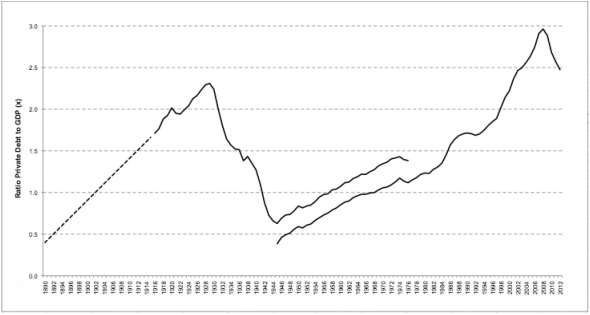
In the two decades preceding the 1929 peak, total private debt increased by 200%. This is significantly tamer than the 400% increase in the comparable timeframe prior to 2008.
The magnitude of risk that debt deflation posed to the economy exceeded the level reached during the Depression since the late 1990s. The experience since that time has been one of policymakers pursuing all means possible to continue the expansion of private debt. Any collateral imbalances or asset bubbles were seen as less damaging than a full-out debt deflation. The solution to too much debt was more private debt, until the breaking point in 2008 was reached. The government stepped in, as it did in the 1930s, to replace collapsing aggregate demand from stagnant private debt growth with spending fueled by expansion of debt.
The creation of private debt has a direct relationship to the long-term negative US current account deficit, which I will explore in part 3. Similarly, debt creation prior to the Depression was also trade related. Contrary to popular belief, debt creation worked in an unconstrained manner unhinged from the gold standard, but in terms of trade, the US was in the much better position of having long enjoyed a trade surplus.