Advisor Perspectives welcomes guest contributions. The views presented here do not necessarily represent those of Advisor Perspectives.
 This essay is excerpted from a recent version of The Credit Strategist (formerly the HCM Market Letter). To obtain the complete issue, you must subscribe directly to this publication; Please go here. The Credit Strategist is on Twitter - @credstrategist
The election is mercifully over. The configuration of government has not been changed although the hand of the Democrats has been strengthened. Ironically, the primary thing that went up in smoke with Mitt Romney’s candidacy is the possibility of change from the last four years. Coming with the re-election of a man whose entire presidency has been based on the prospect for change, this brand of irony has to sting. While there may be compromise to avoid the self-inflicted crisis of the fiscal cliff, the course of fiscal policy is unlikely to alter significantly. There is a great deal of bold talk about tax reform, but the odds of our current leaders replacing our profoundly flawed tax regime with one that would breed economic growth and productivity are low. Congress will be lucky to avoid the fiscal cliff; asking it to alter the economy’s DNA is unrealistic.
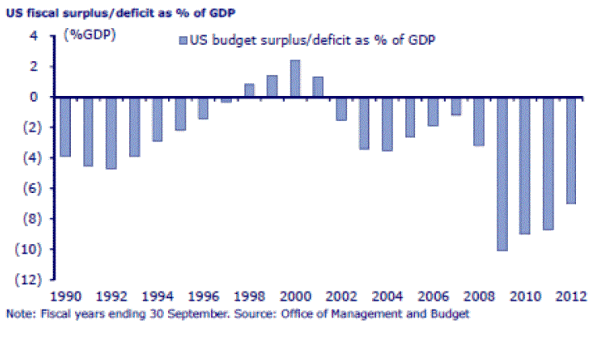
Figure 1
Terminal Deficits
The election revealed the cracks in the Republican program. Mitt Romney should have been able to win this election, yet he didn’t really come close. There are many reasons why he lost. Here is our catalogue of some of them.
- Mr. Romney’s campaign was logistically inferior to Mr. Obama’s. The community organizer out-managed the private equity manager by a long shot.
- Mr. Romney emerged from the Republican primaries badly tarnished by personal attacks made by other candidates who frankly never had a chance to win the nomination. The party needed its politicians to put the interests of the party ahead of their own selfish interests; instead it allowed its candidates to cannibalize each other. By the time Mr. Obama arrived at the scene, he was just picking at the bones.
- The Republicans are on the wrong side of globalization. The United States is becoming more ethnically and religiously diverse; white are no longer the majority of the population. Instead of appealing to a populace that isn’t there any longer, the party needs to adapt its message to a multi-ethnic and aspirational constituency while walking the fine line between promoting equality of opportunity rather than equality of result.
- The Republican Party needs to find a way to reduce the influence of its right wing. Republicans believe Americans want to be left alone by their government, yet they promote retrograde social policies that police private behavior and perpetuate inequalities that deprive individuals of freedom of choice. Without a more libertarian bent to their policies, the party will continue to alienate large groups of voters – young people, gays, minorities, etc. While Republicans would like to think that all Americans are equally situated, they need to acknowledge that many people’s personal choices are limited by their economic and social circumstances. This is why the party’s antediluvian immigration policies must change to reflect not only reality but humanity.
- The Republicans were too dependent on their anti-tax orthodoxy particularly when the current tax system exacerbates economic inequality on a daily basis. It is very difficult for them to make the case for lower taxes leading to prosperity when the Clinton Presidency proved precisely the opposite. Republican anti-regulatory and tax policies are still perceived as the primary causes of the financial crisis. Nominating an individual who could be painted as benefitting from some of the most pernicious of these policies (i.e. carried interest tax break, offshore bank accounts, leveraged buyouts) was unwise, as I noted at the time. In order to get out front on the tax issue, the Republicans need to put forth a plan that not only contributes to economic growth but also to tax fairness. The key to any such plan would be the elimination of the differential tax treatment of capital and labor. Those with capital (the wealthy) should not enjoy huge tax advantages over those who only have their labor to trade.
The nausea of the election will now be replaced by the nausea of the watching Congress wrestle with the fiscal cliff. While it would be act of epic stupidity for Congress to allow the country to drive over this cliff, avoiding it will almost certainly involve delaying difficult decisions on entitlement reform and defense spending. Congress is unlikely to act until the last possible minute. The media is bending over backwards to extract any strain of bipartisanship from the comments of Barack Obama and John Boehner. I don’t buy it. What I heard John Boehner say is that the Republicans will accept higher taxes as part of a larger tax reform plan; that statement places an all-but-impossible condition on Republican agreement to raise revenues. Mr. Obama has already said he will veto any plan that doesn’t raise taxes on those earning more than $250,000 a year. As opening negotiating gambits, both leave a great deal to be desired. The election did little to alter the competing views of government and economics that divide the parties. The problem is that neither philosophy of government has cornered the market on wisdom.
The fiscal cliff debate spells more volatility for the markets. But this debate is a sideshow. The main event is reducing the growth of the $16 trillion federal deficit and putting a definitive end to $1 trillion annual deficits. By 2016, the federal deficit will be pushing $20 trillion. Will the economy be $20 trillion in size by then? I doubt it. The current fiscal path of the United States is clearly unsustainable and will sooner or later trigger a crisis. Moreover, the next crisis will occur in a more leveraged and interconnected global market system that is populated by fewer too-big-to fail institutions. Moreover, we have done little to regulate the hundreds of trillions of dollars of outstanding derivatives contracts (largely due to efforts by Wall Street to derail reform). Unfortunately, until a crisis puts the fear of God into our leaders, they are unlikely to do more than the minimum with respect to any of these fiscal challenges. In 2008, the powers-that-be were able to pull the world back from the brink; nobody can assure us they can repeat that feat the next time the system freezes up.
Europe
When the people in charge are the last to know what’s going on, you know you’re in trouble. Yet time and again Europe’s political and economic leaders seem unprepared for what appears obvious to everybody else. Did they really think Greece was going to be able to keep its promises this time? What is different now versus the last two times Greece had to be given more time or more money to avoid a free-fall default? Actually, there is a great deal that is different, but none for the better. Today, Greece’s economy is weaker than it was the last time it needed a bailout, deeper into depression, and less capable of producing the income necessary to repay its debts. The youth unemployment rate is now a frightening 58% (up 4% during the month of October). Greece is well on its way to becoming a failed state thanks to the demands of Germany and the European Central Bank (ECB). How could it be otherwise when austerity starves the economy of the fuel it needs to run?
Further, who in the world believed that Germany would be immune from the economic collapse of its major trading partners? I have been arguing for months that German growth would not only slow but likely recede, and that is precisely what is happening. Despite Germany’s economic might, the country’s balance sheet is increasingly burdened with debt, which will depress growth. On November 7, the European Commission rained on Barack Obama’s victory parade by forecasting that German growth would be a mere 0.8% in both 2012 and 2013. The Commission lowered its 2013 forecast of overall European growth to an even weaker 0.4%. Now that the election is over, investors can start worrying about Europe all over again. Some of us never stopped worrying. Europe is not stabilizing; it is sliding deeper into an economic abyss. Those arguing otherwise should share with the rest of us the herbs they are smoking (which are now legal in two more states).
Market Outlook
Those arguing that the stock market is going to rally have to rationalize two serious headwinds. First, corporate earnings appear to have peaked in this business cycle. Second, investors are unlikely to pay higher multiples for declining earnings in a fragile macroeconomic environment. There is good reason why the S&P 500 has fell below its 200-day moving average last week.
Traditional measures place the S&P 500’s earnings multiple at 12x, well below its average of 15x. But as the debate over valuation, there is another measure of stock prices that is receiving more attention: the S&P 500 Shiller P/E (the “Shiller P/E”).
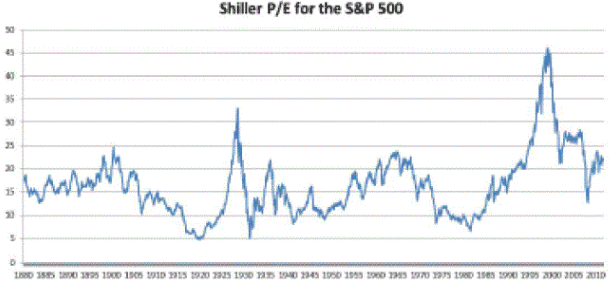
Figure 2
Cyclically Adjusted P/Es
While traditional P/E multiples are based on one year’s earnings, the Shiller P/E uses the average of the prior 10 years of trailing earnings (adjusted for inflation). In other words, traditional P/E measures what an investor pays for one year’s earnings while the Shiller P/E measures what an investor pays for the last 10 years average real S&P 500 earnings. A recent paper by the highly respected Cliff Asness of AQR Capital Management paints a sobering picture of the stock market’s prospects in terms of the Shiller P/E. At the end of September, the Shiller P/E was 22.2x (it is slightly lower now). This is much higher than the average of 16.5x reaching back to 1881, although it is about half of the peak multiple during the 1999-2000 stock market bubble. The Shiller P/E seeks to smooth out booms and busts and measure earnings over the economic cycle. As Figure 2 above illustrates, stocks look reasonably priced compared to the average price of stocks since 1985. But that period’s average stock price was arguably grossly distorted by the Internet Bubble of the late 1990s. Viewed in a longer historical context, stocks are not inexpensive at all.
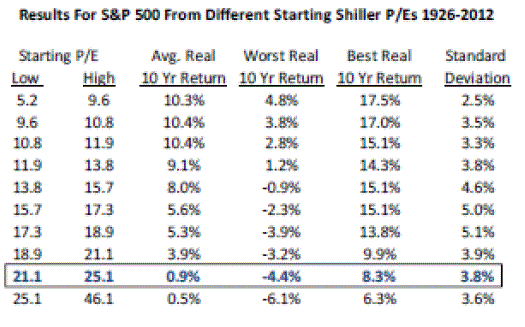
Of more concern, however, is Mr. Asness’s work on how the stock market performs in periods after its valuation reaches its current level. Figure 3 shows the average, worst and best real (inflation-adjusted) returns for the S&P 500 at various starting P/E ratios. Based on the current ratio in the low 20x range, history suggests that investors may be facing another decade of disappointing returns in stocks.
Figure 3
A Grim Stock Market Outlook
Mr. Asness does point out that this chart has been criticized for small-sample bias and other statistical problems. He also notes that the Shiller P/E is not always useful as a guide to stock prices. He concludes that he would not make a large tactical position based on the Shiller P/E alone but would take it into consideration particularly when it is below 10x or over 30x. At its current level in the very low 20s, he does make a reasonable case that one should not expect stock market returns of 10% over the foreseeable future.
Last week, I had the pleasure of attending a presentation by my friend Lee Cooperman. I believe I am correctly characterizing Mr. Cooperman’s view of the market as agnostic; he sees potential 10% upside or downside from here. Nonetheless, he strongly believes that stocks are more attractive than other asset classes. His view is based on a number of factors, but the comparison he showed between stock prices and corporate bond yields sums it up very nicely. The S&P 500 (using a traditional measure and not the S&P 500 Shiller P/E) is trading today at the same multiple that it was trading at in 2009, but high yield bond spreads today are only 630 basis points over Treasuries compared with a mouth-watering 2,500 basis points three years ago. In other words, stock multiples have not moved but high yield bond spreads have compressed by 75% (applying the S&P 500 Shiller P/E would not alter this argument). Mr. Cooperman’s point is that on a valuation basis, stocks are far more attractive than corporate bonds – and he is absolutely correct. That doesn’t mean that there aren’t opportunities remaining in the corporate bond market, but those opportunities are far more limited than they were after the market was crushed by the 2008 financial crisis. The same argument would apply to opportunities in the stock market even if one agrees that stocks are overvalued (or at least not “cheap”). Perhaps the most interesting observation made by Mr. Cooperman during the presentation is one that I have heard him make before: stock market prognostications tell us much more about the prognosticator than the likely direction of the market. Coming from one of the great readers of the market over the last 40 years, that is a truth that all of us should bear in mind.
Months ago, I was telling people that the Dow could drop by 1,000 points in the two days following an Obama re-election. Fortunately, I was only 40% correct in this instance. American voters appear to be satisfied with policies that will insure years of below-trend growth and ever-increasing debt; or perhaps they are just resigned. The solutions on offer from Washington will do little to alter the dangerous course of U.S. finances. Even Simpson-Bowles, whose adoption would be greeted with glee by the stock market, is unlikely to truly alter the debt-laden economic trajectory on which this country is set. But it would provide a start as well as a sign that we are capable of governing ourselves to some degree. Equities may be more attractive than bonds on a valuation basis, but that won’t be enough to make them go up. With revenues and earnings faltering, equities will not rise until confidence increases – confidence in the economy and confidence in our leaders’ ability to govern effectively. If they whiff on the fiscal cliff, the stock market will suffer.
Michael E. Lewitt
[email protected]
Disclaimer
All opinions and investment recommendations expressed by Michael E. Lewitt in The Credit Strategist as well as on Twitter under the Twitter name @credstrategist are solely the opinions of Mr. Lewitt and do not reflect the opinions of Cumberland Advisors or its affiliates or employees, managing directors, owners or principals.
Disclosure Appendix
This publication does not provide individually tailored investment advice. It has been prepared without regard to the circumstances and objectives of those who receive it. This report contains general information only, does not take account of the specific circumstances of any recipient, and should not be relied upon as authoritative or taken in substitution for the exercise of judgment by any recipient. Each recipient should consider the appropriateness of any investment decision having regard to his or her own circumstances, the full range of information available and appropriate professional advice. The editor recommends that recipients independently evaluate particular investments and strategies, and encourages them to seek a financial adviser’s advice. Under no circumstances should this publication be construed as a solicitation to buy or sell any security or to participate in any trading or investment strategy, nor should this publication or any part of it form the basis of, or be relied on in connection with, any contract or commitment whatsoever. The value of and income from investments may vary because of changes in interest rates or foreign exchange rates, securities prices or market indexes, operational or financial conditions of companies, geopolitical or other factors. Past performance is not necessarily a guide to future performance. Estimates of future performance are based on assumptions that may not be realized. The information and opinions in this report constitute judgment as of the date of this report, have been compiled and arrived at from sources believed to be reliable and in good faith (but no representation or warranty, express or implied, is made as to their accuracy, completeness or correctness) and are subject to change without notice. The editor may have an interest in the companies or securities mentioned herein. The editor does not accept any liability whatsoever for any loss or damage arising from any use of this report or its contents. All data and information and opinions expressed herein are subject to change without notice.
The Credit Strategist
Michael E. Lewitt, Editor
The Credit Strategist is published on a monthly basis by Michael E. Lewitt. Address: 5030 Champion Blvd., G6 #161 Boca Raton, FL 33496. Telephone: (561) 239-1510. Email: . Delivery is by electronic mail. Annual subscription rate is $395 for individuals and $995 for institutions. Visit our web site at www.thecreditstrategist.com. Copyright warning and notice: It is a violation of federal copyright law to reproduce or distribute all or part of this publication to anyone (with the exception of individuals within the same institution pursuant to the subscription agreement) by any means, including but not limited to photocopying, printing, faxing, scanning, e-mailing, and Web site posting without first seeking the permission of the editor. The Copyright Act imposes liability of up to $150,000 per issue for infringement. Information concerning possible copyright infringement will be gratefully received.
Read more articles by Michael Lewitt
 This essay is excerpted from a recent version of The Credit Strategist (formerly the HCM Market Letter). To obtain the complete issue, you must subscribe directly to this publication; Please go here. The Credit Strategist is on Twitter - @credstrategist