Advisor Perspectives welcomes guest contributions. The views presented here do not necessarily represent those of Advisor Perspectives.
With alternative investments and active management strategies growing ever more popular, an advisor recently told me, "It's just a fad and will end with heartache as all investment fads do. I've watched it play out over and over during my 30-year career."
But I am not persuaded. The secular market cycle today is different from the bear market 30 years ago, and not all market cycles favor the same investment strategies.
While we often focus on the long-term return of stocks, the reality is that market growth is very uneven, not just due to volatility, but also because markets go through long-term secular bull and bear cycles. In a secular bull market – such as the one that fueled stock prices’ rise between 1982 and 2000 – the optimal investment strategy is fairly straightforward – buy and hold, buy more on the dips, and dial up leverage and risk exposure. In a secular bear market, though, buy-and-hold produces the flat returns associated with the overall markets. Concentrated portfolios of carefully selected stocks, sector rotation, alternative investments, and tactical asset allocation become more effective.
Using the wrong strategy for the prevailing investment environment produces poor results. Just as many styles of active management generated little to no value and became a cost drag in the 1980s and 1990s, so too does buy-and-hold now generate benchmark returns that will do little to achieve client goals.
The ultimate key is to match the investment strategy to the market environment, given that such cycles can persist for one to two decades. A secular bear market has been underway for 12 years, and it appears it will continue for a while yet – which means the appropriate investment strategies still have many more years to shine.
Defining secular market cycles
Secular stock market cycles are extended periods when markets deliver below-average or above-average returns. Often lasting for one or two decades, secular bull and bear markets are an important backdrop to the overall market environment; although shorter-term, cyclical bull and bear markets (which might last one to three years) can both occur within a broader secular bull or bear environment, the secular market serves as an overriding tailwind or headwind that further enhances or reduces market returns.
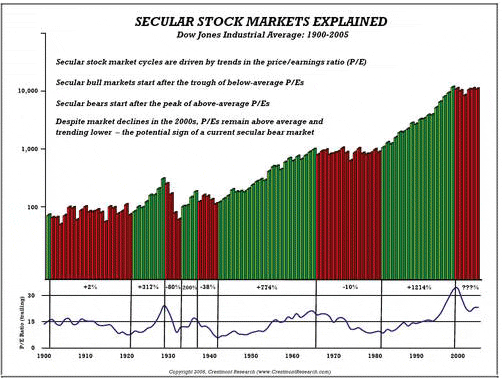
As it turns out, not only have these secular market cycles occurred with amazing consistency throughout history, but they also follow a predictable pattern: bear market cycles begin once markets reach historically high P/E ratios, and continue until markets reach historical lows, at which point a secular bull market begins, carrying the markets higher and higher until valuation once again reaches a historical peak, and the cycle begins anew. A visualization of secular market cycles over the past century from Crestmont Research is shown below.

As the chart shows, green sections are secular bull markets, during which prices rose nearly unabated for an extended period of time. Red sections, on the other hand, represent secular bear markets, where prices typically barely broke even, or even finished lower, at the end of the phase. As you can see from the bottom area of the chart, the defining line between secular bull and bear market cycles has been when valuation – not prices – make a peak or trough.
Virtually all of the cumulative return for the past 100 years actually came in approximately half of those years – the secular bull market environments. During the other half of the century, markets merely treaded water while the economy and earnings grew, until valuations eventually reached a trough at the lower end of the range so a new bull market cycle could begin.
Secular market cycles and investment strategies
As a result of this underlying dichotomy, the investment strategies that will be most advantageous shift over time.
In a secular bull market cycle, the optimal strategy is to buy and hold, and buy more on the dips when the market (temporarily) declines. Increasing leverage or exposure to riskier assets can generate even greater returns, given that there is little actual risk – in secular bull markets, any cyclical bear markets end quickly as the market resumes making new highs. The end phase of secular bull markets is often marked by euphoria where stocks are seen as virtually riskless, equity exposure is at all-time highs, and investment account margin loans and other investment leverage is high. As long as the secular bull market persists, these strategies continue to be effective. Until the cycle turns.
When the secular bear market cycle begins, the optimal investment strategies shift significantly (and can affect other planning strategies as well). As the above chart illustrates, buy-and-hold during a secular bear market leaves the client with roughly the same amount of money one or two decades later (or even underwater, after inflation), which may drastically fall short of the client's financial planning objectives. Accordingly, as I wrote in Understanding Secular Bear Markets: Concerns and Strategies for Financial Planners (FPA membership login required) in the March 2006 issue of the Journal of Financial Planning (with co-author Ken Solow), four strategies are typically popular in secular bear markets to combat the low-return environment: concentrated stock-picker portfolios, sector rotation, alternative investments, and tactical asset allocation.
Many of those secular bear market investment strategies have been neither popular nor successful since the 1970s – when the markets last went through a major secular bear market. Back then, many investment funds that couldn't effectively manage the secular bear environment shut down, with huge rewards accruing to the few who did figure out how to survive and thrive (such as Warren Buffett and Peter Lynch) and enjoy the secular bull market as it began in the early 1980s. During the two decades that followed as the secular bull market continued, the more active secular bear market strategies were both unnecessary – expanding P/E multiples benefited all investment approaches – and resulted in a cost drag for active management that didn’t produce much benefit – because the "benefit" in a secular bull market is dialing up risk and leverage, not actively managing it!
Looking back and looking forward
Veteran advisors understand that the 1980s and 1990s were characterized by a secular bull market, where buy-and-hold-and-buy-more-on-dips was a remarkably efficient and effective investment strategy. It's nearly impossible for an active manager to shine without dialing up risk (which continues to work until the cycle turns and it stops working). But since the market valuation peak in 2000, a secular bear market has been underway, leading to a 12-years-running investment period in which equities have made little or no progress. While some markets have at least broken even or generated a slight positive return with dividends, in the preceding 12 years, between 1988 and 2000, the market exploded, with the S&P 500 price level alone rising from just over 300 to more than 1,500 (not including dividends) – a remarkable contrast to the fact that now the S&P 500 is still at its 1999 levels!
Investors have been seeking new approaches to replace the predictable failings of buy-and-hold in a secular bear market, and advisors feel the pressure to come to the table with better investment offerings, more alternatives, or some other way to generate the returns that clients need to achieve their financial planning goals. As long as the secular bear market persists, continuing to invest as though it's a secular bull market will continue to result in unfavorable outcomes.
At some point the cycle will turn, and a new secular bull market will begin. At that time, buy-and-hold-and-buy-more-on-dips will once again become a popular and effective strategy, and active managers will again struggle to add value short of just adding risk. However, history shows clearly and consistently that secular bull markets do not begin until markets regress not just to the average P/E ratio, but to the lows, suggesting that this secular bear market may still have many years left to play out, given a Shiller P/E ratio that still exceeds 20. New secular bull markets typically don't begin until the 6-10 P/E range.
In fact, as Ed Easterling recently pointed out in an Advisor Perspectives commentary, the current Shiller P/E ratios are remarkably close to where secular bear markets normally begin, not end – the past 12 years of dismal returns have merely compressed valuations from nosebleed heights down to a level of "merely high."
As it stands now, secular bear market investment strategies may still have more than a decade of life remaining, after already being effective for the past 12 years. That’s more than a passing fad to me.
For those interested in reading more about secular bull and bear market cycles, I highly recommend the resources at Crestmont Research, including Ed Easterling's two books, Unexpected Returns: Understanding Secular Stock Market Cycles and his more recent Probable Outcomes: Secular Stock Market Insights.
Michael E. Kitces is the publisher of the e-newsletter The Kitces Report at www.kitces.com and author of the blog, The Nerd’s Eye View, where this was originally published.
Read more articles by Michael Kitces