Advisor Perspectives welcomes guest contributions. The views presented here do not necessarily represent those of Advisor Perspectives.

This essay is excerpted from a recent version of The Credit Strategist (formerly the HCM Market Letter). To obtain the complete issue, you must subscribe directly to this publication; Please go here. The Credit Strategist is on Twitter - @credstrategist
“To view…fund managers as immoral was a gross simplification of the world. And what was there to replace capitalism, anyway? Communism? Theocracy? Most of the Third World had already suffered nearly terminal bouts of idealism. It was the Communists, after all, who had littered the world with cheap AK-47s in order to ‘liberate’ the masses. But the only lasting effect was that every wall between Cairo and the Philippines had at least one bullet hole in it. But nothing changed. Nothing changed because these alternate belief systems flew in the face of human nature. Of even common sense. Anyone who has ever tried to share pizza with roommates knows that Communism cannot ever work. If Lenin and Marx had just shared an apartment, perhaps a hundred million lives might have been spared and put to productive use making sneakers and office furniture.”
Daniel Suarez, Daemon (2009)
There is a famous story attributed to the great British playwright George Bernard Shaw that in many respects describes what is happening in Europe today. Shaw was speaking with a woman at a party (apparently he attended a lot of parties) and told her that anybody would agree to do anything for money if the price was high enough. The woman disagreed, so Shaw asked her if she would sleep with him for £1 million. She said, “Well, I might for £1 million.” Shaw then asked, “Would you sleep with me for ten shillings?” The woman answered: “Certainly not! What do you take me for?” And Shaw replied, “We’ve already established what you are, Madame, now we are merely haggling over the price!”
Europe is little different than a woman who is willing to sleep with a man for £1 million but not for 10p. She knows what she is but wants to haggle over the price. In the case of Europe, she is insolvent, and hopelessly so. Her procurer – in this case the European Central Bank (ECB) – can front her some money for a while, but in the end she is either going to have to repay him or suffer a very rough consequence. In the meantime, however, she can continue to entertain her customers, in this case those willing to extend her credit in one form or another. Sooner rather than later, however, these creditors are going to grow tired of her tricks and turn their attention otherwise. At that point, she will be left to deal with the ECB because nobody else will have her.
The world eases
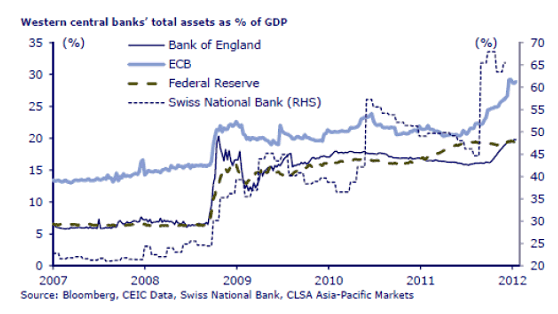
Over the past several months, the developed world’s central banks have shifted toward a decided easing mode through quantitative easing. The Federal Reserve adopted Operation Twist, the Bank of England engaged in a new round of bond purchases, and the ECB has been purchasing the bonds of its weak sisters and launched its LTRO program in December (another tranche is due this month). Even China, which has less room to ease given rapid credit expansion over the last three years, has loosened the monetary reins recently as well. Figure 1 below shows the increasingly dominant role played by these central banks (and the Swiss National Bank) in their respective economies. Central bank balance sheets are swelling to record levels as unsustainable private sector debt burdens are being shifted to the public sector.
Figure 1
Central banks rule
In the short term, central bank easing is producing improved funding conditions in the private markets. Weak European sovereigns such as Italy and Spain have thus far been able to fund themselves at lower rates. European banks are also seeing improved spreads although their access to capital markets remains limited. The covered bond market has been relatively hospitable to the strongest European banks, a promising sign. Important indicators such as the Euribor-OIS spread have rallied for four consecutive weeks and aggregate bank spreads have also tightened by almost 100 basis points. For the moment, the financial system has backed away from the precipice. While all of these are promising signs, they will go for naught if they are not accompanied by meaningful reform of the labor markets in southern Europe and other pro-growth changes throughout the European Union. But they are certainly better than the situation that we were facing at the end of the year.
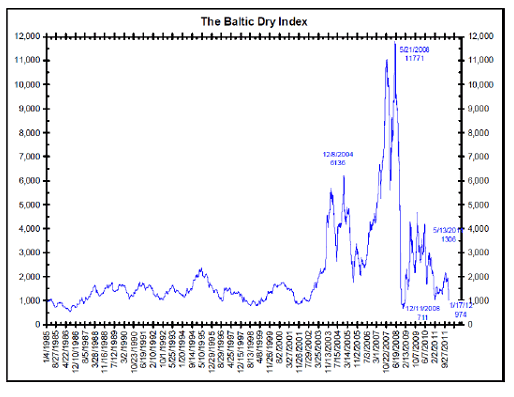
Despite these Herculean easing measures, global growth remains below potential. One worrying sign is a sharp drop in the Baltic Dry Index (see Figure 2 on the next page). This index fell below 1000 for the first time since January 2009 on signs that Chinese demand for iron-ore cargoes is slowing. Thus far in 2012, this index is down 44 percent, led by weaker Chinese demand for iron ore. The Baltic Dry Index has often been a good indicator of a coming slowdown in economic activity. It suggests that the world’s central banks will have to keep their pedals to the metal in order to sustain global growth in the year ahead. It also suggests that organic growth remains extremely weak as the world continues to fight its way out of the debt crisis. It is far too soon to break out the champagne glasses, although one might have thought differently had one a strong enough stomach to watch the coverage from Davos.
Europe
The self-congratulatory tone of Davos was particularly frustrating to watch this year. For those of us who stopped being fooled a long time ago, it was galling to sit and watch Jean-Claude Trichet and Mario Draghi congratulate themselves for delaying the day of European reckoning for a year or so. What these men need to be doing is convincing southern European leaders to impose meaningful labor and other reforms to render their economies competitive. Then again, these leaders are the descendants of the generations that stumbled into two world wars, the Holocaust, and countless other smaller disasters along the way, so perhaps we should not expect more of them. But since we are the ones who will be living with the consequences of their errors, it is our duty to speak out in order to try to produce a better outcome.
Figure 2
Baltic Dry Index Collapses
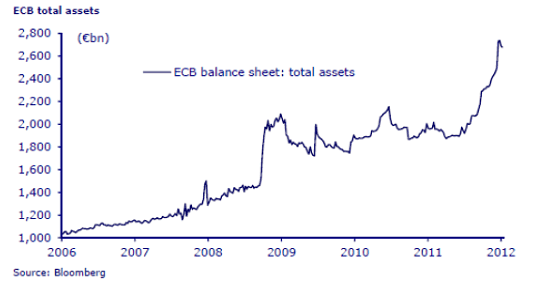
For the umpteenth time, you cannot solve a debt crisis with more debt. Figure 3 on the next page shows the results of the ECB’s efforts to bail out insolvent countries and banks – it has merely shifted bad debts from the banks’ balance sheets to their own. Nobody can say precisely how much of the ECB’s €2.8 trillion ($3.4 trillion) of debt will not be repaid, but the amount of bad debt is much bigger than a bread box. Despite all of the changes that we see in the world around us, the basic laws of economics have not been repealed. It would be nice to think that just because we can create derivative financial instruments out of thin air that these instruments will automatically have value, but that is simply not the case. In order to have value you must create value. And much of what the modern financial system does fails to create value. Accordingly, you cannot solve an insolvency crisis with more debt. You can only solve an insolvency crisis by taking losses on bad debts and building economies back up with pro-growth policies. And that is not being done.
As long as you pretend that bad debts are money good, you are weighing down economies with obligations that trap them in a cycle of failure. Several of Europe’s sovereigns – Greece, Portugal, Spain, and Italy for sure – are insolvent. Many of Europe’s banks are insolvent in large part because they own too much of these bankrupt sovereigns’ debts (and are buying more under the ill-conceived LTRO program). The world’s leaders can all play pretend and let this situation fester until it can no longer be fixed – which is pretty much what they’ve been doing for the last decade or so – or they can start to impose the tough reforms that will give Western economies a chance to grow in the future. The choice is theirs. Thus far they are not making the right choice.
Figure 3
ECB Buys ‘Til It Bursts
U.S. Monetary Policy
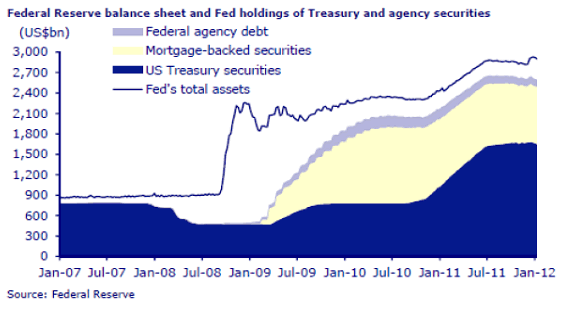
The Federal Reserve made it clear last week that it is not going to raise rates for almost three more years (in Fed speak, economic conditions are likely to “warrant exceptionally low levels for the federal funds rate at least through late 2014”). It did not make that judgment based on a belief that economic growth is going to accelerate in any meaningful way, or that inflation is going to become a problem within that time frame. Its judgment was based on a belief that U.S. growth will be tepid and that deflation rather than inflation is a near-term concern. GDP has averaged 1.6 percent over the past four quarters and real GDP growth has averaged 2.5 percent over the past 8 quarters. This tells us that growth has slowed down and is not expanding like in previous recoveries. This is likely due to the weight of debt suffocating all levels of the economy as well as the lack of confidence in economic and political leadership. The longer the Republican nomination circus goes on, the lower the chance that confidence will recover anytime soon. The prospect of four more years of an Obama presidency is going to depress markets (as well as this author).
Figure 4
Fed Isn’t Far Behind ECB
Interestingly enough, inflation-based securities (TIPS) rallied by a half-point after the Federal Reserve’s announcement that it was targeting 2 percent inflation, suggesting that the markets see the central bank printing money around the clock until it can create the inflation that remains absent from the economic scene today. The U.S. economy remains larded with overcapacity in a number of key areas, the most troubling being housing, commercial real estate and employment. As long as these key areas remain underutilized, deflation rather than inflation will remain dominant. That does not mean that prices at the supermarket or the gas station are going to plunge – in fact, both food and gasoline prices are likely to remain high, particularly if future GDP prints are as disappointing as the ones we saw in 2011 and the Federal Reserve is tempted into another round of quantitative easing. Prior bouts of quantitative easing led to higher commodity prices, but declines in debt-swollen asset prices counteracted overall inflation trends. For the average person (now known as the “99%”) everything but housing has increased in value. The problem is that only those members of the 99% that were renting their homes/apartments benefitted from this phenomenon. Overall, most people have suffered from Federal Reserve policies, particularly savers, homeowners, and those who followed the precepts of what were considered prudent financial management.
Private equity’s worst nightmare
If Stephen Schwarzman thought the Obama administration’s previous attempts to repeal the carried interest tax felt like Hitler’s invasion of Poland, he is likely to find the next round feeling like the U.S. attack on Hiroshima. Public opinion appears to have finally caught up to this issue with the presence of former private equity mogul Mitt Romney as the leading candidate in the Republican presidential field. The carried interest tax has always been a hot button for The Credit Strategist since it is both unprincipled as a matter of tax law and grossly misguided as a matter of tax policy. As a matter of tax law, it taxes labor as capital. As a matter of tax policy, it increases the incentives for investors to use debt rather than equity and increases the amount of debt in the economy. Neither of these effects is hospitable to economic growth, particularly when the type of debt employed is non-recourse and essentially creates a heads-I-win, tails-you-lose set of incentives for private equity managers.
This one-way incentive system is exacerbated by the one-sided fee system that grossly overcompensate private equity managers with a two percent management fee regardless of the success of their efforts and additional fees for doing what they are supposed to do in the first place (like monitoring and arranging financings for their portfolio companies). Why wouldn’t somebody want to become a private equity manager with this set of rules? Fortunately, it appears that this game is coming to an end, because it represents one of the most egregious examples of how the elite has rigged the game in its own favor while imposing enormous negative costs on society. The ultimate cost, of course, is paid by the institutional investors who end up paying the lion’s share of whatever gains these investments generate to the managers. Private equity returns, when properly adjusted for leverage, concentration risk, liquidity and fees, are mediocre at best with few exceptions.1 Unfortunately, large institutions in the public sector are so desperate to meet their funding goals that they have been brainwashed into believing that they must invest in a compensation scheme dressed up as an asset class. There are far better ways to generate the returns required by large public funds than private equity (stewards of those funds should feel free to call me for ideas – at the risk of sounding like Jeff Gundlach, I have been generating those returns for two decades).
This debate, while necessary, is coming at an unfortunate time because the likely nomination of Mitt Romney, a beneficiary of private equity’s undeserved benefits, is also likely to leave us with four more years of Mr. Obama as our president, which means anti-growth business policies and weak foreign policy management.2
Investment Recommendations
This section is available only to paid subscribers.
Michael E. Lewitt
1. I discuss exorbitant private equity fees and mediocre private equity returns at length in Chapter 5 of my book The Death of Capital: How Creative Policy Can Restore Stability (John Wiley & Sons: 2010). There are probably a few copies left on Amazon.
2. Speaking of Mr. Obama’s foreign policy, it is apparent that while Iranian sanctions are now starting to bite, this administration waited far too long to take action to prevent Iran from moving forward to gain nuclear weapons capability. Mr. Obama has also been far too passive in allowing Venezuelan President Hugo Chavez to forge alliances with Iran and China, which poses a direct threat to U.S. interests in our own hemisphere. While Mr. Chavez is unlikely to live very long, there is little assurance that his successors will follow a more constructive path. It is time for the U.S. to add a Venezuelan oil and central bank embargo to the Iranian embargoes in order to make it clear to the Venezuelan dictator that his antics have a cost. Trying to appease him is not only a sign of weakness; it is evidence of a dangerous naïveté that the U.S. cannot afford.
Disclaimer
All opinions and investment recommendations expressed by Michael E. Lewitt in The Credit Strategist as well as on Twitter under the Twitter name @credstrategist are solely the opinions of Mr. Lewitt and do not reflect the opinions of Cumberland Advisors or its affiliates or employees, managing directors, owners or principals.
Disclosure Appendix
This publication does not provide individually tailored investment advice. It has been prepared without regard to the circumstances and objectives of those who receive it. This report contains general information only, does not take account of the specific circumstances of any recipient, and should not be relied upon as authoritative or taken in substitution for the exercise of judgment by any recipient. Each recipient should consider the appropriateness of any investment decision having regard to his or her own circumstances, the full range of information available and appropriate professional advice. The editor recommends that recipients independently evaluate particular investments and strategies, and encourages them to seek a financial adviser’s advice. Under no circumstances should this publication be construed as a solicitation to buy or sell any security or to participate in any trading or investment strategy, nor should this publication or any part of it form the basis of, or be relied on in connection with, any contract or commitment whatsoever. The value of and income from investments may vary because of changes in interest rates or foreign exchange rates, securities prices or market indexes, operational or financial conditions of companies, geopolitical or other factors. Past performance is not necessarily a guide to future performance. Estimates of future performance are based on assumptions that may not be realized. The information and opinions in this report constitute judgment as of the date of this report, have been compiled and arrived at from sources believed to be reliable and in good faith (but no representation or warranty, express or implied, is made as to their accuracy, completeness or correctness) and are subject to change without notice. The editor may have an interest in the companies or securities mentioned herein. The editor does not accept any liability whatsoever for any loss or damage arising from any use of this report or its contents. All data and information and opinions expressed herein are subject to change without notice.
The Credit Strategist
Michael E. Lewitt, Editor
The Credit Strategist is published on a monthly basis by Michael E. Lewitt. Address: 5030 Champion Blvd., G6 #161 Boca Raton, FL 33496. Telephone: (561) 239-1510. Email: [email protected]. Delivery is by electronic mail. Annual subscription rate is $395 for individuals and $995 for institutions. Visit our web site at www.thecreditstrategist.com. Copyright warning and notice: It is a violation of federal copyright law to reproduce or distribute all or part of this publication to anyone (with the exception of individuals within the same institution pursuant to the subscription agreement) by any means, including but not limited to photocopying, printing, faxing, scanning, e-mailing, and Web site posting without first seeking the permission of the editor. The Copyright Act imposes liability of up to $150,000 per issue for infringement. Information concerning possible copyright infringement will be gratefully received.
Read more articles by Michael Lewitt