Advisor Perspectives welcomes guest contributions. The views presented here do not necessarily represent those of Advisor Perspectives.

This essay is excerpted from a recent version of The Credit Strategist (formerly the HCM Market Letter). To obtain the complete issue, you must subscribe directly to this publication; Please go here. The Credit Strategist is on Twitter - @credstrategist
“What is most important is that the systems of immediate concern – currencies, capital markets and derivatives – are social inventions and therefore can be changed by society. The worst-case dynamics are daunting, but they are not inevitable. It is not too late to step back from the brink of collapse and restore some margin of safety in the global dollar-based monetary system. Unfortunately, the deck is stacked against commonsense solutions by the elites who control the system. Diminishing marginal returns are bad for society, but they feel great for those on the receiving end of the inputs – at least until the inputs run dry. Today, the financial resources being extracted from society and directed toward elites take the form of taxes, bailout costs, mortgage frauds, usurious consumer rates and fees, deceptive derivatives and bonuses. As citizens are crushed under the weight of this rent extraction, collapse grows more likely. Finance must be returned to its proper role as the facilitator of commerce rather than a grotesque end in itself.”
James Rickards, Currency Wars (2011)
The ghosts of Christmas past are haunting Western economies this year. These ghosts lurk around the landscape in two forms. First, they assume the guise of the discredited economic policies that have failed abysmally and left these economies choking on debt and bereft of growth. Second, they parade around in the form of the financial and political elites who have spent years enriching themselves at the expense of the rest of society through the promotion of these bankrupt economic policies. As more information leaks out about the 2008 bailouts (the most egregious recent example being the MF Global debacle), and an increasing number of post hoc justifications are delivered by bailout participants to justify their actions, it becomes increasingly clear just how corrupt the system has become. Ben Bernanke argues that the Federal Reserve did not contribute to the housing bubble while members of the media laud him for allegedly saving the Western world from a disaster to which he was a main contributor through easy money policies. Just this week he was lauded by some for leading the latest bailout of Europe by the world’s central banks (more on this below). While Europe desperately needs the liquidity that this scheme provides, nobody should mistake liquidity for solvency and think for a moment that the crisis is over. Much more work is needed to heal the wounds that European policy makers and business leaders have inflicted on their societies since the European Union was formed.
While Alan Greenspan played his own part in fomenting the investment bubble from which the world is still recovering, at least he had the courage to admit that he was operating under incorrect assumptions about human nature and markets. Mr. Greenspan believed that economic actors would act in their own interest was correct, but he failed to realize that these actors’ individual profit-seeking would lead to unhealthy doses of collective risk-taking that would almost destroy the system. For some reason, Mr. Bernanke still appears to be clinging to the flawed belief that economic actors will wisely react to low interest rates as he tries to boost the value of financial assets. But unless he receives some serious assistance from fiscal policy, all he will accomplish is delay the day of reckoning. Mr. Bernanke needs to insist that his monetary promiscuity be coupled with genuine regulatory and fiscal chastity. Without those changes, the system will merely indiscriminately ejaculate liquidity around without targeting it to productive areas. The result is those areas that propagate risk – like derivatives trading – will suck up all of the seeds and spawn monsters. The system cannot foster any more monsters, as the Europeans are learning to their dismay.
Those of us who warned of the 2008 crisis are haunted by the ghosts of Ben Bernanke and Tim Geithner and Barney Frank and Larry Summers and others who – well-intentioned or not - have inflicted enormous harm on the global economy. These men tread down the hallways of our minds dragging heavy chains behind them, chains that are heavy and rusty and ugly. We can only hope that by next Christmas these ghosts will be laid to rest.
Europe – Will The Latest Bailout Work?
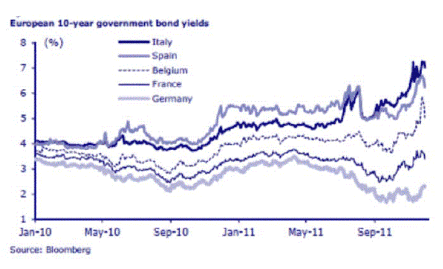
On November 30, the world’s central banks banded together and announced joint action to boost global liquidity. Specifically, they announced that they would lower the pricing on existing temporary U.S. dollar liquidity swap arrangements by 50 basis points to the U.S. dollar overnight swap (OIS) plus 50 basis points and extend these swap arrangements from August 1, 2012 to February 1, 2013. Clearly this was in reaction to deteriorating funding conditions that were reaching the point-of-no-return in Europe, particularly with respect to dollar funding. For several weeks, funding conditions had been deteriorating sharply: the Euribor-Libor spread kept widening through November as banks grew increasingly reluctant to lend to each other; European banks were encountering increasing difficulties accessing U.S. dollar funding; and Germany experienced an almost unheard-of failed bond during Thanksgiving week, which led the Bundesbank to engage in the even more unheard-of purchasing of a couple of billion Bunds.
Figure 1
Europe’s Credit Deteriorates
While nobody is saying anything, one has to suspect that one or more large European banks were on the cusp of failure (most likely a French one). Since the world is generally awash in liquidity, it is apparent that the authorities were aware that funds were not finding their way to places where they were needed, posing a systemic threat. All of the world’s banks are interconnected through complex webs of derivatives, and the failure of one may not be containable despite the assurances of regulators and the banks themselves (the latter of whom are the last ones whose words should be believed). It is a fact that many European banks are on the brink of insolvency, and it is also a fact that this move by the central banks will help their liquidity but do little to address their solvency issues. TCS would like to be encouraging and say that this move by the central banks was an important first step, but it may just as likely turn out to be another diversion on the road to disaster. It is just too early to tell despite the stock market’s jubilant reaction, and the ultimate outcome will depend on what is done to deal with the underlying solvency issues facing both Europe’s banks and its sovereigns.
Back in the real world, Europe is experiencing severe economic contraction across the board. Bank assets are shrinking in virtually every country, including Germany, which is the healthiest member of the European Union despite having a debt/GDP ratio of about 87 percent (Source: ISI Group). It is highly likely that every member of the union – including Germany – will have negative GDP growth in 2012. The combination of shrinking bank assets and government austerity measures will render it nearly impossible for these economies to generate growth in the year ahead. Since Europe is a major export market for both China and the U.S., that is a worrisome sign for overall global growth.
One thing that should end is the European Central Bank’s (ECB) obsession with inflation. European inflation is currently running at about 3 percent, a level that is hardly worth worrying about in the face of the massive deflationary forces bearing down on the Continent. The ECB’s constitution does not permit it to act as a lender of last resort (unlike the Federal Reserve), so its role will be limited to a modest amount of market-making purchases of sovereign debt (unless its constitution is amended). Chalk this up to another flaw in the architecture of the European Union. ECB Chief Mario Draghi has hinted that the bank is prepared to play a larger role in resolving the crisis, but only after a number of other steps tightening the union are taken. Clearly the ECB is going to adopt the Obama model of leadership and lead from behind. Quietly, however, the ECB has been using its financial resources to do more than the headlines suggest. It had already purchased 203.3 billion euros of Eurozone sovereign bonds and loaned 641.4 billion euros to the Eurozone banking system by the end of last week, and is considering extending the maturity of its loans to Eurozone banks by two to three years. The ECB is working toward dealing with the large refinancing needs of Europe’s banks in the next couple of years (there is more than 600 billion euros due to mature in 2012). Thus far in 2011, European banks have sold 413 billion euros of bonds, which is equivalent to only two-thirds of the amount of bonds maturing this year. This is another indication of shrinking bank balance sheets throughout Europe.
All of Europe’s economic problems cannot be blamed on the European Union, however. Rigid labor markets, high taxes and excessive government spending are problems that preceded the Maastricht Treaty. But these problems are not only rendering the Treaty unworkable, they are spreading the damage around the world. Solving the liquidity problem threatening the banking system will not solve the solvency problem simultaneously threatening those banks, the entire European Union, and the rest of the world. The coordinated liquidity moves made by the world’s central banks on Nov. 30 may prove to be a good first step, but they are far from enough.
The systemic threat posed by the crisis in Europe is more serious than the crisis that occurred in 2008. Partly that is because it is a continuation of the same crisis, and partly it is because the wrong steps were taken once the first crisis passed to deal with the underlying causes and remaining imbalances. TCS has written repeatedly both here and elsewhere that every scheme that has been floated to solve the European debt crisis involves one version or another of monetizing trillions of Euros of debt. Frankly, there are few if any other options available to European authorities. Budget reform is being implemented in a number of countries such as Greece, Italy and Spain, but austerity will not help the functionally insolvent banks in these countries or in other countries such as France that have loaned hundreds of billions of dollars to their weaker neighbors. Only a massive capital support scheme will help those institutions. But the question must be asked whether if, at this late date, any such scheme will convince markets that stability is being restored. European authorities may have waited too long.
In the end, it all comes down to Germany. It was one thing when funding problems were limited to the so-called periphery because that permitted investors and policy makers to maintain the illusion that there even is such a thing as a periphery in an interconnected world. But now that Germany’s economy is starting to show the strain, the jig may be up. TCS has been warning for several months that Germany’s credit would deteriorate however the crisis was resolved. Either Germany will foot most of the bill and incur an enormous amount of additional debt in the process, or the European Union and its currency will collapse and send the region into a depression that will send Germany’s exports plunging and its economy into a deep recession. The recent rise in German interest rates has already suggested that investors are starting to realize that the economic engine of Europe cannot be insulated from the costs of bailing out its neighbors.
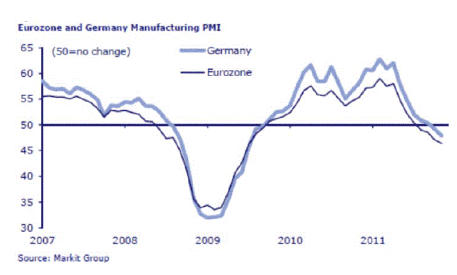
Germany’s economy is showing troubling signs of a slowdown. Figure 2 below illustrates the slowdown in its all-important manufacturing sector. With Germany’s largest trading partner being the rest of Europe (60 percent), the country has seen its exports drop off significantly in 2011. The German Manufacturing PMI hit 42.5 percent in October, well below the 50 percent level that indicates growth. European manufacturing slowed at the fastest rate in two years in November. If Germany catches cold, the rest of Europe will already be suffering from pneumonia.
Figure 2
German Manufacturing Catches Cold
Germany experienced its first failed bond auction and France is experiencing funding pressures as its AAA credit rating is increasingly likely to be lost, troubling signs that that the crisis is reaching what were previously considered areas protected from the crisis. It is far less surprising to see Italian and Spanish bonds trading at unsustainable levels because those economies are in obvious distress. Italy now has an inverted yield curve, with its latest bond sales on November 29 coming at 7.89 percent for 2 year bonds and 7.56 percent for 10 year bonds. Spain’s yield curve is not inverted but its 2-year paper is approaching 6% (5.84%) and its 10-year paper approaching 7% (6.68%). While all of these levels declined after the Nov. 30 central bank rescue mission, they all remain too high and unsustainable. Most notable, however, is the fact that the failure of Germany’s bond auction demonstrates that there is no longer a periphery as the crisis permeates the entire European Union.
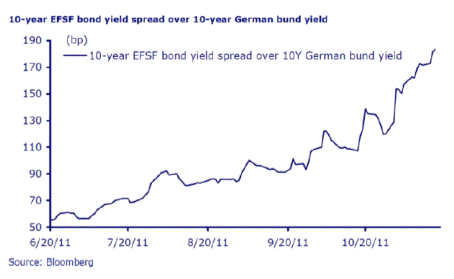
Moreover, many of the proposed monetization schemes being floated to bail out Europe involve leveraging the European Financial Stabilization Fund (EFSF). Beyond the usual complaints that leveraging an already debt-engorged system is no way to solve a debt crisis, it is going to be increasingly difficult to leverage the EFSF if the fund’s borrowing costs keep increasing (Figure 3 below precedes the Nov. 30 “Shock and Awe” attack by the central banks). Moreover, the fund is likely to lose its AAA rating when France, one of its main backers, loses its AAA rating in the near future (with Germany, in TCS’s opinion, not as far behind in losing its AAA rating as others believe).
Figure 3
EFSF Spreads Keep Widening
Investors in both Europe and the United States are waiting for the pressure on Germany to grow so great that Chancellor Merkel will finally agree to some type of massive monetization scheme involving Eurobonds or massive bond purchases by the European Central Bank. Any such scheme would effectively place the full faith and credit of Germany behind the debt of its weakest large members, however it is disguised by the participation of the IMF or ECB or some other alphabet collection.1 Frau Merkel is resisting any such scheme for any number of reasons, including the difficulty of convincing Germans to pick up the tab for its profligate brethren and a desire to squeeze the maximum austerity concessions out of these spendthrifts before surrendering to what many believe is the inevitable. The truth is that nobody can be certain whether the Germans will ultimately cave in to the demands to rescue the union. One can be fairly certain, however, that if Germany does concede, it will demand greater control over what its money is spent on. This will require bridging the gap between political and economic union that remains the fault line dividing Europe today. One can be certain of only one thing: Europe – and global financial markets – will be pushed to the brink before the crisis is calmed, and we are still a good distance from the brink today. Interventions like those of the world’s central banks on Nov. 30 will be stops along a very rocky road before global financial markets reach any kind of stability.
1. And don’t for a minute believe that the United States won’t be far behind in being on the hook in some manner for the bailout. If the IMF is involved, then the U.S. will pay through its contribution to Madame Lagarde’s organization. Whatever the form of the bailout, the U.S. will pay more than its fair share – Tim Geithner will see to it.
The United States
If there is good news, it is that the U.S. economy appears to have stabilized at above 2 percent GDP growth as it enters what is likely to be an excruciating election year. One would like to think that Congress is licking its wounds after the failure of the so-called Super Committee to come up with even $1.2 trillion of budget savings over ten years, but it’s hard to believe that Congress even cares. The lack of seriousness with which our lawmakers conduct our nation’s business is so obvious that one can only hope for 100 percent turnover in the House of Representatives and removal of all incumbents in the Senate next November. There is not a single member of Congress – not a single member – who has sufficiently distinguished him or herself to deserve to keep his or her seat after November 2012.
For many, the failure of the so-called Super Committee (the title was ironic, right?) was not surprising and merely demonstrated that little will be accomplished in terms of economic reform until after the 2012 election. But there is little reason to believe that much will be accomplished after the election as well. If Mr. Obama is re-elected (which will cause the stock market to plunge by at least 1000 points), nothing will change and the economy will just get worse. If Romney is elected, he is likely to adopt a series of traditional conservative (i.e. neoliberal) measures that have failed in the past. Romney has thus far been bereft of new ideas and risks boring the electorate to death by next November. He needs to wake up and start fighting for real change (not the type of change Mr. Obama pretended to espouse).2 As shoppers rushed around like chickens without their heads last weekend to spend whatever discretionary income they have, they would have done well to remember (they won’t, but still…) that the U.S. debt burden passed the $15 trillion mark at just about the time the Super Committee talks failed.3 Moreover, third quarter GDP was reduced to 2% (although fourth quarter GDP should be higher than that) and both employment and housing remain in crisis mode. The U.S. is far from out of the woods.
The Failure of Financial Reform
While solving a debt crisis with more debt never works, it is particularly dangerous when it is done in a context where regulation inadequately protects the system from the uses to which that new debt can be used. And that, unfortunately, is the situation in which we find ourselves. Despite the combination of cheerleading, denial and lobbying eructating from the canyons of Wall Street and the City, the fact remains that finance has not been sufficiently reformed to remove the threat it poses to systemic stability. Derivatives remain a greater threat than in 2008 because today they are concentrated in a smaller number of too-big-to-fail institutions.
Moreover, as James Rickards argues in his brilliant new book, Currency Wars, it is the gross and not the net exposures that matter in a financial crisis due to the counterparty risks that such a crisis exposes. Wall Street likes to harp on net exposures as a way of deflecting attention from its ongoing Financial Doomsday Derivatives Machine, but this is completely misleading. As Mr. Rickards explains:
“In complex systems analysis, shorts are not subtracted from longs – they are added together. Every dollar of notional value creates some interdependence. If a counterparty fails, what started out as a net position for a particular bank instantaneously becomes a gross position, because the ‘hedge’ has disappeared. Fundamentally, the risk is the gross position, not the net.”4
While the derivatives lobbyists have been working overtime to limit the regulation of these instruments, they continue to pose a threat to systemic stability that few appreciate. The derivatives business is an enormous profit center for Wall Street (at least until it blows up every five years and inflicts massive losses on the banks) and the securities industry is loath to give up what effectively amounts to monopoly profits on an opaque product on which it enjoys a massive information advantage over its customers. So just like regulators and others didn’t “see it coming” in 2008, they don’t see it coming now.5
Banks also remain undercapitalized. While Basel III will impose greater burdens on banks than currently exist, the capital requirements remain insufficient. U.S. banks are fortunately in much better shape than they were in 2008, but the troubles in Europe should encourage us to even further strengthen them. And the idea that banks will do this on their own and don’t need the government to impose higher capital requirements on them is laughable (and this is being written by no lover of government regulation). The near hysterical resistance of the banks to the Volcker Rule and other sensible regulations demonstrates that they simply don’t want to get it. An economy needs a healthy banking system, and the U.S. does not yet have one. U.S. banks, despite their strong liquidity and decent capital levels, are still nursing their wounds from the 2008 crisis. They are still doing everything within their power to use customer deposits to engage in speculative trading (under the guise of “making markets” or “handling customer orders”). They are still opposing derivatives regulation. And they are still grossly over-compensating their employees (particularly when their paltry contributions to society are taken into consideration), weakening their balance sheets in the process.
Finally, Dodd-Frank is as bad as the tax code – a Brobdingnagian tome of convoluted and contradictory rules that requires a Talmudic scholar to decipher. Like the tax code, our bought-and-sold Congress allowed the legislation to be written by special interests. While the announced retirement of Barney Frank was undoubtedly one of the few political/economic high points of 2011 (although undoubtedly a downer for CNBC’s ratings), Mr. Frank and his colleagues have inflicted so much damage on the economic landscape that it will take a generation to undo the damage.6 While Dodd-Frank may make the system a little safer, it has not made it nearly safe enough. And as we’ve learned, there is no such thing as being half-pregnant when it comes to financial regulation.
The Financial Transactions Tax
There have been increasing calls for a tax on financial transactions such as stock trades. While this has been more frequently heard in Europe, it is also being proposed by some in the United States. Originally proposed by Nobel Prize Winner James Tobin, most proposals call for a small tax on a broad array of stock trades that would raise hundreds of billions of dollars. TCS believes that these proposals are on the right track but need to be modified in order to better target the types of activities that are harming capital formation and productive investment. In The Death of Capital, I called for a “Tax on Speculation” (pp. 225-36) based on the argument that the U.S. is obviously in desperate need of revenue but should seek to raise it through taxes that target economically damaging activities rather than productive ones. In the category of such damaging activities I include those that do little or nothing to add to the productive capacity of the economy.
Based on that test, I proposed the following taxes on speculative activities (as a % of the fair market value of the transaction):
- Naked credit default swaps – 1.25 percent.
- Debt and preferred stock issued in leveraged buyouts, leveraged recapitalizations, or debt financings used to pay dividends to LBO sponsors – 0.60 percent.
- Quantitative and flash trading strategies – 0.35 percent.
I then would add a general financial transactions tax on the following types of transactions based on my belief that most secondary trading of stocks, bonds and bank loans today has little to do with capital formation:
- Equity derivatives (options, futures contracts) – 0.25 percent.
- Large block trades – 0.25 percent.
- All other stock, bond and bank loan trades – 0.25 percent.
I would exempt the last group of taxes from tax exempt accounts. Overall, however, I do not believe that taxes of such truly small percentages would discourage anybody who should be trading from doing so, and would at least have them contribute something to society for what in many cases (especially the first group of transactions) are activities that have done far greater damage than good to the markets and society. Such a tax would contribute hundreds of billions of dollars to the U.S. Treasury from a group that benefits disproportionately from extremely favorable capital gains treatment and other tax breaks.
Investment Recommendations
This section is available only to paid subscribers.
Parting Thoughts
At the end of the year, it is customary for me to thank all of my readers for their support. This year this is somewhat different than in years past since I am doing so for the first time outside of the ambit of the firm that I co-founded. So it is especially gratifying to give thanks after having received such generous support and encouragement from so many people both for my writing and my other new business ventures. From the bottom of my heart, I would like to take this opportunity to thank all of you who has been so supportive.
We are often told that life is short. But I would like to suggest that life is actually very long. It is long in possibilities, long in the people we affect, and long in the people who influence and affect us. Life is long because it gives us the opportunity to make a difference in the lives of others, particularly those who are less fortunate than us or who need a helping hand. And it is long when we allow others to enter our lives and enrich us. Life’s possibilities are endless as long as we are open to them.
In the year ahead, I hope that life will be long for all of you, as well as for my family and my friends, and for everyone who takes time out of their lives to make this world a better place and reach out their hands to others to lift them.
May we all enjoy Godspeed in the year ahead. He gives - every moment, every day - and what He gives is what makes our lives long when we pass it on to others.
Michael E. Lewitt
2. Our Republican platform would include the following: tax reform (a flat tax with few if any deductions and lower rates and a “Tax on Speculation” described below); promoting natural gas exploration in the U.S.; real financial reform (banning naked CDS, banning flash trading, reinstituting the uptick rule, increasing bank capital, imposing a real Volcker Rule); exiting Afghanistan immediately; imposing sanctions on Iran’s central bank and an oil embargo on the country; backing strict Congressional term limits; and last but not least, repealing Obamacare.
3. TCS finds it very difficult to understand how shoppers can be spending money in the face of both a jobs and a housing crisis, but maybe that’s how we got into a jobs and a housing crisis in the first place. The fact that the unemployment rate dropped to 8.6 percent is a joke since it was based on a shrinking labor force. It would be unseemly for President Obama to brag about a diminishing unemployment rate based on people dropping out of the labor force due to their inability to find work. Payrolls only increased by 120,000 in November, well below the number required to compensate for the number of jobs needed to keep up with population growth.
4. James Rickards, Currency Wars: The Making of the Next Global Crisis (New York: The Penguin Group, 2011), p. 210.
5. Many people have asked me my view of the restructuring of Greek debt that avoided a payout on credit default swaps (CDS) written on Greek bonds. As I wrote last month, one of the solutions to the entire CDS situation is banning all naked CDS (i.e. CDS that is not purchased to hedge existing debt holdings). As for those holders who will not be paid out because of a loophole in their insurance contracts, I suggest they hire better attorneys next time.
6. According to The Wall Street Journal, California’s Maxine Waters would be the next Democrat in line to run the House Financial Services Committee if the Democrats are somehow able to regain control of the House of Representatives in 2012. Based on her questioning of various witnesses during televised hearings of that committee, Ms. Waters may be the single least qualified member of Congress to head that committee.
Disclosure Appendix
This publication does not provide individually tailored investment advice. It has been prepared without regard to the circumstances and objectives of those who receive it. This report contains general information only, does not take account of the specific circumstances of any recipient, and should not be relied upon as authoritative or taken in substitution for the exercise of judgment by any recipient. Each recipient should consider the appropriateness of any investment decision having regard to his or her own circumstances, the full range of information available and appropriate professional advice. The editor recommends that recipients independently evaluate particular investments and strategies, and encourages them to seek a financial adviser’s advice.
Under no circumstances should this publication be construed as a solicitation to buy or sell any security or to participate in any trading or investment strategy, nor should this publication or any part of it form the basis of, or be relied on in connection with, any contract or commitment whatsoever. The value of and income from investments may vary because of changes in interest rates or foreign exchange rates, securities prices or market indexes, operational or financial conditions of companies, geopolitical or other factors. Past performance is not necessarily a guide to future performance. Estimates of future performance are based on assumptions that may not be realized. The information and opinions in this report constitute judgment as of the date of this report, have been compiled and arrived at from sources believed to be reliable and in good faith (but no representation or warranty, express or implied, is made as to their accuracy, completeness or correctness) and are subject to change without notice. The editor may have an interest in the companies or securities mentioned herein. The editor does not accept any liability whatsoever for any loss or damage arising from any use of this report or its contents. All data and information and opinions expressed herein are subject to change without notice.
The Credit Strategist
Michael E. Lewitt, Editor
The Credit Strategist is published on a monthly basis by Michael E. Lewitt. Address: 5030 Champion Blvd., G6 #161 Boca Raton, FL 33496. Telephone: (561) 239-1510. Email: [email protected]. Delivery is by electronic mail. Annual subscription rate is $395 for individuals and $995 for institutions. Visit our web site at www.thecreditstrategist.com. Copyright warning and notice: It is a violation of federal copyright law to reproduce or distribute all or part of this publication to anyone (with the exception of individuals within the same institution pursuant to the subscription agreement) by any means, including but not limited to photocopying, printing, faxing, scanning, e-mailing, and Web site posting without first seeking the permission of the editor. The Copyright Act imposes liability of up to $150,000 per issue for infringement. Information concerning possible copyright infringement will be gratefully received.
Read more articles by Michael Lewitt