Conventional wisdom about the best way to construct a portfolio has been discredited, according to three industry thought leaders – Jerry Miccolis, Bill Bengen and Harold Evensky. Each has distinct visions of the ways in which advisors should build portfolios in the wake of the financial crisis of 2008, but all three agree that traditional methods must be scrutinized.
The financial crisis of 2008 was a rare event jarring enough to make people remember where they were when they first learned what was going on. At the very least, advisors surely remember where their clients’ portfolios were positioned when crisis struck – most likely in a range of supposedly well diversified assets whose values, all of a sudden, were plunging in unison.
Since then, advisors have been forced to ask themselves – what could I have done differently?
Miccolis, Bengen, and Evensky got together last week to explain how they are tackling that very question. Appearing for a panel discussion at the Business & Wealth Management Forum in Chicago on October 15th, the three industry leaders explained how they have changed their approaches to portfolio construction since 2008.
A tail risk hedge diamond in the rough
For Miccolis, recovering from 2008 was a matter of shedding the seductive simplicity of conventional wisdom – identifying the core benefits he most sought from his portfolio allocations and working methodically backwards to the sophisticated tools that would reap the proper dividends. Miccolis is Principal and Chief Investment Officer at Brinton Eaton Wealth Advisors, a New Jersey-based advisory firm.
“The modern portfolio theory that most of us are used to using and dealing with doesn’t really correspond to the real world,” Miccolis told the audience. “One of the things that we’ve been doing is taking modern portfolio theory and making it real.”
The standard measure of correlation, for example, “is not up to the job in the real world,” Miccolis said. He said he now favors the use of a statistical application known as copulas, which allows him to capture more dynamically the probabilities of how asset classes may interact. However tempting the simpler calculation of basic correlation might be, Miccolis no longer believes he can afford to eschew tools that will improve his understanding of his portfolio.
To approach portfolio construction systematically, Miccolis said, his firm focuses on four central features that define a good portfolio: strategic focus, natural hedging, risk exploitation, and – especially important since 2008 – catastrophe protection.
To achieve better natural hedging, for instance, Miccolis outlined a more active, responsive approach than traditional rebalancing, which Miccolis called “pretty naïve.” In its place, Miccolis uses a sector rotation approach that takes into account the momentum of various assets.
Miccolis explained his approach as follows: He starts by dividing the S&P 500 into 10 distinct sectors by industry. Employing a simple algorithm to obtain a moving average for each sector, Miccolis then compares each sector’s current index price to its moving average and applies a simple rule: If the index exceeds the moving average, it’s a sign to get in; when it dips below, that’s a sign to get out.
Miccolis said this strategy would have consistently surpassed the S&P 500 index over the last two decades.
The part of Miccolis’ presentation that most piqued the audience’s curiosity was his unconventional strategy, developed since 2008, for most effectively managing the risk of economic catastrophe.
Tail risk protection, Miccolis noted, has been in high demand since the havoc that the fall of 2008 wreaked on investors’ portfolios. “It’s a seller’s market out there right now for tail risk protection,” Miccolis said, adding that many of the solutions being pitched are either very expensive or ineffective.
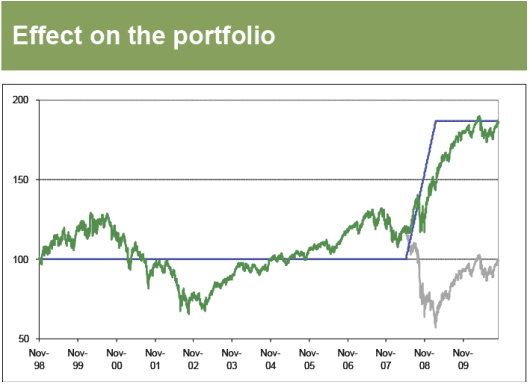
Miccolis’ three exacting criteria for the tail risk hedge he sought were (1) that it should not give back the value it accrues after a crisis passes, but rather it should lock those gains in; (2) that it must be inexpensive; and (3) that it cannot disrupt the overall makeup of his portfolio.
“Very, very, very few things … satisfy all these criteria,” Miccolis said, noting that #1 is an especially tricky goal to achieve – common tail risk hedges, such as VIX, fail this test and were consequently rejected by Miccolis.
The solutions Miccolis said he eventually settled on were little-known offerings from Barclay’s and Deutsche Bank – products from each bank, similar to one another, known as Astro and Emerald, respectively. These essentially go long on daily volatility in an index – i.e., the S&P 500 – and short weekly volatility.
The end result is that in normal times, with relatively steady volatility, these options – which, crucially, cost a negligible amount – are essentially a wash. Not earning big returns, but not bleeding funds out of the portfolio either. Times of great market stress, however, when daily volatility skyrockets, are when such a product “pays off big time,” Miccolis said.
He provided an illustration of how this catastrophe protection would have kicked in during the crisis of 2008.

Asked if this wasn’t just an obscure market inefficiency he had found that could easily be arbitraged away as more investors became aware of it, Miccolis said his approach was different.
The banks who market these products “are buying a little tiny options on the S&P, a little bit every day on an Index whose trading volume is measured in the trillions and whose option trading volume is not that much smaller,” Miccolis said, and the options the banks buy are relatively tiny. “It is inconceivable that it will ever get to the size that it will influence the way … the S&P index itself behaves. It is just inconceivable. So I think the day where that kind of thing that is arbitraged away is well beyond our lifetimes.”
More information about Miccolis’ hedging strategy can be found in an article we published earlier this year.
More art than science
If Miccolis’ reaction to the events of 2008 was to treat investing like an even more precise science, Bengen’s was the opposite. Bengen, a California-based advisor and president of Bengen Financial Services, who is most famous for his research on safe withdrawal rates, told the audience that, whereas before 2008 he viewed investing as a “mathematical exercise,” the aftermath of 2008 has taught him that “the world’s best investors are more like artists than mechanics.”
The traditional tenets of investing “misled us” and put too many advisors in a position to be shocked and devastated by the effects of 2008 on their clients’ portfolios. “Maybe you can say it’s been justified the last couple years – the market has rebounded and everything is hunky dory,” Bengen warned. “We are just setting ourselves up for another smackdown.”
Among the traditional assumptions Bengen now approaches with more healthy skepticism is the idea that buy-and-hold is always the wisest approach. The 2008 crisis showed, Bengen said, that “buy-and-hold does not fit all investment environments.”
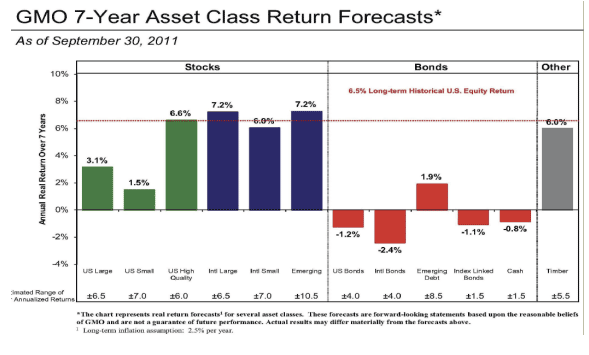
Bengen also argued that “fixed asset class allocations can be poison,” citing forecasts of Jeremy Grantham and GMO to illustrate how weak bonds may be in the coming years:
Bengen cautioned not to use any such forecasts as the primary basis for portfolio construction – Bengen, for example, said that for tactical reasons his portfolio is about 70% Treasury securities and other high-quality bonds, Grantham’s forecast not withstanding. But such outlooks illustrate how traditional assumptions about the relative risks and rewards of various asset classes cannot be blindly accepted anymore.
All this means that Bengen now finds investing to be a more thoughtful exercise than it once was. “I think there are a lot of other things that we've got to think about – the macroeconomic picture, the risk in emerging markets,” he said. Macroeconomics is one area, for example, that Bengen said he has come to believe should “never” be ignored.
Citing the famous advice of revered investor Peter Lynch that “anybody who spends more than 14 minutes a year on economics is spending too much time,” Bengen said he has come to differ. “Maybe that was good in the 80s and 90s, but clearly the environment we are in now I think you have to look at the macroeconomic picture, the risk of another financial crisis,” Bengen said. “Until the sovereign debt crisis is resolved – that will be years – I think we have a different environment, one that you have to be more circumspect in.”
Economic cycles are a good illustration, Bengen said. “Cycles are generally not mentioned in our educational material. In fact, they are kind of looked down upon,” Bengen said. But “bubbles exist,” and they occur in markets all over the world. “Bubbles can be opportunities to make money,” Bengen explained. “And they can also be opportunities to lose a lot of money.”
That said, Bengen warned against leaning too heavily on specific economic forecasts. “Economic forecasts are about as good as horse picking at the races,” he said. “I try not to get hung up on any kind of a forecast of any finite economic area, unless I have a strong conviction that we are going in a particular direction.”
Bengen also recommended advisors not neglect the impact of central bank interventions, citing the Fed’s recent bouts of quantitative easing as an example of the outsized role such banks often play in the markets post-2008.
Overall, Bengen said, “I'm looking more and more at investing by value, by asset class. I don't often pick individual investments anymore, I try to basically choose asset classes that I think are well priced and have a chance of appreciation in the future.” The focus of his investing, he said, now more than ever is capital preservation.
Bengen sees opportunities today in Europe, where he will “slowly build, with currency hedges, a position in European stocks,” he said.
Bengen was asked later if his approach constituted market timing. “Market timing has obviously got really a bad name in our profession. It's up there with astrology, and numerology and a lot of other things,” he explained.
“It is how you define market timing. If you are trying to catch tops and bottoms precisely, it is a fool’s errand, I agree. It is not something such that should be attempted. But if you are trying to preserve capital … I think it makes sense.”
The only two certainties in life
Evensky – who is President of Evensky & Katz, a Florida-based wealth management firm – echoed some of the broad sentiments of his counterparts, but he also advocated a more restrained approach.
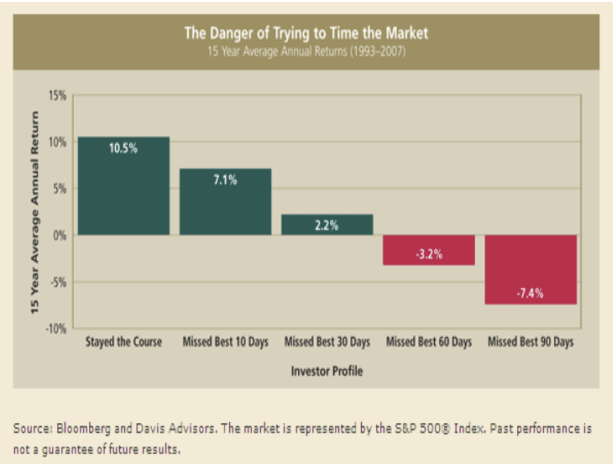
“In my office I have a crystal ball, I have an Ouija board, and so far they have been completely unsuccessful telling me when to get out,” Evensky said. “Markets don't just collapse quickly, they recover quickly.”
Anyone who tries to get too cute with their approach to the markets takes a serious risk of missing out on big gains. He presented the following data to show how taking your money out of the market for even a short period can have devastating effects unless you can precisely time a rebound.
Evensky remains an advocate of a more traditional buy-and-hold approach, although he said that 2008 underscored the crucial distinction between what he called “buy-and-forget” investing and “buy-and-manage.”
“Having a rigorous rebalancing parameter structure in there is going to make a huge amount of difference over time,” Evensky said experience has shown. “That is a form of tactical allocation, but it is one that we don't have to predict the future in order to achieve.”
Evensky also said the uncertainty of 2008 underscored the importance of focusing on the aspects of your clients’ portfolios that you can most easily anticipate – taxes and inflation.
“Our clients don’t live in a two-dimensional world of risk and return. They live in a three-dimensional world, and that third dimension is going to be critical,” Evensky said. “It is the one thing over which we have some control.“
Five years and two buckets
Because Evensky believes that, over time, staying consistently invested in the market is the best way to assure gains, he gears his strategy to making sure he is never forced to deviate from that approach. Crises like 2008 often force investors to withdraw prematurely from an investment strategy in order to preserve assets, and that’s exactly what Evensky seeks to avoid. Instead, he advocates what he called his “five-year mantra.”
“If you are really long-term, you can live with the ups and downs,” Evensky said. “The problem we face as practitioners is we have a lot of clients taking money out. Then you have a real issue. Things turn around dramatically. So the question is, how do we manage market volatility when we have a need to get income off of the portfolio?”
Evensky said the answer is what he calls his “two-bucket approach.” In each client’s portfolio, he determines whatever amount the client is likely to need for cash flow over the next five years, and he sets that aside, segregating it into one “bucket” that will always be available for redemption, whatever happens with the markets. He then invests the rest without having to worry about disruption to his strategy.
Miccolis, during the Q&A portion of the event, took issue with this approach. “It will be easier for you to explain what you were doing to your clients, but if your real goal is … to be stewards of their financial future – to secure their financial future and the safest way that you know how – I don't think that's a good way to do it, as easy as it is to explain,” Miccolis said. “The right answer is to look at the totality of all of those things. We as financial planners have the tools to do precisely that.”
Evensky agreed with Miccolis that more elaborate “bucketing” strategies do clients a disservice but stood by his approach. Rather than what would traditionally be considered “bucketing,” Evensky said, “it is basically a certain amount of cash flow reserve for short term cash flow needs so I don't have to touch the investment portfolio.”
Immediate annuities and reverse mortgages are two products, neither in vogue 10 years ago, that Evensky said he is giving renewed consideration as he looks at the safest ways to meet his clients’ goals.
Overall, Evensky argued that the events of 2008 call for a more restrained approach, not new gimmicks or tricks to try to beat the market. Of those who advocate more aggressive market timing, Evensky concluded by asking, “Maybe there is a high probability you think you will be right. I will debate that. But the question is, what are the consequences if you are wrong?”
Just three years removed from the crash of 2008, the implied answer to that question was not one that needed to be spelled out.
Michael Skocpol is a staff writer for Advisor Perspectives.
Read more articles by Michael Skocpol