Advisor Perspectives welcomes guest contributions. The views presented here do not necessarily represent those of Advisor Perspectives.
Given that yields on Treasury and high-quality corporate bonds are near 50-year lows, investors looking for relative value in fixed income should consider purchasing lower-rated investment-grade corporate bonds. As Gluskin Sheff’s David Rosenberg said last Wednesday, “if you have money to put to work, and are looking for a reward that more than compensates for the incremental risk involved at this juncture, credit is a good place to be looking.”
Since late July, when the equity market started falling in response to the European debt crisis and the simultaneous U.S. debt-ceiling standoff, yields on lower-rated investment-grade bonds (BBB and A) increased substantially. Meanwhile, yields on top-quality investment-grade bonds (AAA and AA) have fallen, moving in the same direction as U.S. Treasury yields.
Relative value in BBB and A
As you can see from the chart below, during most of 2011 the median yields for AAA, AA, and A investment-grade corporate bonds were similar to one another and tracked U.S. Treasury 10-year yields quite closely. Yields on BBB-rated bonds have always been higher, but their spread over Treasury bonds was mostly constant.
Since the economic troubles started in late July, however, yield patterns have changed considerably. Spreads over Treasury bonds have uniformly increased for all rating grades except AAA. Spreads for A-rated bonds have widened the most, followed by BBB, and then AA, but the absolute level of yields is still highest for BBBs because they started at a higher point.
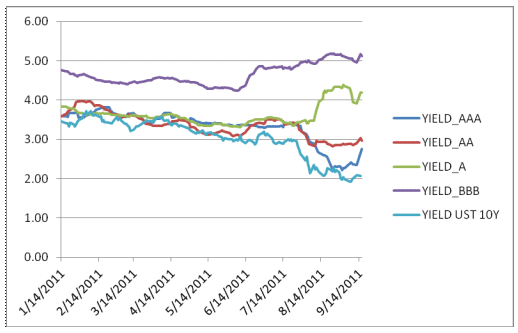
10-day moving average of median odd-lot corporate yields
Source: TRACE & BondDesk
Industry distribution depends on rating grade
Clearly BBB-rated bonds are paying higher yields than all other investment-grade corporate bonds, and they are providing higher yield across all industries. Note that only five of the top 10 most-active BBB-rated issuers are financials (highlighted in yellow):
Top 10 Most Active “BBB” Issuers |
||
Ticker |
Company Name |
Num Trades |
GNW |
GENWORTH FINANCIAL INC |
4,728 |
PRU |
PRUDENTIAL FINANCIAL INC |
1,721 |
PNC |
PNC |
1,392 |
NOK |
NOKIA OYJ |
1,114 |
SLM |
SLM CORP |
1,050 |
TI |
TELECOM ITALIA CAPITAL SA |
813 |
GPS |
GAP INC |
796 |
AA |
ALCOA INC |
672 |
Q |
QWEST CORP |
625 |
AXP |
AMERICAN EXPRESS CO |
598 |
In the A-rating grade, on the other hand, seven out of the top 10 issuers are financial firms. Financial bonds almost always pay more than industrials, but that phenomenon has intensified lately because of concerns about both the U.S. and the global economy, particularly Europe.
Top 10 Most Active “A” Issuers |
||
Ticker |
Company Name |
Num Trades |
BAC |
BANK OF AMERICA CORP |
12,243 |
GS |
GOLDMAN SACHS GROUP INC |
7,564 |
MS |
MORGAN STANLEY |
4,978 |
C |
CITIGROUP INC |
1,979 |
WFC |
WELLS FARGO & CO |
1,784 |
VZ |
VERIZON COMMUNICATIONS INC |
1,543 |
HBC |
HSBC FINANCE CORP |
1,494 |
T |
AT&T INC |
1,460 |
RBOS |
ROYAL BANK OF SCOTLAND PLC |
1,370 |
COP |
CONOCOPHILLIPS |
792 |












