Small- to mid-cap stocks (smid-caps) have outperformed since 1999. The long-running outsized returns delivered by this market-cap segment have attracted considerable attention, and many wonder if it’s too late to add exposure to smaller stocks. Below, we offer a few things to consider in determining how much exposure to smid-cap stocks you should maintain.
Historical risk/return and correlation
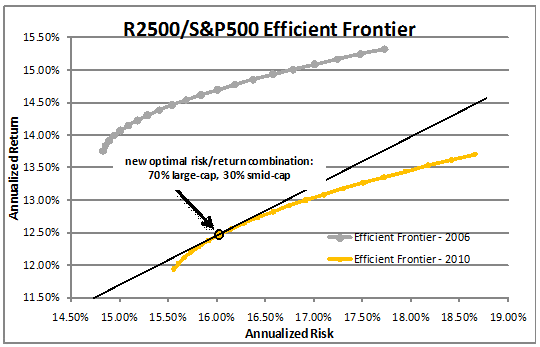
Historically, smaller stocks have higher expected return and higher risk than their large-cap counterparts. Because they are not perfectly correlated to large stocks, however, adding small caps to your portfolio may enhance return but actually reduce overall risk. Modern portfolio theory tells us that the optimal portfolio is that which offers the best risk/return profile. Using that notion, an optimal mix may be 70% large-cap and 30% smid-cap stocks.
- Over the past 32 years, the small/midcap Russell 2500 Index has posted an annualized return of 13.81%, higher than the S&P 500’s annualized return of 11.94% and the small-cap Russell 2000 Index’ 12.83%.
- The annual standard deviation of the Russell 2500 Index return over the same period was 18.66%, versus 15.56% for the S&P 500 and 20.06 % for the Russell 2000 Index.)
|
|
Ann. Ret. |
Ann. Risk |
| S&P 500 |
11.94% |
15.56% |
| Russell 2500 |
13.81% |
18.66% |
| Russell 2000 |
12.83% |
20.06% |
| Source: Standard & Poors, Russell Mellon, AIP Research |
- The Russell 2500 Index has a correlation with the S&P 500 of 0.88, and a near-perfect correlation of 0.99 with the Russell 2000:
|
S&P 500 |
Russell 2500 |
Russell 2000 |
| S&P 500 |
1.00 |
|
|
| Russell 2500 |
0.88 |
1.00 |
|
| Russell 2000 |
0.83 |
0.99 |
1.00 |
| Source: Standard & Poors, Russell Mellon, AIP Research |
Efficient frontier and optimal asset allocation
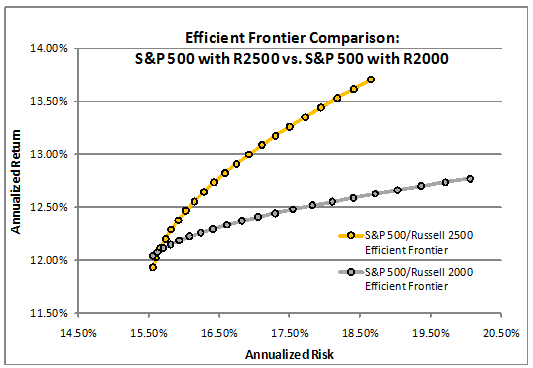
Because the Russell 2500 Index boasts superior returns to both the Russell 2000 Index and the S&P 500 Index, and because the benchmark has less-than-perfect correlation with the large-cap S&P 500 Index, a blended portfolio of large- and smid-cap stocks dominates both a pure large-cap portfolio and a blended portfolio of large-cap and small-cap stocks:

Finally, given the above data, we can search for the optimal blend of large-cap and smid-cap stocks. The scattergram below identifies the risk and return profiles of large-cap and smid-cap blends, with the smid-cap exposure increasing from 0% to 100% in increments of 5%:
Market-cap representation
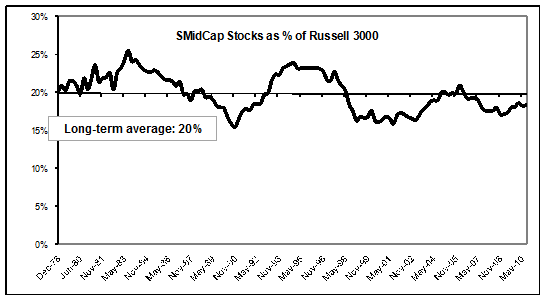
The capital asset pricing model (CAPM) and the efficient market hypothesis, meanwhile, tell us that we should use market exposure as our guideline in determining proper exposure to an asset class. We measured the total market capitalization of the Russell 3000 Index and the Russell 2500 Index over the past 127 quarters. By dividing the latter into the former, we can determine what percentage of the Russell 3000 consists of smid-cap stocks. Employing this approach, we arrive at a similar conclusion for the optimal smid-cap allocation:
Increasing benefits of diversification
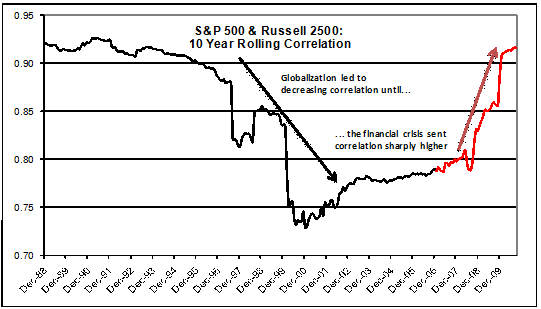
As globalization expands, the performance of larger stocks and smaller stocks may diverge, given that large companies derive significant revenue from overseas while small stocks rely on international business much less. As the global economy has become increasingly integrated, the correlation between the S&P 500 and the Russell 2500 has been decreasing. As such, the benefits of diversifying with both large- and smid-cap stocks have been increasing. It’s important to note, however, that we were recently reminded that in times of crisis, correlation among asset all classes moves towards one:
Benefits of neglect
There has been considerable research regarding the performance of “neglected,” or under-followed, firms. Thinner analyst coverage is associated with higher returns, regardless of firm size.
Several theories have been put forth to explain this effect. Investors may be willing to pay a higher price for stocks that have a recognized “brand,” despite the fact that they may offer lower future returns. Another theory is that news may be incorporated into price less quickly for under-followed stocks, and thus they are more prone to experience long-term price momentum. A third theory posits that less-followed firms are simply less efficiently priced, more volatile, and therefore offer higher returns.
| Average Analyst's Coverage |
| S&P 500 |
15.6 |
| Russell 2500 |
5.6 |
| Source: Standard & Poors, Russell Mellon, IBES, AIP Research |
Smid-cap companies have about 60% fewer analysts covering their stocks than large-cap companies, leading to greater stock price inefficiencies.
Size rotation
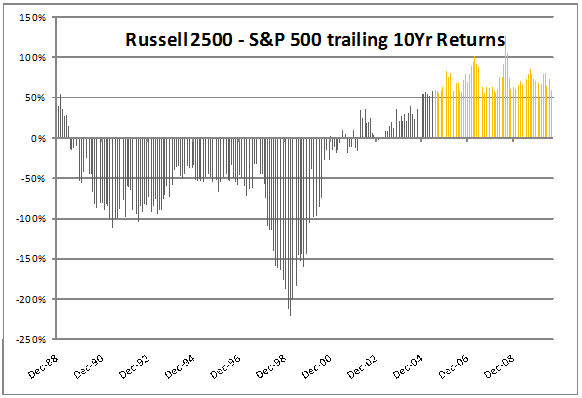
As illustrated below, the performance swings between large-cap outperformance and small-cap outperformance can be sizable. While smid-caps have outperformed large-caps significantly over the past 8-10 years, the magnitude of their outperformance is not nearly equal to the magnitude and duration of the outperformance recorded by large-caps over smid-caps during the 90’s.
Loss likelihood and time decay
We’ve already shown that, when viewed separately, smid-cap stocks are slightly more risky than large-cap stocks. We’ve also demonstrated that combining smid-caps with large-caps leads to a better risk/return profile for investors. Another way of decreasing the risk of smid-cap stocks is by increasing one’s holding period. While smid-caps have greater risk, they also have greater return potential. Thus, when you increase the holding period, the greater return potential slowly overwhelms the impact of higher volatility/greater risk.
| Loss Probability: |
S&P 500 |
FR2500 |
| 1 Year |
21.4% |
23.0% |
| 3 Year |
15.9% |
10.1% |
| 5 Year |
14.0% |
3.1% |
| 10 Year |
8.8% |
0.0% |
| January 1978 – September 2010; past results do not ensure future result |
Conclusion
We’ve presented several arguments that favor exchanging small-cap exposure for smid-cap exposure, and we have explained why we believe smid-cap exposure of 25-30% may be appropriate for many investors. We framed our reasoning in a risk/return discussion. While many believe it’s too late to gain exposure to this segment of the US equity market, most investors do not carry 25-30% of their domestic stock allocation in small and mid-cap stocks. The diversification benefits of smid-cap exposure increase with time, and that the current length and magnitude of smid-cap outperformance falls well within observed norms. While some believe stand-alone exposure to smid-cap stocks is too risky, even that risk can be mitigated with a sufficiently long holding period.
Jon Quigley is a managing partner and John Bright is a partner with Advanced Investment Partners, a Florida-based investment management firm specializing in active quantitative U.S. equity strategies.
Read more articles by Jon Quigley, CFA and John Bright, CFA