Advisor Perspectives welcomes guest contributions. The views presented here do not necessarily represent those of Advisor Perspectives.
Investors today have a right to be confused. A cadre of investment strategists tell them that stocks are cheap, authoritatively declaring that the price-earnings ratio of the S&P 500 index is much lower than the historic average. Yet, another crowd of analysts claim that the market is overvalued, quoting different price-earnings numbers. Who is right?
This is a critical issue. Although market valuations have virtually no relationship to short-term returns, they clearly impact long-term returns. Investors who stampeded into the market during the tech mania learned the hard way that expensive entries into an asset class do not pay off in the long-term. The S&P 500 price index today is at a level that was first achieved in 1998.
The crux of the difference between the “cheap” and “overvalued” views lies in the selection of earnings numbers, of which there are two basic sets. The broadest traditional measure is “as reported” earnings which includes all charges except the cumulative impact of accounting changes, discontinued operations and extraordinary items. All of these exclusions are defined by Generally Accepted Accounting Principles (“GAAP”).
The second set is “operating earnings” which is “as reported” earnings less a number of additional exclusions such as restructuring charges, asset sale gains and losses, major litigation charges, goodwill write-downs, inventory and other write-offs. There is no GAAP definition of “operating earnings” and hence, management has latitude in how it is calculated. Analysts also often adopt unique calculation methods.
In fact, the original intent behind “operating earnings” was to create a measurement of a firm’s earnings from its core operations that could be compared across time periods. It was never intended as a valuation measure.
In theory, the difference between the two earnings numbers should be modest. In fact, from 1970 to 1990, “as reported” earnings averaged only 2% less than “operating earnings”.1 However, since then the average difference has skyrocketed to 17%.2 This is evidenced in the following graph which compares the trailing four-quarter “operating earnings” for the S&P 500 (in blue) to the “as reported earnings” (in red).
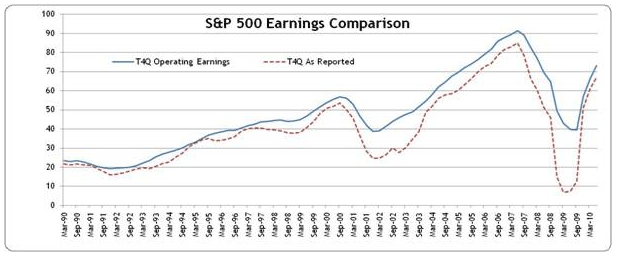
In retrospect, it is clear that during the tech boom of the late 1990’s and the financial boom of the last decade, companies either overpaid for acquisitions or booked illusory profits that resulted in massive write-offs in the subsequent recessions. The enormous profits booked by AIG from its Financial Products subsidiary’s issuance of ill-conceived and mispriced credit default swaps, which effectively bankrupted the entire company in 2008, exemplifies this behavior.
1. Jeremy J. Siegel, Stocks for the Long Run, 4th Ed. (New York: McGraw Hill, 2008) 103.
2. Based on quarterly earnings. Data from Standard & Poor’s at http://www.standardandpoors.com/indices/sp-500/en/us/?indexId=spusa-500-usduf--p-us-l--.












