Interest rates should stay low for the foreseeable future, and the Fed's use of non-standard monetary policy to bolster liquidity will likely continue, Christopher L. Foote, an advisor to the Boston Fed's Center for Behavioral Economics and Decisionmaking said on September 10 during a meeting of the Financial Planning Association of Massachusetts at Bentley University in Waltham, Massachusetts.
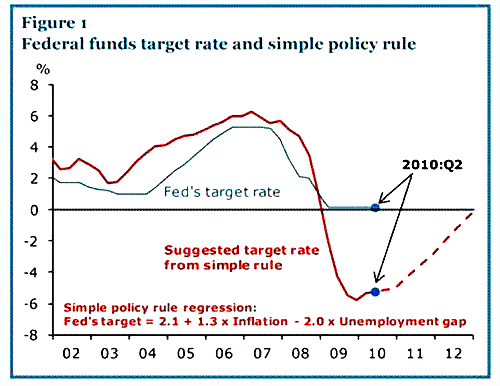
According to Foote, the Taylor Rule, a widely cited forecasting tool, predicts that the current inflation rate of 1.2 percent and the unemployment rate of 9.6 percent will keep the target federal funds rate in the range of -3.5 to -4.5 percent. Since the federal funds rate cannot fall below zero, Foote said, the Federal Reserve will probably continue to employ unconventional monetary policies to encourage bank lending and increase the money supply beyond what its normal toolkit would allow.
The Taylor Rule is a mathematical formula first published by Stanford economist John B. Taylor in 1993 that forecasts the target federal funds rate using the current annualized inflation rate and the difference between the current unemployment rate and the Non-Accelerating Inflation Rate of Unemployment (usually estimated at between 5.5 and 6 percent). According to the Taylor Rule, spikes in unemployment above the natural rate call for lower interest rates, especially when inflation is subdued.
As Foote noted, the Taylor Rule's forecasts have correlated closely with the actual target federal funds rate over the past decade (see Figure 1), even though the Fed does not explicitly follow the rule.
Source: Federal Reserve Bank of San Francisco












