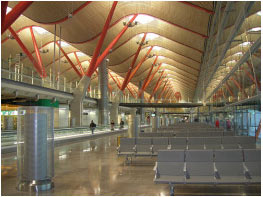
In February 2006, Spanish Prime Minister Jose Luis Rodriguez Zapatero opened the new fourth terminal at Barajas International Airport in Madrid. At 1.2 million square miles, the terminal, designed by famed British architect Richard Rogers, was one of the largest buildings in Europe, and a marvel of contemporary architecture. Even though the €1.2 billion construction project was completed in 2004, the building's opening was delayed for two years by administrative disputes.

Bea y Fredi, "Terminal 4 10," February 12, 2006
via Flickr,
Creative Commons License
Today, Barajas Terminal 4 one of the most visible artifacts of the profligacy that fueled Spain's property bubble and led to the country's current financial crisis. Spain, like several other European states, has continued to spend rapidly over the past two years, even as its economy has contracted. As a result, the Spanish government's debt has skyrocketed, raising fears of a possible sovereign default. This month Greece turned to the European Union and the International Monetary Fund for a €110 billion ($146 billion) rescue package, bankrolled largely by a reluctant Germany, to help finance the Greeks’ estimated $368.6 billion public debt, on top of a €750 billion continent-wide plan to prop up the European currency. An additional package for Spain, where the national debt now totals around $814 billion, could prove too much for German taxpayers, or anyone else, to bear.
A Spanish default could present a greater threat of international contagion than the one now looming in Greece. The Federal Financial Institutions Examination Council estimates that U.S. banks hold $68 billion in Spanish debt, about 8 percent of the latter country's total obligations. Meanwhile, U.S. banks hold just $18 billion in Greek debt, about 5 percent of that country's total promises. This has left many investors wondering if the worst of the European debt crisis is yet to come.
The bubble bursts
In 2006, Spain was in the middle of its 11th straight year of economic growth. Housing prices had increased by 150 percent since 1998, while housing stocks had doubled in the same period. The country's 4 percent inflation rate was the highest in the 12-member euro zone, while its $86 billion current account deficit was the second-largest in the world in absolute terms after the U.S., and the largest in relative terms, at 7.4 percent of gross domestic product.
And then the bubble burst. Between 2007 and 2010, real estate prices in Spain dropped by a total of 15 percent. Once property values began to fall, many of the 40- and 50-year mortgages offered by Spanish lenders to attract younger borrowers went into default. This cascaded in to a full-on financial crisis. Unemployment is now 18.1 percent and rising. Spain's budget deficit approached 11 percent of GDP in 2009, while its public debt was 59.5 percent of output.
Today, Spain's ballooning debts are raising questions about the country's future solvency. On April 28, Standard & Poor's lowered Spain's long-term sovereign credit rating from "AA+" to "AA." Spain is not the only euro area member to have its credit rating slashed in recent weeks. S&P cut Portugal's rating down to "A-" from "A+" and downgraded Greek debt to junk status after promises of assistance from the European Union and the International Monetary Fund appeared too weak to prevent the country's fiscal collapse without further loans and austerity measures. Spain, however, with a GDP of $1.4 trillion, has the fifth-largest economy in the $14.5 trillion European Union. A Spanish default, though perhaps less likely than Greek or Portuguese one, would pose a greater threat to the common European currency.
Spain's political leaders seem eager to blame anyone but themselves for the mess their country is in. According to Spanish newspaper El Pais, Zapatero in February ordered the country's National Intelligence Center to investigate whether financial speculators and the "Anglo-Saxon media" – the American and British press – were conspiring to bring down the Spanish economy and weaken the euro. The euro vs. U.S. dollar exchange rate has indeed fallen considerably from its December 2009 high of around $1.50, to about $1.30, as currency traders have hedged against Europe's fiscal troubles. Zapatero, however, confuses – or perhaps purposely jumbles – cause and effect.
The truth is that Spain's success over the past decade was more a product of good fortune than of virtue. Like other euro area countries with historically weak currencies, Spain benefited from the cheap credit allowed by low European interest rates, which remained below Spanish inflation from 2002 onwards. Spain also benefited from high immigration rates, which moderated wages and helped prop up demand for real estate and consumer goods. But the real estate crisis has dried up that once-easy credit. And as Spanish firms continue to shed jobs at an alarming clip, would-be immigrants are deciding to stay home.
Rough road ahead
If the Spanish government wants to pay off its debts and restore its bond rating, it will have to do so the hard way: by cutting spending and raising taxes. In an interview with the Financial Times last month, Zapatero said that his ruling Spanish Socialist Workers' Party would remain committed to austerity measures through the next general election, which is due by March 2012. Zapatero pointed to decisions this year to raise the country's value added tax by two percentage points, to cut new public employment offers to 10 percent of the replacement rate and to cancel an additional €5 billion in investments as evidence of this commitment. Current plans call for annual deficit reductions of 2-3 percent of GDP over the next three years, to bring the country back within the euro area limit of 3 percent of output by 2013.
But deficit reduction will solve only Spain's most acute economic problems. In the long term, the country must be more competitive with its European trading partners. Zapatero says he wants measures to reduce the workday and reform collective bargaining, but so far the government has hedged, facing political pushback from both labor unions and business interests. While reforms like these could cost the Socialists points at the polls, they may also give Spanish employers the leverage they need to reduce wages, cut hours and avoid new layoffs. A reversal of job losses could eventually turn into job growth, which would support spending and output.
In the meantime, investors and Anglo-Saxon scribblers will be watching. Spain faces a rough road ahead. While S&P projected that the country's deficit this year would be more or less in line with the government's target of 9.8 percent, the rating agency also said that the government's projections may by overly optimistic in the medium term. The Spanish government projects real annual economic growth between now and 2013 of 1.9 percent. S&P says 0.6 percent is more realistic. If S&P's growth estimates are correct, then Spain's deficit will still exceed 5 percent of GDP by 2013, while its gross government debt will be more than 85 percent of output. That number will continue to trend higher through the middle of the decade.
Rising borrowing costs could make matters even worse, and could impede the government's ability to reach its targets this year and next. On May 6, Spain paid an average yield of 3.53 percent on the sale of €2.35 billion of benchmark five-year bonds, 72 basis points above what it paid a month ago, and the highest premium on bonds of that maturity since May 2008. The one saving grace for Spain might be that it has a relatively long time to settle its debts compared to Greece and other troubled neighbors. More than 60 percent of medium- and long-term debt held by Spanish institutions is not due to mature until 2014, according to the Bank of Spain.
Whatever happens, one thing that does not seem to be on the table for now is a Greek-style bailout. When told this month of a rumor that he might request a €280 billion rescue package for Spain, Zapatero told journalists in Brussels: "The truth is I give it no credit; it is complete madness."
Read more articles by Charlie Curnow