The following is in response to Lance Paddock’s article, Game On, which appeared last week. That article was in response to Dave Loeper’s article, No Shell Game? Then What Is It?, which appeared the previous week, and was in response to Roger Schreiner’s article, It’s No Shell Game, which appeared on March 2. These articles are part of an ongoing exchange between Mr. Loeper and Mr. Schreiner. The exchange began with Mr. Schreiner’s February 16 article, The $100,000 Challenge to Passive Managers, and was followed on February 23 by Mr. Loeper’s article, The $2 Million Charity Challenge to Active Investors.

Lance Paddock says that whatever allocation I choose, I should accept Schreiner’s original $100,000 challenge. I stand by my statement that I will not make a bet where the opponent has complete ability to block me from winning.
Let us first go back and briefly review the high-level context of this seemingly endless series of articles.
Schreiner started out by asking passive managers to bet on their passive portfolios relative to what he will actively manage. He chose annual returns and daily standard deviation as the measurements according to which the return must be higher and the risk must be lower for a manager to win the bet.
In my response to Schreiner’s first piece, I exposed that the rules of his bet made it possible for him to block a win by a passive manager. I was not attacking Schreiner’s integrity, nor did I say that he would exploit the stacked deck his rules created. These were facts then, and they still are. I also offered up the Charity Challenge I originally made to Warren Buffett. My bet measured things based on dollars instead of returns and risk.
I suspect that Schreiner didn’t like the fact I exposed the bias of his bet, and in his response he inaccurately accused me of misstating his rules. He and his fellow active advocates also responded by defending active management based on typical rationales – that smart people like Harvard and Yale invest actively, that measuring dollars isn’t a good way to gauge what active managers offer – and promoting benefits active managers always trumpet but cannot guarantee they will deliver – things like controlling risks, out-performing, etc. Schreiner also didn’t like the sample client I used in my Buffett bet because the client was accumulating money and some clients distribute money.
I retorted that I am indifferent about how Harvard and Yale invest, and that they make mistakes too (ala Madoff). I reminded them that it is possible to have a passive portfolio that has low risk merely by setting an investment policy with lower equity exposure, contradicting Schreiner’s broad claim that all passive portfolios are going to be very risky.
I also focused on that fact that the client was lost in this whole debate – and that is where our ultimate responsibility lies.
Most recently, Paddock joined in with an article that once again says I should accept Schreiner’s bet, because if Schreiner would engage in the rigging I exposed in my first article, the negative publicity from such easily identified tactics would prove my point instead of Schreiner’s.
In the midst of all of this, I received an e-mail from Ron Surz, a frequent contributor to
Advisor Perspectives, that actually said, “Active-passive has morphed into wealth management versus return management.” Ron, I beg of you to stop separating your investment decisions from your client’s wealth. I fully recognize that the industry is focused on being croupiers attempting to manage market-relative returns; but if wealth is not what we are managing, what is the real value and purpose of our activities? Is it to sell meaningless statistics used to justify our existence but with no real,
manageable value to anyone?
Examining some of the premises from these exchanges, we can see who really is being “tendentious,” as Paddock characterized me last week. For those of you who don’t want to look it up, it means biased.
Can Schreiner’s rules be gamed to prevent a win by a passive manager?
• Yes, this is a fact. That doesn’t say that he would and I never said that he would, but his rules enable the active player to prevent a passive challenger from winning his bet.
Would exploiting the rules to block a win by a passive challenger be easy to detect?
-
According to Paddock, yes. But one of the approaches an active manager could use to block a passive win would be merely going to cash for a period of time to ensure that his daily standard deviation would be lower than the passive challenger’s, thus preventing a passive manager win. Since going to cash is one of Schreiner’s active management tools, how could the passive challenger prove that Schreiner’s use of cash was just an attempt to block a passive win? Schreiner could merely say his market “signals,” Ouija board, or whatever method he uses to time the market “told” him to go to cash, and the passive challenger would be left with yet another useless, illogical and biased argument like the ones you all have been reading from my detractors on Advisor Perspectives.
Is what Harvard and Yale do relevant to this debate?
- If one uses Harvard and Yale as justification for the rationale to manage actively as Schreiner did, then, and only then, is it germane. Once one uses such an argument, then one must also accept the fact they also make mistakes which discredits the validity of the endorsement one was seeking. I never used Harvard and Yale’s mistakes as the rationale for why I invest passively. But Schreiner did use them as rationale for why one should invest actively. Perhaps in Paddock’s mind exploiting the credibility of those institutions as evidence for his approach while ignoring their mistakes isn’t biased. But selectively focusing on only the positive while ignoring the negative when it contradicts your belief is truly biased, or if you prefer, “tendentious.”
Do I tell clients we are at the mercy of markets, which are uncertain, as Paddock said I should?
- Always, and continuously. Ethically, what other alternative does any manager – active or passive – have? There are other decisions in people’s lives though that we can manage, which is what they pay us to do.
Do I tell clients that we will underperform the markets by our expenses?
- Yes, always, and I add that the small amount of tracking error we introduce in our rebalancing decisions may mean we underperform by a small amount more than the expenses. I also tell them that there is always a chance they could significantly outperform with active management but that it also introduces a potential risk of material underperformance. Is this not factual?
Do I tell clients that “unfortunate timing of when markets do well or not could end up reducing their wealth and causing them to compromise their goals?”
- Yes, always. How could you not disclose this reality and still sleep at night?
Do I tell clients that I have no confidence that I add any value and assume that the markets will behave as they have done in the past?
- No, because our value is to help clients continuously make the best decisions about their competing life goals in the face of continuously uncertain markets. Our advice is based on balanced, measured confidence of exceeding their goals based on this continuous uncertainty assuming that the markets are not going to behave as they have in the past but could be all over the place. Our value isn’t about returns, and we don’t represent that we can control things we cannot control. Because markets misbehave in ways no one can control (except, of course, Schreiner?), our value is decisions and advice about what the client can do to make the most of their life (things we can control) despite the market’s uncertainty.
Do I tell clients we invest passively because of the mistakes Harvard and Yale have made?
• Of course not; this would be as irrelevant and irrational an argument as saying the reason you invest actively is because Harvard and Yale do.
Is the sequence of returns going to impact each client differently based on their unique goals?
• Yes, at least on this point we apparently agree, except perhaps for Ron Surz, who appears to think wealth is irrelevant to the investment decision.
Are return and risk statistics the best way to judge the issue, since, as Paddock acknowledged, the timing of client underperformance is unpredictable?
- I say no. Paddock and Schreiner say yes.
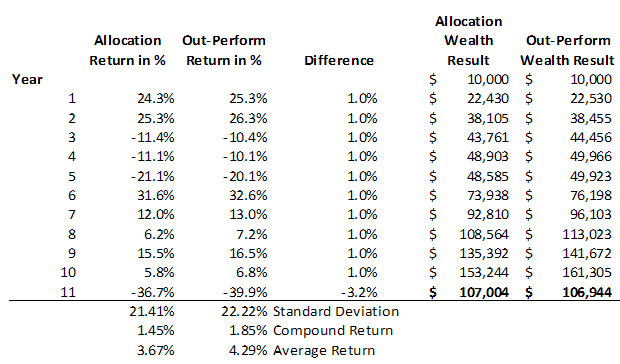
Take an example like the one that follows. This is a young wealth management client saving $10,000 a year with very high risk tolerance and risk capacity. We take an Aggressive Growth allocation that is 100% equities and compare the dollar results for the client to a manager that outperformed by 1% each and every year for a decade, and then underperformed the last year by 3.2%.
In Schreiner’s bet, the passive manager did not win. The active manager wouldn’t either. It would be a tie, because, while the active manager outperformed the allocation with a higher compound return, his risk was also higher. I suspect, however, that if this occurred both Schreiner and Paddock would likely be promoting how skillful they are, as evidenced by ten consecutive years where they outperformed each and every year and by the fact that, despite the higher standard deviation, they nonetheless outperformed in three of the four down years.
On the wealth side, we see that just one year of underperformance wiped out a decade of superior risk-adjusted returns. In ten out of the eleven years, this manager did end the year with more wealth than the passive allocation, but that evaporated at the end of the eleventh year.
Schreiner, Paddock and apparently Surz all think the way to measure this is by the risk and return statistics. The client invested $120,000 ($10,000 initial investment, plus eleven years of $10,000 contributions) but ends the eleven-year period with $107,000. Do they really believe the right way to measure this is to tell the client they received a 1.85% return, never mind about the $13,000 loss? The return and risk figures are as useful as telling the client what the average temperature was in Chicago, based on readings taken December 31st of each year.
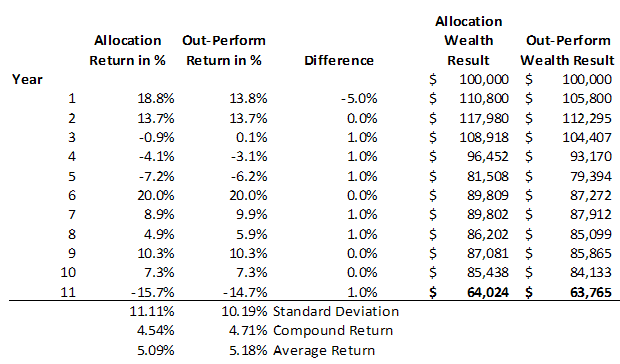
Let’s take another example, one that is less risky than the last one that was invested 100% in equities. Instead, we have a client with $100,000 who needs to withdraw $8,000 a year until his social security or pension kicks in eleven years from now. We use a more conservative, balanced allocation in this case.
In Schreiner’s bet, this active manager would win because his risk was significantly lower and his return was higher. This manager has exceptional risk control, as he outperformed in every one of the four down years. He also equaled or exceeded the market in six of the seven up years.
On the wealth side, this exceptional manager that produced superior returns with significantly less risk had less wealth at the end of every one of the eleven years. But that’s ok, because (as Ron Surz kindly tells us) that isn’t important. It isn’t the active manager’s fault that he underperformed in the first year. That never really happens. (Please note my sarcasm.)
Back to the Game
The risk control Schreiner claims he can deliver to clients is observable in the risk and return statistics in the second example. Both examples reflect what he and Paddock both acknowledged that they cannot control and is “unpredictable.” Both examples used the real data for our simple passive allocations for the time period of 1998 through 2008.
The manager out-performance examples were contrived to make a point.
Obviously there are many client goals and circumstances for which the outperforming managers would have produced more wealth, just as there are other examples where less wealth would have resulted despite the superior returns. So where do we disagree?
First, we disagree on how things should be measured. In Schreiner’s bet, he demands that the right way to measure things are risk and return statistics. I disagree with that and that is exactly why my challenge to active managers measured things in dollars – like real clients do. Paddock’s explanation of the rationale for my bet is right on target. He says, “the frequency and depth of draw-downs is the right metric, not whether by luck in this particular challenge they happen to fall at an inopportune time because of withdrawals for one approach or the other.” Here, he is acknowledging the risk of underperformance to which he subjects his clients. Paddock acknowledges it is luck.
What would the outcome be for all his clients instead of just the one sample client we use to make this bet? Some, because of luck, would be collateral damage in his war against the markets. Some would be winners. Some might even win because of good luck. It is still luck, though, and something neither he nor I can control. He charges a fee to play his game. I charge a fee to avoid it.
That’s why in my $2,000,000 Charity Challenge I challenged twenty active managers to a bet measured in dollars for a real “client-like” scenario. I even wrote in my book, Stop The Investing Rip-off, that if all twenty challengers took me up on my bet it is likely that somewhere between three and nine would beat me. It is unlikely that ten or more would beat me though. One reason is that some would have unlucky timing of returns, because that is outside their control. Maybe two to four managers that outperformed on a return basis would end up losing to me because of this real uncertainty. In all likelihood, about half the managers would underperform exclusive of this timing effect and a couple might actually win because of lucky timing. They would all have the burden of the certainty of higher expenses they would have to overcome. How much this affects the number of winners depends on the uncertain markets. The burden of, say, an additional 1% fee would be more difficult to overcome in a 2-4% return environment where the fee is 25-50% of the market’s return, than if we were in an environment of 15-20% returns where a 1% fee is only 5-7% of the market’s return. I acknowledge that I don’t have a clue what the markets will return. (But Schreiner does.)
Together, these realities have my bet stacked in my favor, which I admit. Add together the timing risk applied to a real client scenario measured in dollars, the reality that some (statistically, about half) of the managers will underperform anyway, and the burden of additional costs, and perhaps you see how my bet is an unfair bet in which it is very unlikely that more than nine of the twenty managers would win. It is possible, but the odds are stacked in my favor. Ironically, this reality escapes those active activists that play this game every day with not just one pretend client to bet on, but instead an entire book of real clients’ lives.
The value we deliver to clients doesn’t have to be based on misleading statistics that result in random luck determining the real well-being of the client. Think about Paddock’s admission that the timing of returns is luck that may work against a client. If that is the case, as he acknowledges, what is he getting paid to manage? Do you see why I refer to managers like him as croupiers?
We get paid to manage things we can control, not leave the outcome to luck and charge a fee for the privilege of making the bet. I can manage how much the client is spending or saving. I can manage his overall exposure to risky assets and avoid subjecting him to unnecessary capital market risk merely because he has the guts to tolerate it. I can manage the timing and size of goals the client has – that is what we give advice about. I can manage taxes. I can manage expenses. I can avoid the risk of materially underperforming at the wrong time for any client by not subjecting any client to that risk. I can control all of these factors with a high degree of confidence, knowing that the advice will need to change as the markets and the clients’ lives change. That is not to say that some clients might not have been better off with some active bet, because I know that is the case, and I tell clients that. It’s just that, as Paddock acknowledged, it is something I cannot control. Unlike Schreiner, Paddock and apparently Surz too, I’m not going to charge my client a fee for something that is just luck and completely out of my control.
So, no, I’m not going to make a bet that I can be blocked from winning and that measures things with statistics that no client can spend, hiding the real impact of luck on clients lives. Maybe you can get Bogle to make that bet, or Warren Buffett, since he bet on a passive index in the original bet we are all copying.
I’m going back to helping my clients make the most of their lives instead of playing games.
David B. Loeper, CIMA®, CIMC® , is President and CEO of Richmond, VA-based Wealthcare Capital Management
Read more articles by Dave Loeper