This article originally appeared in Wealth Manager Magazine:
Long-term equity investors face a critical juncture. They can believe a V-shaped economic recovery is imminent, if not underway, and valuations for broad-based equity indexes properly reflect an end to the “decrepit decade” of return-less risk in US markets.
Or they can believe true economic recovery – growth, not just stability – is still a long way off and US equity valuations are in bubble territory, not reflective of the rough terrain ahead.
For index-based investors, getting this decision right is critical. Outperformance in the equity markets over the long term (by which I mean at least 10 years) is a byproduct of one’s entry point, as Yale economist Robert Shiller has shown in his studies. Superior long-term performance is highly dependent on buying when the market is cheap.
Macroeconomic issues
The case for economic recovery, at least one of the V-shaped variety, is difficult to make. First and foremost, one has to assume that the rise in unemployment will end, not just decelerate, as has been the case. Strong forces, however, make that unlikely.
We are losing more than 200,000 jobs every month. As John Mauldin of Millennium Wave Advisors has documented, an average of 250,000 jobs need to be created every month over the next five years to return the economy to 5% unemployment – the level associated with “full employment.” Since the beginning of 1999, however, there have been only 19 months (out of a total of 128) where at least that many jobs were created. To flip current job losses into an era of job creation of that magnitude is highly unlikely.
Before employers hire new workers, they will increase hours for their current workers. That has been the case as we emerged from most past recessions, but has it yet to occur this time around. The average worker is putting in only 33 hours per week, down from 39 hours in 1965.
Consumer spending, the traditional engine of the US economy and driver of employment, is 10% below its historical trend line. From 1950-1980 consumer spending was remarkably stable, amounting to 62% of GDP. In the last three decades, as personal debt rose from 55% of national income to 133% of national income, consumer spending rose to 70% of GDP.
That debt binge is over and has been replaced by a new frugality.
Don’t assume that this new frugality affects only luxury products – it is affects virtually every segment of the consumer economy. McDonalds recently announced disappointing earnings, and revenues for NASCAR, the all-American blue-collar pastime, are declining. We are still learning just how frugal Americans can be.
Debt-fueled consumer spending created an abundance of retailing venues, and now many will be forced to contract or will cease to exist. The automobile industry figured this out the hard way, as Chrysler’s and GM’s bankruptcies forced them to close thousands of dealerships. Similar consolidations will wrack the retail industry, leaving many more unemployed.
Problematic excess capacity exists in financial services, housing and construction-related industries, automobiles, and in other major sectors of our economy. Manufacturing utilization in the US, which some call the “output gap,” is at 65%, its lowest point in 60 years.
High unemployment and low capacity utilization are combining to prevent inflation. The US has never had an episode of inflation that was not driven by wage increases, and capacity utilization historically must reach 80% before inflationary pressures are felt. Very few companies can increase prices in the absence of inflation, impairing their ability to grow revenue.
Even the airline industry, which seems to have largely rationalized its overcapacity (when was the last time you saw more than a few empty seats on a flight?), still cannot raise prices without suffering adverse consequences.
Deep structural problems plague the economy. Two noted economists, both of whom accurately forecast the housing crisis and the current economic cycle, concur on this point. On July 23, Robert Shiller said the nation remains in a “bad recession” and he foresees the “risk of a weak economy for years to come.” On September 4, NYU professor Nouriel Roubini said he expects a U-shaped global economic recovery in which growth is going to remain below trend, especially for the advanced economies, for at least two or three years.
Assessing market valuations
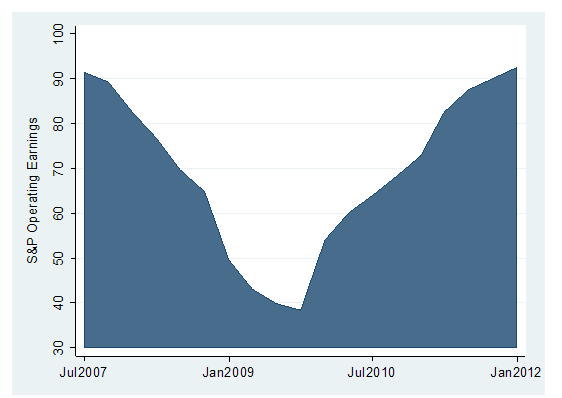
While the economy struggles, Wall Street analysts forecast a V-shaped earnings recovery. The sharply chiseled contour of the “V” is evident in this graph of actual operating profits beginning in 2007 (when they peaked) through the second quarter of this year, followed by analysts’ projections through 2011:

Source: The Hussman Funds
Indeed, valuations across the US equity markets reflect such a recovery.
But David Rosenberg, the former chief strategist at Merrill Lynch who now holds the same position at the Canadian firm Gluskin Sheff, has stridently argued that markets are overvalued. Rosenberg points to the fact that PE ratios were 27.6 based on trailing 12-month operating earnings as of October 9, about twice the level observed historically when the economy has begun to recover from recession. That PE ratio expanded by 10 points since the market bottom in March, driving the 60% market rally.
Based on reported earnings (net of write-downs), Rosenberg says PE ratios were 140 – about three times their level at the peak of the tech bubble.
On a forward 12-month basis, PE ratios were 16.2, driven down by the typically overly optimistic forecasts reflected in the graph above. Rosenberg noted that forward multiples have not been that high since February, 2005, when this decade’s economic expansion was into its fifth year.
Normalized PE ratios, which average earnings over a 10-year period to smooth the effect of business cycles, are approximately 19, as compared to an average of 17 over the last century. Bull markets typically begin when this PE ratio is in single digits.
Price-to-book ratios are 2.4 – in line with historical averages but well above the typical end-of-recession level of 1.5, according to Rosenberg.
Based on a regression analysis, Rosenberg said current valuations reflect anticipated economic growth of 4.0% over the next decade. That’s well above the historical average (3.0%) and above the expansion that followed the end of the recession in 1982.
Optimists argue that economy and the market are poised for growth, and point to the rapid economic expansion that followed the 1982 recession. Their argument is basically “the deeper the recession, the stronger will be the recovery.” Even if that were the case, however, economic growth for the decade following the end of the 1982 recession was 3.5%, below the 4.0% implied by today’s valuations.
The 1982 recession was very different from the one we face today. That recession was brought on by tight monetary policy that was needed to overcome high inflation. None of the deleveraging forces, which drove down asset prices, were at play then. Moreover, the recovery from that recession was helped by the low-tax, free-trade policies of the Reagan administration – not exactly the kind of talk we are hearing from Washington these days.
The optimistic V-shaped scenario requires one to believe that the current economic cycle will follow the path of bust and boom of historical cycles. Given the fragile state of the American consumer, that seems unlikely.
Summing it up
Before making any changes to your asset allocation, recognize that in the short term anything can happen. The short term could be a few weeks, a few months, or even a year. It is impossible to forecast the market’s direction over short-term cycles.
For long-term investors with time horizons of ten years or more, though, none of the classic indicators are in place to suggest outsized performance in the equity markets.
While the signs are ominous for broad-based index equity investors, selective strategies may offer opportunities. For example, using Monte Carlo analysis, Geoff Considine has shown in Advisor Perspectives that superior performance should come from low-beta, low-leverage “dividend aristocrat” stocks, with solid franchises and the ability to raise prices if inflation occurs.
Superior returns may come from outside the equity markets. Over a 10-year horizon, the breakeven inflation rate is 1.9%, significantly below the average inflation rate of 3.0% over the last century. The bond market is saying that past and future fiscal stimulus packages and the Fed’s exceptional monetary policy measures, all of which share the goal of creating inflation, will fail in this respect. TIPS are the safest way to protect against the rapid inflation scenario, while still providing downside protection in the event of deflation.
Read more articles by Robert Huebscher