Advisor Perspectives welcomes guest contributions. The views presented here do not necessarily represent those of Advisor Perspectives.

It becomes clearer every day that the stock market does not follow a random walk and that there may be some predictability in long-term returns. But there's little agreement on how best to make such predictions. In this article, I'll take a look at using price/earnings ratios to predict future stock market performance.
In the late 1990's, Yale professor Robert Shiller used P/E's to warn about the overvalued stock market. His concerns were based on a method of measuring price/earnings ratios he had been working with since the early 1980's. The method goes back to work by Graham and Dodd and measures the price of a broad stock market measure, like the S&P 500, in relation to the past 10 years of average earnings. The reason for using 10 years is to smooth out (or “normalize”) the effects of business cycles. Shiller also adjusts his measures for inflation by translating both prices and earnings into consistent "real" numbers before doing the ratio calculations. You can access the Shiller data here.
When we look at the past 15 years (referring to Table 1 below), it is worth paying particular attention to two time periods.
Table 1 - Recent History of Annual Shiller P/E's
| Beginning of Year |
Shiller P/E |
| 1994 |
21.5 |
| 1995 |
20.0 |
| 1996 |
24.3 |
| 1997 |
27.5 |
| 1998 |
32.3 |
| 1999 |
40.4 |
| 2000 |
42.5 |
| 2001 |
36.0 |
| 2002 |
30.1 |
| 2003 |
22.9 |
| 2004 |
25.7 |
| 2005 |
26.5 |
| 2006 |
25.4 |
| 2007 |
26.3 |
| 2008 |
24.0 |
| 2009 |
15.3 |
| Average 1928-2009 |
17.4 |
| High 1928-2009 (2000) |
42.5 |
| Low 1928-2009 (1982) |
7.4 |
| Current Value (8/18/09) |
17.7 |
Data Source: Shiller Data Base
• In 1996, Shiller expressed concerns that the stock market was becoming significantly overvalued. At that time the Shiller P/E had risen to 24, compared to a long term average of around 17. In December of that year, Alan Greenspan, influenced by Shiller’s work, made his famous "Irrational Exuberance" speech. Despite these warnings, the stock market kept going up, and the Shiller P/E rose to an all-time high of 43 in 2000 before the dot-com bubble finally burst.
While the Shiller P/E may be a good predictor of long-term stock market performance, it has never been touted as a predictor of market turns.
- During the recovery from the bursting of the dot-com bubble, many of us were comforted that, although stocks were rising, they were just working their way back from depressed values. However, when we look at the Shiller P/E's, we note that the post-bubble P/E’s never dropped down even to average levels. Stocks basically went from ridiculously overvalued to significantly overvalued. In various writings and television appearances in 2006 and 2007, Shiller indicated that he felt stocks were still overvalued.
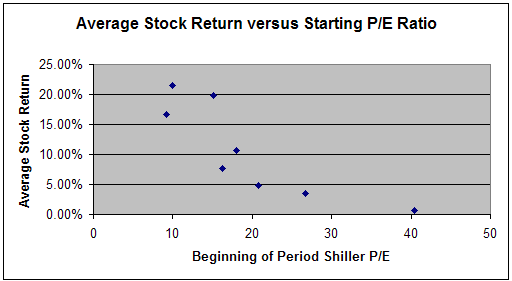
When we look further back into history, we can see that Shiller P/E's have been excellent predictors of subsequent 10-year stock market performance. High P/E's (over 20) have invariably predicted poor stock market performance. With the benefit of hindsight, the all-time high P/E levels of the late 1990's virtually screamed "lost decade ahead!" (See Table 2 and the graph below)
Table 2 - Shiller P/E's and Average Stock Returns
| Period |
Beginning
of Period
Shiller P/E |
Average
Stock
Return |
| 1929-1938 |
26.7 |
3.55% |
| 1939-1948 |
16.2 |
7.70% |
| 1949-1958 |
9.9 |
21.56% |
| 1959-1968 |
18.0 |
10.63% |
| 1969-1978 |
20.8 |
4.84% |
| 1979-1988 |
9.2 |
16.65% |
| 1989-1998 |
15.1 |
19.86% |
| 1999-2008 |
40.4 |
0.65% |
| Average 1928-2008 |
17.4 |
11.09% |
Sources: Shiller Data Base, Stern NYU Data Base
I decided to take a closer look at how advisors might be able to use Shiller P/E's when managing client portfolios. I ran some tests comparing historic stock and Treasury-bond returns going back to 1928 with the historic Shiller P/E's. I measured returns based on overlapping 10-year periods.
For a base case, I constructed buy-and-hold portfolios of Treasury bonds and stocks with the starting mix set so that the portfolio mix would average 50/50 over the 10-year measurement period. I also constructed 50/50 portfolios based on annual rebalancing. The buy-and-hold portfolios produced an average annualized return of 8.30 percent, and the rebalanced portfolios averaged 8.41 percent.
Next, I incorporated the Shiller P/E's to help determine the asset mixes. In one approach, I used a buy-and-hold strategy by establishing the asset mix at the beginning of each 10-year period based on the then-current Shiller P/E. I developed an algorithm based on targeting a 50/50 initial mix at average levels of the Shiller P/E (around 17), and then varying the initial stock percentage from zero to 100 based on the difference from the average. This could also be called the "Rip Van Winkle" approach, with the portfolio set to run on "auto-pilot" for the duration of each 10-year period. This method produced returns averaging 9.46 percent, a 1.16 percent improvement over the base-case buy-and-hold.
Finally, I tried an approach where, instead of buy-and-hold, I varied the asset mix each year based on the then-current Shiller P/E level. This approach produced an average return of 9.67 percent.
These results have allowed me to conclude that the Shiller P/E's certainly offer information that planners may be able to use in making long-term asset allocation recommendations. I was initially surprised that varying the allocation each year did not produce significantly better results than just setting the allocation at the start of each 10-year period. Apparently annual adjustments end up responding mostly to short-term random movements and momentum effects. Setting the allocation at the start picks up most of the effect of valuation on long-term performance.
To follow an approach like the one I modeled, advisors and their clients would have to hold some extreme positions. For example, the model would have recommended holding less than 15 percent stocks during the years 1995-1999. Annual stock returns averaged over 25 percent during this period, so it would have been a challenge to stick with such allocations. The strategy, however, would have paid off in the long run.
As of late August, with the S&P around 1,000, the Shiller P/E was quite close to its long-term average of 17. For now I'm advising clients to hold allocations at long term targets. If the rally continues and the S&P climbs past 1150, I'll recommend clients cut back allocations to stocks.
is an actuary and a financial planner, and is managing director of Tomlinson Financial Planning, LLC in Greenville, Maine. His practice focuses on retirement planning. He also does research and writing on financial planning and investment topics.
Read more articles by Joseph A. Tomlinson, FSA, CFP