Geoff Considine’s article last week, The Retirement Portfolio Showdown: Jeremy Siegel v. Zvi Bodie, highlighted an important issue that has been at the center of academic debate for several decades: How long must one be invested in the equity markets to have full confidence that they will earn superior returns (as compared to bonds) and overcome the risks of bear markets?
Considine cited two divergent views – those of Jeremy Siegel, who argues for an equity-centric portfolio virtually regardless of investors’ time horizons, and those of Zvi Bodie, who says equity investors are always at risk and would be better off with Treasury Inflation Protected Securities (TIPS) as the core holding in their portfolios. Considine showed that, as we expect, returns are greater from stocks than from bonds when we extend the time horizon from one to 10 years. But risk increases too – although the probability of stocks outperforming bonds is greater over 10 years than over a single year, the magnitude of potential losses is greater over the longer time frame.
What if the time horizon is extended further? Most retirement-oriented investors have horizons of greater than ten years. Is there a time horizon at which the risks of equity investing (both the probability and the magnitude of potential losses) decreases to the point where equities become a far more compelling choice than bonds or TIPS?
A look at the historical data
Industry consultant Ron Surz provided me with some data that helps answer this question. The following table shows the worst and best outcomes for stocks and bonds over various time horizons:
Worst drawdowns in real terms from January, 1926 to December, 2008
|
Months |
Years |
|
1 |
3 |
6 |
9 |
1 |
5 |
10 |
20 |
25 |
Stocks |
-30% |
-45% |
-52% |
-66% |
-68% |
-66% |
-44% |
4% |
48% |
(date) |
9/31 |
5/32 |
5/32 |
5/32 |
6/32 |
5/32 |
9/39 |
3/82 |
7/82 |
Bonds |
-10% |
-16% |
-26% |
-28% |
-27% |
-43% |
-40% |
-49% |
-49% |
(date) |
10/79 |
2/80 |
2/80 |
3/80 |
3/80 |
9/81 |
9/81 |
9/81 |
9/81 |
60/40 |
-18% |
-28% |
-35% |
-48% |
-50% |
-43% |
-34% |
-16% |
-12% |
(date) |
9/31 |
5/32 |
5/32 |
5/32 |
6/32 |
5/32 |
9/74 |
3/82 |
6/82 |
Best rallies in real terms from January, 1926 to December, 2008
|
Months |
Years |
|
1 |
3 |
6 |
9 |
1 |
5 |
10 |
20 |
25 |
Stocks |
42% |
91% |
100% |
80% |
162% |
363% |
488% |
1,689% |
3,433% |
(date) |
4/33 |
8/32 |
8/33 |
11/33 |
6/33 |
5/37 |
5/59 |
3/62 |
6/57 |
Bonds |
15% |
23% |
30% |
32% |
35% |
91% |
137% |
215% |
290% |
(date) |
12/08 |
12/08 |
12/82 |
3/83 |
10/82 |
9/86 |
2/42 |
9/01 |
9/06 |
60/40 |
25% |
53% |
61% |
57% |
109% |
239% |
220% |
808% |
1,407% |
(date) |
4/33 |
9/32 |
9/33 |
9/33 |
6/33 |
5/37 |
6/42 |
6/52 |
5/57 |
Each entry in these tables represents the worst outcome (drawdown) or best outcome (rally) for a given time interval during the last 83 years, along with the date the interval with the best/worst outcome ended. For example, the best one-year rally for stocks was during the year ending in June 1933, when stocks returned 162%.
The data show real returns, adjusted for inflation. The S&P 500 was used for stocks, and the Citibank High Grade Corporate Bond index was used for bonds (prior to its inception the Solomon High Grade Bond index was used).
For all-equity portfolios, the worst drawdowns were negative for all ten-year time horizons, but for 20- and 25-year time horizons there were no negative returns (that is, the worst drawdowns were positive outcomes). The best rallies similarly occurred over 20- and 25-year periods, easily outdistancing the best outcomes over shorter time periods. So, for equities, investors need to have at least a 10-year horizon – and perhaps as long as a 20-year horizon – in order to be confident of earning a positive inflation-adjusted return and having a chance at far superior returns.
Longer time horizons do not mitigate the risk for all-bond portfolios. For holding periods of five years or longer, the worst drawdown is between 40% and 50%. Since these numbers represent cumulative (un-annualized) returns, the risk is mitigated with bond portfolios, but it does not go away. “The tendency to recover from the worst isn’t in the bond data,” Surz said.
The benefits of a 60/40 equity/bond portfolio are clearly evident from the data above, as shown by the reduction in drawdowns over longer time horizons combined with the potential for outsized returns from market rallies. This is consistent with the research Considine presented in his article.
By assuming these returns are normally distributed (in a bell curve), Surz calculated the probability of real (after inflation) loss for the three portfolios (stocks, bonds, and 60/40):
Number of years |
Stocks |
Bonds |
60/40 |
1 |
20% |
18% |
16% |
5 |
10 |
7 |
5 |
10 |
5 |
3 |
2 |
15 |
3 |
2 |
1 |
20 |
2 |
1 |
0.5 |
25 |
1 |
0.5 |
0.1 |
Here again we see that the risks to equity investing drop off appreciably with holding periods longer than 10 years.
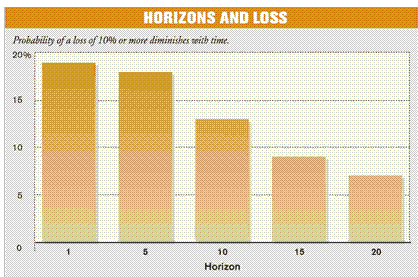
Mark Kritzman, CEO of Cambridge, MA-based Windham Capital Management, has written about this topic. He has similarly calculated the possibility of a loss from a simulated all-equity portfolio with a 7.5% expected annual return and a 20% standard deviation:

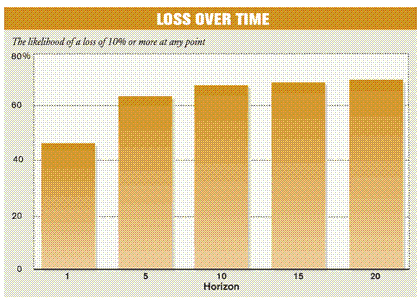
Kritzman also calculated the likelihood of a 10% or greater loss at any time (in contrast with other studies that looked only at the end of the period) in an all-equity portfolio over several different time horizons:
Kritzman’s data reaffirm Surz’s findings and show that end-of-horizon risks to equity portfolios decrease over time. Moreover, the probability of loss at any time during the period stops increasing after 10 years. Kritzman has also shown that the probability of loss within a given time horizon is greater than the probability of loss at the end of the time horizon, correcting a view that risk of loss decreases immediately with increases in the holding period.
Surz and Kritzman therefore agree that stocks become less risky as investors increase their time horizons, and a key transition is between 10 and 20 years, when the probability of inflation-adjusted loss approaches zero, at least based on historical data.
Reconciling the divergent views
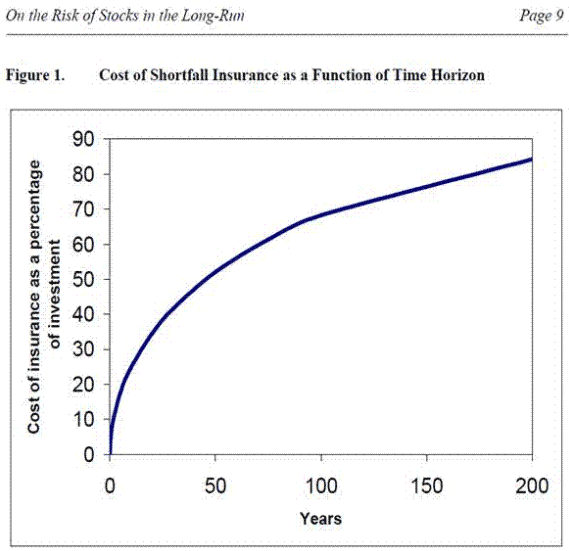
Zvi Bodie, however, disagrees. He argues that the risks to all-equity portfolios continue to increase over time, as illustrated in this graph from his 1995 paper referenced in Considine’s article:
Bodie uses option pricing theory to prove his point. He argues that the price of a put option (which can be purchased to protect the value of an all-equity portfolio) increases as the time horizon increases, based on Black-Scholes option valuations. Since the cost of this protective put option is increasing, the risk of the portfolio is increasing in parallel.
To reconcile Bodie’s findings with others’, I turned to Michael Edesess, a financial advisor who is trained in advanced mathematics and understands the complexities of option pricing. Edesess explained that the views are not necessarily in conflict – they depend on one’s definition of risk, he said.
Surz and Kritzman treat risk as the probability of losing money, but do not incorporate the magnitude of such losses. Bodie’s option pricing methodology reflects both the possibility and magnitude of loss, as Considine explained in his article last week.
Considine’s Monte Carlo analysis similarly incorporates the potential magnitude of losses, and largely confirms Bodie’s results. Considine told me that if he had extended his analysis beyond 10 years, the results would be the same: the probability of under-performing inflation goes down but severity of under-performance goes up as time horizon increases. However, Considine believes investors need equity exposure. “Bodie is focusing totally on market risk,” he said, “but I look at longevity risk and market risk and I reconcile Bodie with the need for equity exposure.”
Surz’ data come from the actual US stock market over 83 years. Edesess explained that, since their history represents only a limited sample of empirical data, stocks won’t necessarily conform to theoretical results, even if the theory is sound. But the Black-Scholes formula ignores all kinds of things, such as varying volatility and volatility clustering, not to mention of course the high probability of outliers (but that would reinforce Bodie’s argument).
So the formula could get relationships wrong – especially in the long run. And maybe the US stock market experience has been unusually pleasant on the whole, as some articles that compared returns across all historical stock markets have claimed.
“Investing in the stock market could be quite risky even over 25 years – there’s no guarantee,” Edesess said. “If one doesn’t want to mess with it they should buy TIPS as Bodie suggests – but of course you could expose yourself to an awful lot of regret later if you do that.”
Read more articles by Robert Huebscher