To forecast economic growth, it’s essential to understand the trajectory of the housing market. Most observers rely on widely publicized data like the Case Shiller index, but those metrics can be very misleading if you don’t understand how they are calculated. If you don’t understand that there are factors beyond Case and Shiller’s control that impact the data, according to John Burns, the founder and CEO of John Burns Real Estate Consulting, a 20-person firm based in Irvine, California.
Hedge funds, private equity funds, banks, home builders and real estate developers subscribe to Burns’ market research data to gauge the health of the real estate market.
By surveying over 300 home builders who operate in more than 2,000 cities, Burns gains unique insights into market trends. Each month he asks builders whether their sales are up or down, whether they plan to start construction on new homes, and for their forecast for market conditions.
By contrast, the Case Shiller index relies exclusively on transactional data from home sales, a flawed methodology since less than 0.5% of homes are sold each month. That is too small a sample size from which to make broad conclusions about the housing market, he believes
The biggest problem with Case Shiller is that current market transactions are not representative of overall market trends. “Transactions for the last three years have been concentrated in the rattiest neighborhoods,” Burns said, “where prices are uniformly cheap.” Those are the neighborhoods where sub-prime lending was rampant, leading to tremendous price appreciation in 2006 and resulting in severe price declines over the last two years. The sales volume has been heavily skewed to these neighborhoods, which means that Case Shiller and median price data has been heavily skewed as well.
At the high end of the market there are far fewer listings, a absence of distressed sellers, and no urgency on the part of buyers, according to Burns. Prices at the high end have fallen slowly, and the preponderance of transactions at the lower end of the market distorts the Case Shiller index, causing it to show a more precipitous decline than is really occurring throughout the market.
Demand and supply imbalances are the ultimate driver behind real estate prices, and Burns’ data show the balance is improving, with months of resale supply recently declining from 12 to 10 months. Normally, those inventories are approximately seven months, and until the overhang of unsold homes is reduced, prices will not recover.
“The Federal government has made a huge difference with its $8,000 tax credit for first-time buyers,” Burns said. That credit is set to expire soon, and as the deadline nears the transaction level will spike. Burns said that California and Utah had similar credits in place and as they neared expiration many buyers got off the fence.
Other incentives, such as favorable terms from the FHA for entry-level buyers and artificially low mortgage rates that the government is maintaining, are helping market conditions. But they are not enough stop the freefall in prices that began in late 2007.
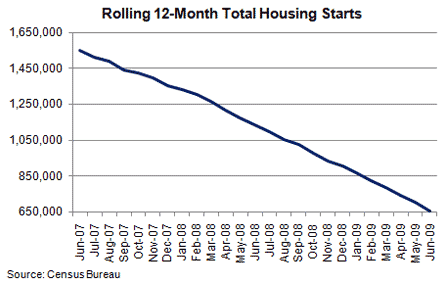
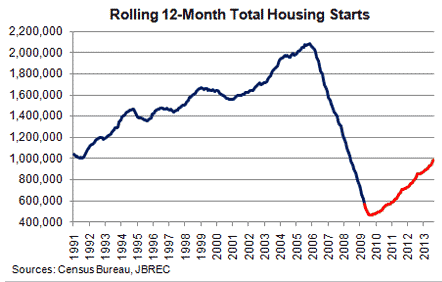
Burns said one of the best ways to calibrate the health of the real estate market is by looking at rolling 12-month housing starts. Looking at data for a single month can be highly misleading. If the weather is exceptionally good one month, or if the Easter holiday falls in March instead of April, data for a single month will be easily distorted and can fluctuate wildly. A margin of error of 5% or 10% in single-month data is reasonable, and the media often overreacts to small changes in these government-released statistics.
The rolling 12-month data are not encouraging:
This line will need to flatten for at least a couple of months for the market to have bottomed. Right now, Burns’ survey data show that builders are still cutting back on the number of houses they plan to build, meaning that bottom is not imminent.
Burns’ clients, many of whom profited handsomely by shorting the real estate market as the bubble peaked, are now looking for the signal that the market has bottomed. That will not happen soon, according to Burns:
He said the recovery will not be a rebound in the housing market, but the beginning of “flat and boring” market conditions. New construction will be at very low levels, foreclosures will remain high, and prices will be stable – not increasing.
Burns forecast is based on three underlying assumptions about the economy: He expects job losses to continue through most of 2010 and job growth to remain very low at least until 2012, mortgage rates to rise from 5.5% to 7% over the next four years (which he calls a “middle of the road forecast”), and the government to continue to intervene in the markets through FHA subsidization of high loan-to-value loans and FNMA and FHLMC purchases of loans from banks.
If any of those three assumptions prove inaccurate, Burns’ forecast will need to be modified, he said. A good leading indicator of the job market is temporary hiring. Right now companies are shedding temporary workers; only when they start re-hiring them will it suggest a job market rebound.
Hours worked are also trending down and companies are putting more workers on furlough programs. A reversal of either trend will be a further signal of recovery in the job market and indicate pending stabilization in the real estate market.
Another good early indicator of conditions in the real estate market is the National Association of Home Builders Housing Market Index (HMI), which is a monthly survey of home builders in the new-home market. That index has been mired in negative sentiment for the last year and a half and needs to approach “50” before a recovery becomes imminent.
Burns notes that it is tough to boil the housing market down to a few data points to monitor. That is why companies pay his firm to track everything and make sense of it for them. He noted, “In six months, the key statistics to monitor might be something else.”
Read more articles by Robert Huebscher