Robert J. Gordon, an economist at Northwestern University, published a study in early May that found that the recession is all but over. Gordon’s statement was remarkable for its audacity and, more so, because for the last three decades he has been a member of the prestigious Business Cycle Dating Committee of the National Bureau of Economic Research (NBER) – the committee charged with setting the official start and end dates of recessions.
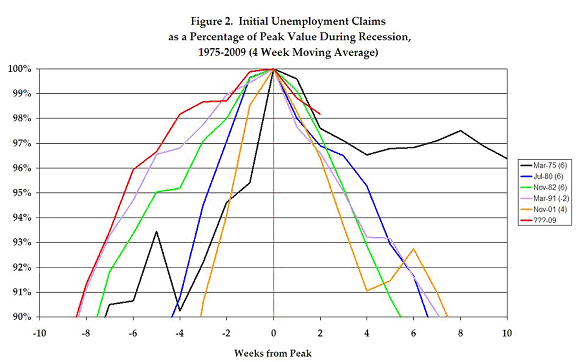
Gordon’s analysis was based on what he claimed was a newly discovered link between new unemployment claims and the NBER’s official recession dating. He argued that the peak in those claims signaled an impending end to the recession, as it had historically in the last five post-war recessions.
Gordon was wrong – the recession did not end “as early as the middle of May,” as he forecast in his article. Nor does an end appear imminent.
Gordon published his findings independently of his role in the NBER. As a member of the dating committee, however, his statements call into question whether his goal is to declare a premature end to the recession. I asked Gordon to comment on his study and he declined to be interviewed.
M.I.T. professor Andrew Lo has said that “if you torture a data series long enough you can make it say anything,” and Gordon did just that. He identified a data series that had corresponded to the end of prior recessions then made a bold leap to predict the end of the current recession.
Critically, Gordon failed to consider the qualitative aspects of this recession – whether unemployment will behave the same as it has in past recessions.
Gordon calculated the four-week moving average of new unemployment claims during the last five recessions (1973-75, 1980, 1981-82, 1990-91, and 2001). In four of these five recessions, new claims peaked between four and six weeks in advance of the NBER-defined trough month of the recession. The exception was the 1990-91 recession, when new claims peaked three weeks after the trough – an aberration which Gordon dismissed as “idiosyncratic.”
In an earlier 1969-70 recession, the new claims peak also lagged the recession’s trough, but Gordon excluded this data point from his analysis without explanation. In that recession, new claims had two peaks, approximately six months apart, the second of which was triggered by a General Motors strike.
For the current recession, new claims peaked in late March and the four-week moving average peaked the week of April 4, leading Gordon to conclude that the trough in the business cycle would follow in four to six weeks, and economic recovery would ensue.
In four of the five recessions Gordon studied (with 1973-75 being the exception), new claims declined steadily after peaking, as shown in Gordon’ data below: